India Bangladesh Relations Following National Elections
Source:Indian Express ↗
Why It Matters
India's relationship with Bangladesh is central to its Neighbourhood First Policy and Act East Policy. Understanding the nuances of their post-election diplomatic dynamics is critical for answering questions on regional diplomacy, trans-border security, and regional organizations (like BIMSTEC) in both Prelims and Mains.
Summary
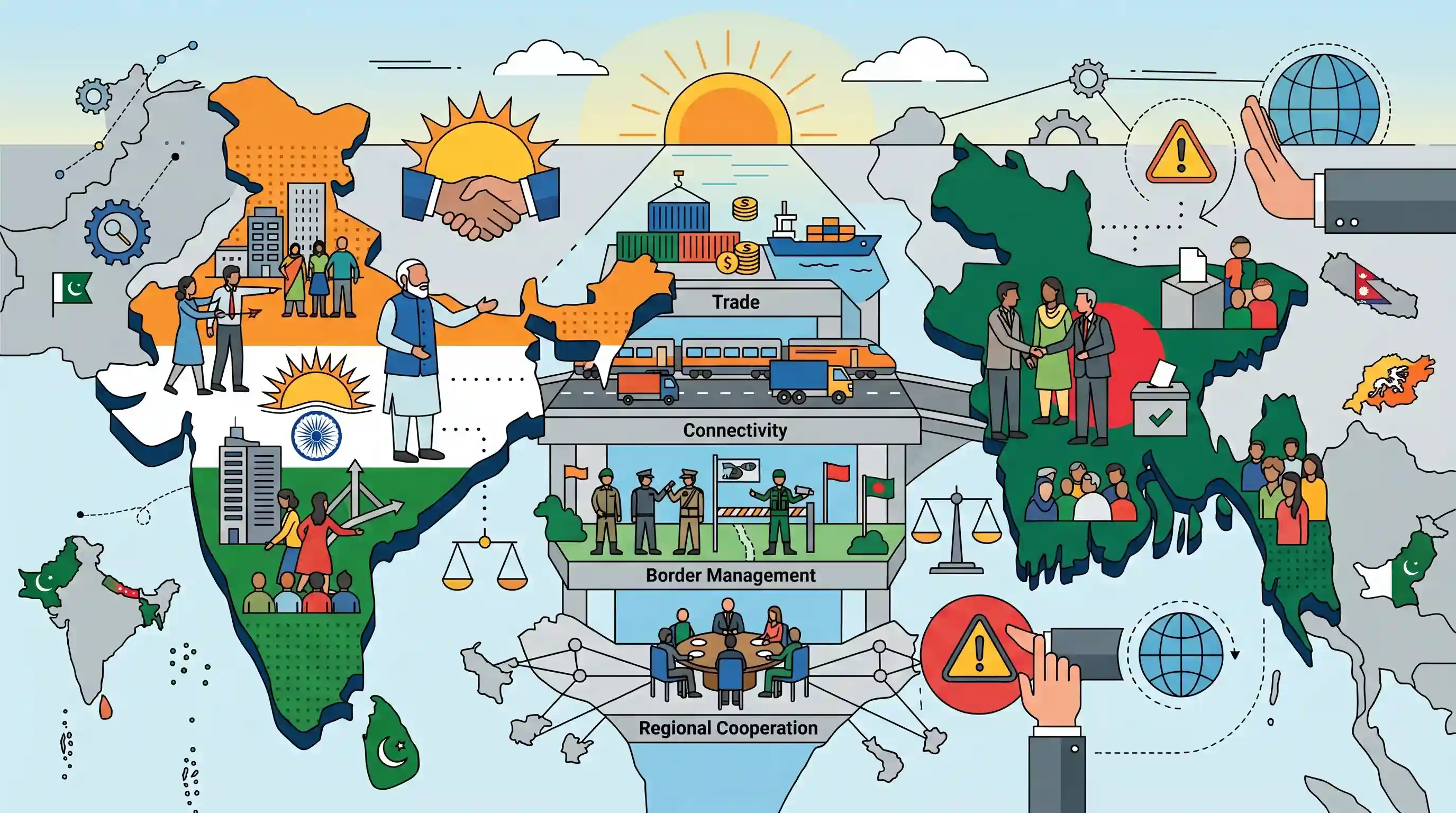
The article analyzes the evolving dynamics of India-Bangladesh relations following recent elections in Bangladesh, advising a pragmatic and measured diplomatic approach. It cautions both New Delhi and Dhaka against expecting immediate, sweeping changes or concessions from each other. Instead, it advocates for focusing on incremental progress in mutual areas of interest such as trade, connectivity, border security, and regional cooperation, while carefully navigating domestic political compulsions and broader South Asian geopolitical complexities.
Key Points
- Stresses the necessity of realistic and tempered expectations for both India and Bangladesh in the post-election period.
- Highlights that domestic political pressures in both countries constrain abrupt or radical shifts in foreign policy and bilateral concessions.
- Suggests prioritizing functional and pragmatic areas of cooperation, including border management, trade, and regional connectivity initiatives.
- Points out the importance of maintaining stability in bilateral ties to counter broader geopolitical volatility in South Asia.
Important Terms
Neighbourhood First Policy

India's primary foreign policy doctrine prioritizing friendly, non-reciprocal relations with immediate neighbors for regional stability, connectivity, and development.
UPSC context
GS Paper II (International Relations). Evaluates India’s regional leadership and balancing Chinese influence in South Asia.
Act East Policy
An action-oriented successor to the Look East Policy, focusing on strategic, economic, and cultural ties with Southeast/East Asia, using Northeast India as a bridge.
UPSC context
GS Paper II. Tests shifts in global strategy, connectivity projects (e.g., Kaladan), and ASEAN centrality.
BIMSTEC
A seven-member regional grouping (Bay of Bengal Initiative) that links South and Southeast Asia, focusing on technical, economic, and security cooperation.
UPSC context
GS Paper II. Relevant as an alternative to SAARC and for maritime security and regional trade in the Bay of Bengal.
BBIN Initiative
A sub-regional connectivity framework focused on seamless cross-border vehicle movement (MVA) and energy trade between Bangladesh, Bhutan, India, and Nepal.
UPSC context
GS Paper II. Highlights practical implementation of "Neighbourhood First" and the challenges of sub-regional infrastructure integration.
CEPA (Comprehensive Economic Partnership Agreement)
A wide-ranging trade deal under negotiation to preserve trade benefits and facilitate investment post-Bangladesh’s 2026 graduation from Least Developed Country (LDC) status.
UPSC context
GS Paper II/III. Tests economic ties, trade facilitation, and navigating the impact of LDC graduation.
Prelims Trap
"Bangladesh is India's largest trading partner globally, and India runs a massive trade deficit with it."
Bangladesh is India's largest trading partner *only in South Asia*, not globally. Furthermore, India consistently enjoys a substantial trade surplus with Bangladesh, not a deficit.
Static Concepts Connected
What is the geographical profile and course of the Teesta River?
- Origin: Originates from the Pahunri (or Teesta Kangse) glacier in the state of Sikkim.
- Course: Flows southwards through Sikkim and the Darjeeling-Jalpaiguri regions of West Bengal before entering Bangladesh.
- Confluence: Joins the Brahmaputra River (known as the Jamuna in Bangladesh) before emptying into the Bay of Bengal.
What are the three UN criteria for graduation from Least Developed Country (LDC) status?
- Income Criterion: A country's Gross National Income (GNI) per capita must sustainably exceed a defined threshold.
- Human Assets: Measured via the Human Assets Index (HAI), tracking health, nutrition, and school enrollment metrics.
- Vulnerability Index: Measured via the Economic and Environmental Vulnerability Index (EVI), tracking exposure to systemic shocks.
Cross-Topic Patterns
Internal Security + Neighbourhood First
The 4,096 km porous border links GS2 diplomacy with GS3 internal security. The push for CIBMS (smart fencing) directly targets illegal migration, cattle smuggling, and insurgent logistics.
LDC Graduation + Trade Treaties (CEPA)
Bangladesh's 2026 LDC graduation will end its duty-free quota-free (DFQF) access to India. The ongoing Comprehensive Economic Partnership Agreement (CEPA) negotiations are the GS2 response to this GS3 trade reality.

Transboundary river mapping (Teesta, Kushiyara, Feni) + CEPA/LDC graduation impacts will likely form a multi-statement 2026 question.
Linked PYQs · 4
Linked PYQs · 4
- 2020MainsGS3
Analyze internal security threats and transborder crimes along Myanmar, Bangladesh and Pakistan borders including Line of Control (LoC). Also discuss the role played by various security forces in this regard.
- 2017PrelimsGS1
With reference to river Teesta, consider the following statements: 1. The source of river Teesta is the same as that of Brahmaputra but it flows through Sikkim. 2. River Rangeet originates in Sikkim and it is a tributary of river Teesta. 3. River Teesta flows into Bay of Bengal on the border of India and Bangladesh. Which of the statements given above is/are correct?
- 2022MainsGS2
Do you think that BIMSTEC is a parallel organisation like the SAARC ? What are the similarities and dissimilarities between the two ? How are Indian foreign policy objectives realized by forming this new organisation?
- 2025PrelimsGS1
Consider the following statements in respect of BIMSTEC : I. It is a regional organization consisting of seven member States till January 2025. II. It came into existence with the signing of the Dhaka Declaration, 1999. III. Bangladesh, India, Sri Lanka, Thailand and Nepal are founding member States of BIMSTEC. IV. In BIMSTEC, the subsector of 'tourism' is being led by India. Which of the statements given above is/are correct?
