Israel and Hamas US-brokered peace plan and hostage release agreement
Source:Indian Express ↗
Why It Matters
The Israel-Palestine conflict is a defining issue in global geopolitics. U.S.-brokered peace deals fundamentally alter the strategic balance in West Asia, which in turn affects global energy security, trade routes, and India's delicate diplomatic positioning between Arab nations and Israel.
Summary
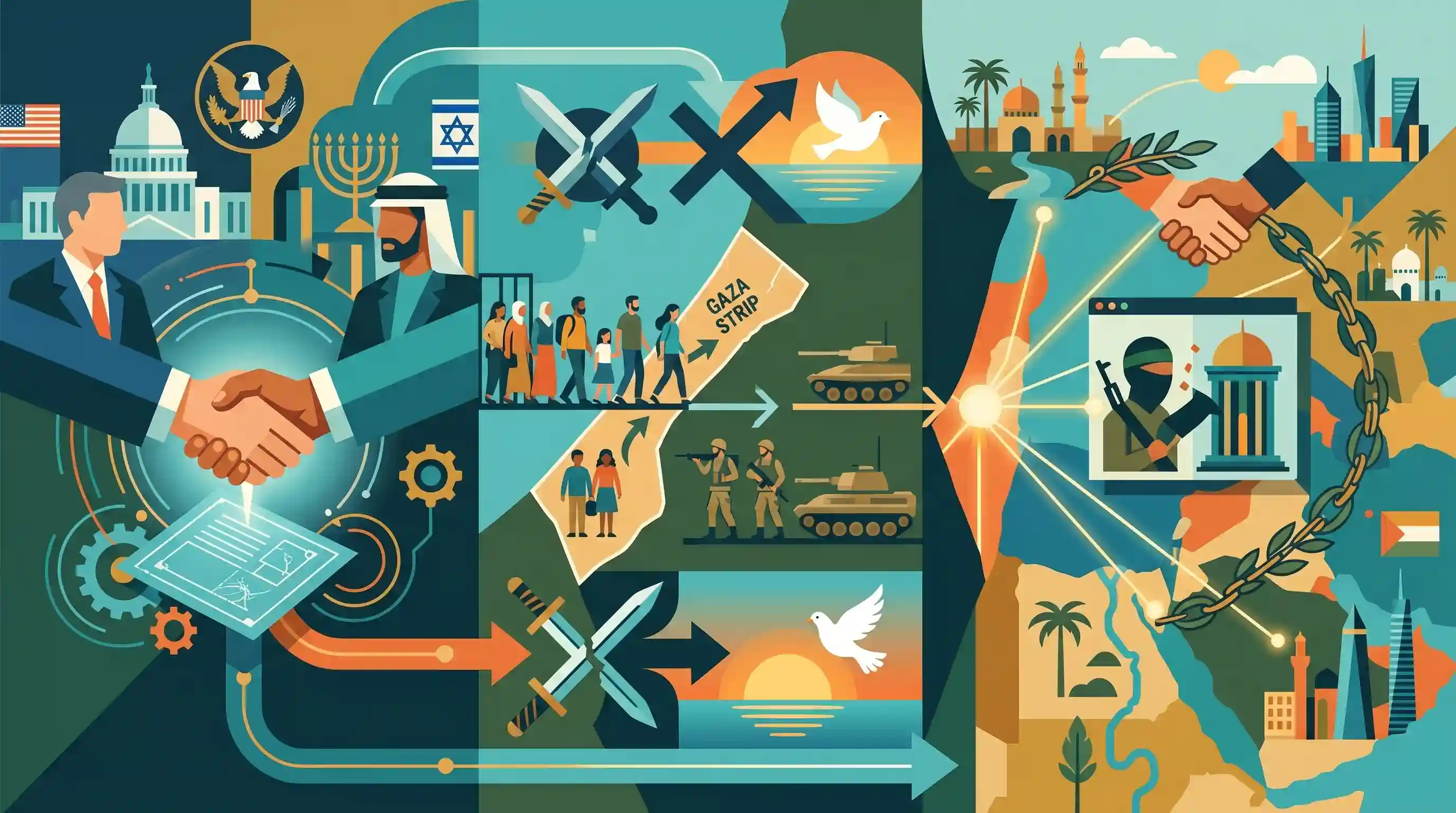
Israeli Prime Minister Benjamin Netanyahu has enthusiastically welcomed a new Gaza peace plan brokered by U.S. President Donald Trump. The proposed two-phase agreement prioritizes the release of all hostages held by Hamas in exchange for a ceasefire and an Israeli military withdrawal from the enclave. The subsequent phase aims for comprehensive regional peace agreements between Israel and surrounding Arab states, while explicitly ensuring that Hamas is entirely removed from power in Gaza. This diplomatic development signals a pivotal shift in the trajectory of the Middle East conflict.
Key Points
- U.S. President Donald Trump brokered a new peace plan aiming to resolve the ongoing Israel-Hamas conflict in Gaza.
- The first phase of the plan requires Hamas to release all Israeli hostages in exchange for an immediate ceasefire and Israeli troop withdrawal.
- The second phase envisions a broader regional peace process involving Arab nations, explicitly aiming to prevent Hamas from remaining in power in Gaza.
- Israeli PM Benjamin Netanyahu praised the deal as 'bold and historic', emphasizing it achieves Israel's war objectives of freeing hostages and dismantling Hamas's political control.
Important Terms
Gaza Peace Plan (Trump 20-Point Plan)

A 2025 multilateral agreement brokered by the U.S. to end the Israel-Hamas conflict via a phased ceasefire, full hostage release, and Gaza's demilitarization.
UPSC context
GS Paper II: International Relations; tests knowledge of landmark treaties and superpower-led mediation in West Asian geopolitics.
Hamas
A Palestinian militant and political group that controlled Gaza since 2007; the 2025 plan mandates its total disarmament and removal from power.
UPSC context
GS Paper II/III: International Relations/Security; relevant for studying non-state actors and the dynamics of the Israel-Palestine conflict.
Gaza Board of Peace
A transition-management body chaired by Donald Trump to oversee Gaza’s reconstruction and security during the implementation of the peace deal.
UPSC context
GS Paper II: International Relations; an example of international transitional administration and multilateral oversight in conflict zones.
Abraham Accords
Normalization treaties between Israel and Arab states (e.g., UAE, Bahrain) that shifted regional focus toward shared economic and security interests.
UPSC context
GS Paper II: International Relations; foundational for analyzing regional integration and the changing diplomatic landscape of the Middle East.
Technocratic Authority
A governance structure led by non-political experts; the plan proposes this model to replace Hamas in administering Gaza’s civil and economic affairs.
UPSC context
GS Paper II: International Relations; relates to 'post-conflict governance' and the use of neutral experts in state-building.
Demilitarization
The removal of all military capabilities and infrastructure from a zone; a non-negotiable term for Gaza's reconstruction under the new peace framework.
UPSC context
GS Paper II/III: International Relations/Security; core concept in conflict resolution and border security management.
Prelims Trap
"The Gaza Strip shares its land borders with Israel, Egypt, and Jordan."
Gaza shares land borders only with Israel and Egypt (via the Rafah crossing). It is the West Bank that borders Jordan.
Static Concepts Connected
What are the defining agreements of the Israel-Arab peace process?
- Oslo Accords: Brokered in the 1990s, these established the Palestinian Authority, granting it limited self-rule in designated parts of the West Bank and the Gaza Strip.
- Abraham Accords: US-brokered 2020 pacts that shifted the paradigm by normalizing diplomatic relations between Israel and select Arab states (UAE, Bahrain, Morocco) before Palestinian statehood was resolved.
What are the geographic boundaries of the Palestinian territories?
- Gaza Strip: A narrow coastal enclave bordering the Mediterranean Sea to the west, Israel to the north and east, and Egypt to the southwest.
- West Bank: A landlocked territory bordered by Jordan and the Dead Sea to the east, and heavily surrounded by Israel to the north, south, and west.
Cross-Topic Patterns
West Asian peace & IMEC viability
Sustainable peace is crucial for the India-Middle East-Europe Economic Corridor (IMEC), which relies on stable transit routes through Saudi Arabia, Jordan, and Israel's Haifa port.
De-hyphenation & the I2U2 minilateral
Regional normalization deals empower India's de-hyphenated policy, allowing deeper engagement in geoeconomic minilaterals like I2U2 (India, Israel, US, UAE) without officially abandoning the Palestinian cause.

Expect a 2026 map-based question linking Levant geography (Gaza, West Bank) to India's strategic projects like IMEC and I2U2.
Linked PYQs · 3
Linked PYQs · 3
- 2022PrelimsGS1
The term "Levant" often heard in the news roughly corresponds to which of the following regions?
- 2017PrelimsGS1
Mediterranean Sea is a border of which of the following countries? 1. Jordan 2. Iraq 3. Lebanon 4. Syria Select the correct answer using the code given below:
- 2003PrelimsGS1
Israel has common borders with
