US Israel Bilateral Tensions and West Asian Diplomacy on Iran
Source:Indian Express ↗
Why It Matters
The friction between the US and Israel over diplomatic engagement with Iran marks a critical realignment in West Asian geopolitics. For India, any shifts in US-Iran relations or broader Middle Eastern stability have direct implications for energy security (especially crude oil imports), the security of the large Indian diaspora in the Gulf, and strategic transport corridors like the India-Middle East-Europe Economic Corridor (IMEC) and Chabahar port.
Summary
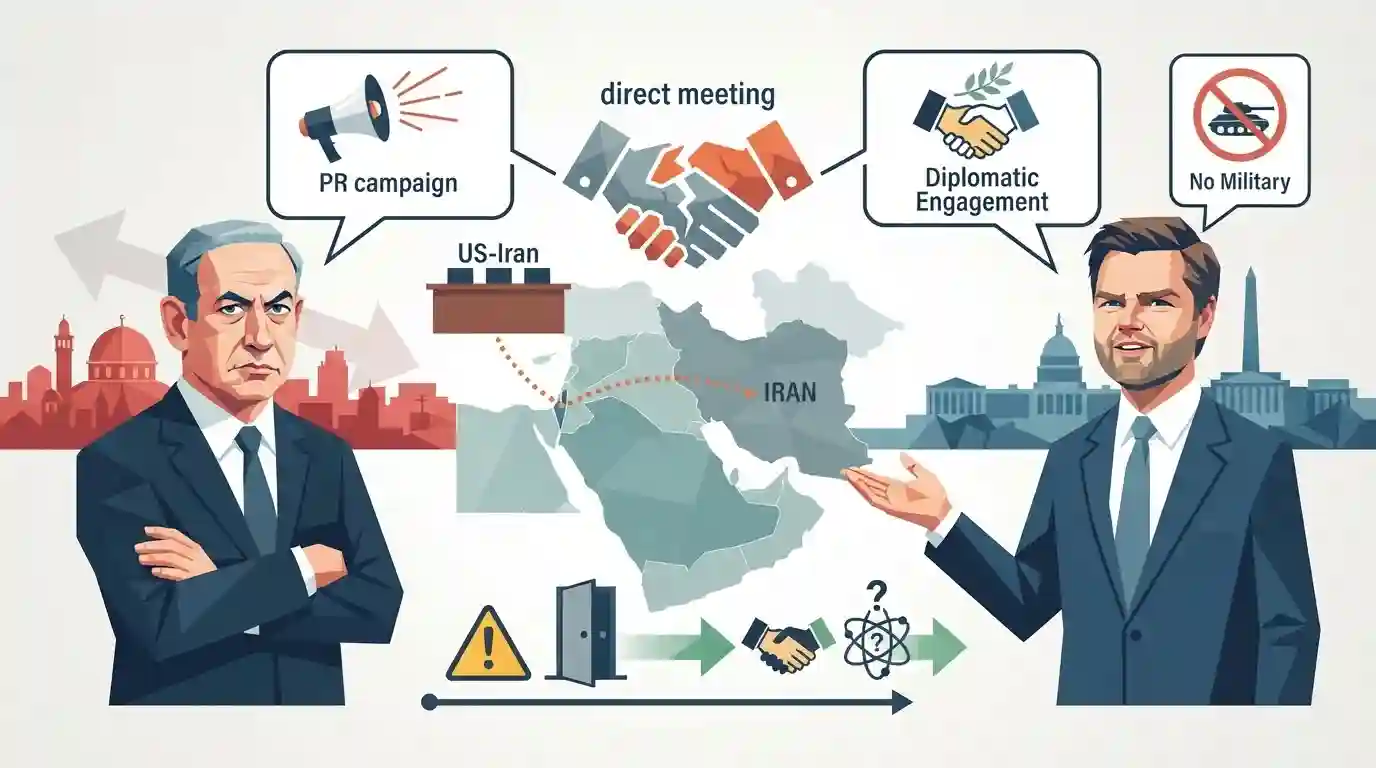
Israeli Prime Minister Benjamin Netanyahu met with US Vice President JD Vance in Washington to address escalating tensions over US-Iran diplomacy. Following an April 8 ceasefire, Vance has advocated for diplomatic engagement with Iran to prevent nuclear proliferation without committing US forces to conflict. Vance previously criticized Netanyahu's government for running paid public relations campaigns to derail US-Iran negotiations and warned Israel against alienating its primary ally. The 'direct' meeting reflects growing friction in the traditional US-Israel strategic alliance and a shift toward diplomatic pragmatism in US West Asia policy.
Key Points
- Israeli PM Benjamin Netanyahu and US Vice President JD Vance held a critical meeting in Washington aimed at addressing deep-seated tensions over diplomacy with Iran.
- US Vice President JD Vance has championed a diplomatic track to prevent Iran from building nuclear weapons without embroiling the US in a Middle Eastern war, especially following an April 8 ceasefire.
- Vance had publicly accused elements within the Israeli government of trying to manipulate US public opinion and executing paid campaigns to derail US-Iran peace negotiations.
- In preceding months, Vance warned Israel against criticizing its 'only powerful ally,' underscoring a growing shift in how some US leaders view unconditional support for Israeli policies.
- The direct, 'frank and candid' meeting highlights a strategic friction point in the US-Israel partnership, as Washington balances regional stability with domestic weariness over foreign military interventions.
Important Terms
West Asian Geopolitics

The study of geographic influence on power relationships, regional conflicts, and international diplomacy in West Asia, heavily shaped by energy security, sectarian rivalries, and major power interventions.
UPSC context
GS Paper II: IR. Tests understanding of regional security, India’s energy dependency, diaspora interests, and strategic balancing.
Strategic Alliance
A deep, long-term partnership between nations involving close cooperation in defense, intelligence-sharing, and technology transfer, aimed at securing shared geopolitical and economic objectives.
UPSC context
GS Paper II: IR. Analyzes bilateral defense frameworks, operational security convergence, and impacts on India's strategic autonomy.
Nuclear Proliferation
The spread of nuclear weapons, fissionable material, or specialized technology to nations not recognized as 'Nuclear Weapon States' by the NPT, creating severe global security challenges.
UPSC context
GS Paper II/III: Global Groupings and Security. Assesses global disarmament frameworks, IAEA safeguard regimes, and regional nuclear developments.
Memorandum of Understanding (MoU)
A formal bilateral or multilateral document describing a broad agreement between parties, establishing a framework for cooperation before binding treaties are finalized.
UPSC context
GS Paper II: Bilateral Agreements. Tests understanding of foreign policy mechanisms, diplomatic negotiations, and bilateral cooperation frameworks.
Diplomatic Pragmatism
An approach to foreign policy that prioritizes realistic, national interest-based solutions and dialogue over rigid ideological alliances or historic geopolitical enmities.
UPSC context
GS Paper II: Foreign Policy. Evaluates major-power foreign policy shifts, strategic realignment, and India's multi-alignment strategy.
Prelims Trap
The US-Israel strategic partnership is codified in a formal mutual defense treaty requiring automatic military intervention.
While Israel is a Major Non-NATO Ally (MNNA) and enjoys unprecedented military aid, the US and Israel do not have a formal, legally binding mutual defense treaty.
Static Concepts Connected
What is the 'Major Non-NATO Ally' (MNNA) status and how does it apply to US partnerships?
- Core definition: A designation under US law that provides foreign partners with defense trade and security cooperation benefits without any binding mutual defense commitments.
- Comparison: Israel was designated in 1987; India is not an MNNA, holding a unique 'Major Defense Partner' status designated in 2016.
- Privileges: Includes entry into cooperative R&D, priority delivery of military surplus, and logistics support, but lacks article-5 style security guarantees.
What are the core pillars of the Joint Comprehensive Plan of Action (JCPOA)?
- Parties and Objective: A 2015 agreement between Iran and the P5+1 (US, UK, France, Russia, China + Germany) limiting Iran's nuclear enrichment in exchange for sanctions relief.
- US Withdrawal: The US unilaterally withdrew in 2018, leading to a cascade of sanction re-impositions and subsequent Iranian enrichment beyond agreed limits.
- Verification Authority: Monitored by the IAEA to verify that Iran’s nuclear program remains entirely peaceful.
Cross-Topic Patterns
US-Iran diplomacy & India's Chabahar transit
Any diplomatic thaw between Washington and Tehran lowers the geopolitical risk premium on India's Chabahar port investments and stabilizes the wider INSTC corridor.
Wavering US-Israel consensus & I2U2 stability
US-Israel friction testing regional stability directly impacts the progress of middle-corridor initiatives like the I2U2 group and the IMEC.

US tactical shifts on Iran nuclear diplomacy likely to be tested against India's strategic balancing of Israel, Iran, and the GCC in 2026.
Linked PYQs · 2
Linked PYQs · 2
- 2018MainsGS2
In what ways would the ongoing US-Iran Nuclear Pact Controversy affect the national interest of India? How should India respond to this situation?
- 2025MainsGS2
"Energy security constitutes the dominant kingpin of India's foreign policy, and is linked with India's overarching influence in Middle Eastern countries.” How would you integrate energy security with India's foreign policy trajectories in the coming years?
