Benin Coup Attempt Thwarted as ECOWAS and Nigeria Intervene
Source:The Hindu ↗
Why It Matters
It illustrates the expanding geopolitical footprint of military coups and jihadist violence from the Sahel into coastal West Africa. It also demonstrates the active interventionist role played by regional blocs like ECOWAS and regional hegemons like Nigeria in enforcing democratic governance and regional stability.
Summary
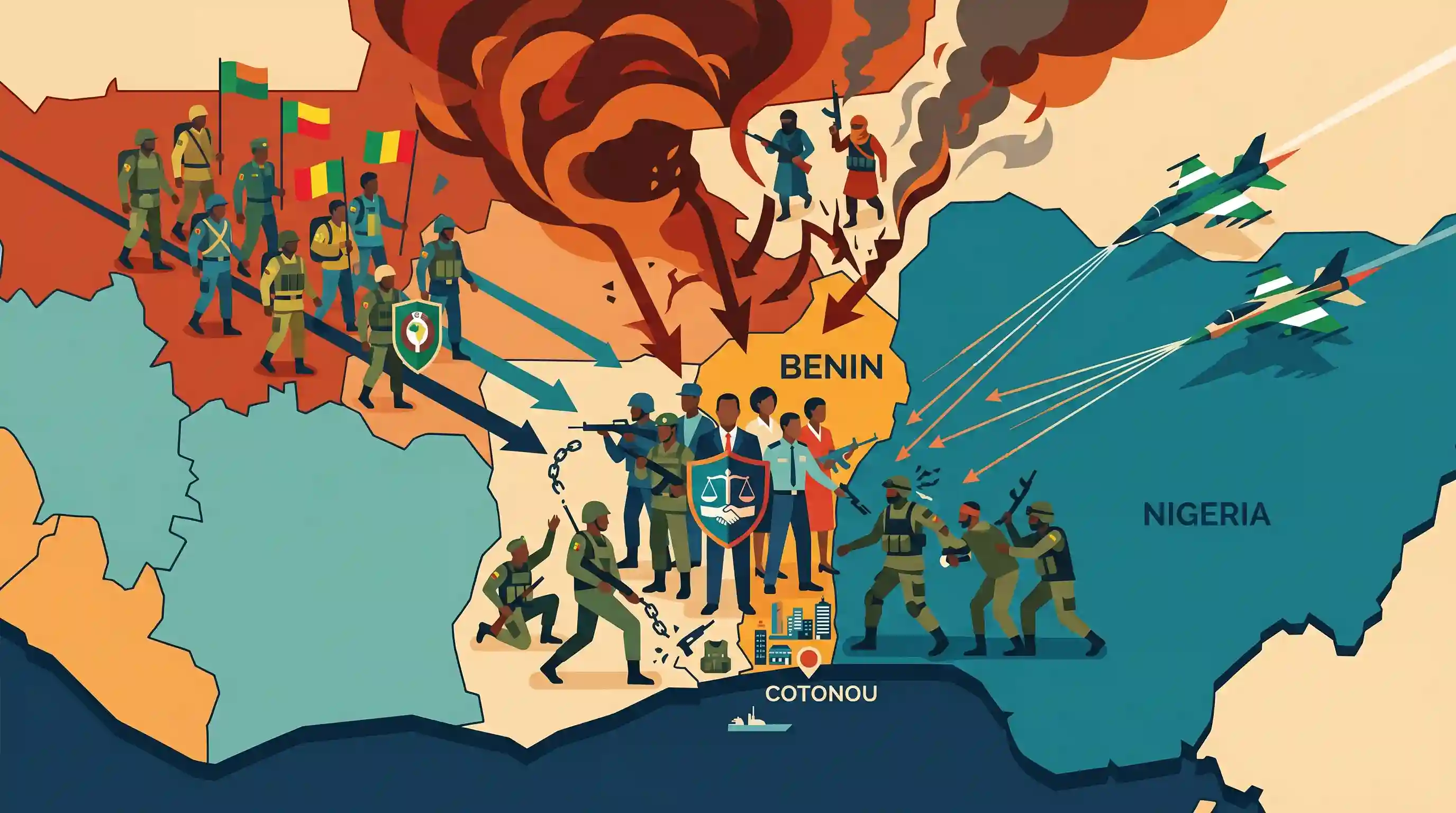
The government of Benin successfully thwarted an attempted military coup against President Patrice Talon, with loyalist forces swiftly regaining control of the economic capital, Cotonou. The coup plotters cited deteriorating security linked to jihadist violence in northern Benin as a primary motivation. Crucial support was provided by neighboring Nigeria, which conducted air strikes, and the regional bloc ECOWAS, which deployed troops to preserve constitutional order. The incident highlights the persistent vulnerability of West African coastal states to the political instability, military coups, and terrorism spilling over from the Sahel region.
Key Points
- Loyal army forces in Benin successfully thwarted a military coup attempt against President Patrice Talon.
- The coup plotters, calling themselves the Military Committee for Refoundation, cited the deteriorating security situation in northern Benin and the neglect of soldiers as their motivations.
- Neighboring Nigeria provided direct military support via air strikes, while the regional bloc ECOWAS authorized troop deployments to preserve constitutional order.
- The incident reflects the ongoing wave of political instability in West Africa, following recent successful military takeovers in Sahel nations like Niger, Mali, and Burkina Faso.
- The underlying cause cited by the mutineers highlights the growing spillover of jihadist violence from the Sahel into coastal West African states like Benin.
Important Terms
ECOWAS

A 15-member regional group in West Africa established to promote economic integration and regional stability through collective security and the preservation of democratic governance.
UPSC context
GS II: International Relations. Crucial for studying regional security architectures and multilateral responses to unconstitutional changes of government.
African Union (AU)
A continental organization of 55 member states that promotes peace, security, and democratic principles across Africa, guided by a 'zero tolerance' policy for unconstitutional government changes.
UPSC context
GS II: Important International Institutions. Relevant for understanding global efforts to safeguard democracy and manage conflict in Africa.
Military Committee for Refoundation (CMR)
The specific group of mutinous soldiers, led by Lt. Col. Pascal Tigri, that attempted to seize power in Benin in December 2025.
UPSC context
GS II: International Relations. Illustrates the domestic military challenges and the trend of 'putschism' affecting West African coastal states.
Organisation Internationale de la Francophonie (OIF)
An international organization of 88 member states and governments where French is spoken, focused on promoting democracy, human rights, and cultural-linguistic cooperation.
UPSC context
GS II: International Relations. Represents the soft power and diplomatic frameworks used to support democratic transitions in French-speaking African nations.
ECOWAS Standby Force (ESF)
A multidisciplinary regional force comprising military, police, and civilian components ready for rapid deployment to maintain peace and restore constitutional order in West Africa.
UPSC context
GS II: Regional Groupings. A key mechanism for military intervention used to preserve territorial integrity and democratic legitimacy in member states.
Sahel Security Crisis
The regional instability involving jihadist insurgencies and coups in countries like Mali, Niger, and Burkina Faso, which now threatens the security of coastal neighbors.
UPSC context
GS II/III: Regional Security/Terrorism. Essential context for understanding the external pressures leading to domestic political fragility in West Africa.
Prelims Trap
Benin is a landlocked nation located entirely within the semi-arid Sahel region.
Benin is a coastal state on the Gulf of Guinea. The recent crisis stems from jihadist violence spilling over from landlocked Sahel nations (Niger, Burkina Faso) into coastal territories.
Static Concepts Connected
What is ECOWAS and what is its primary security mandate?
- Treaty of Lagos: Established in 1975 to promote economic integration across West Africa, headquartered in Abuja, Nigeria.
- ECOMOG Force: The Economic Community of West African States Monitoring Group acts as a regional multilateral armed force to maintain constitutional order.
- Recent Exits: Mali, Burkina Faso, and Niger announced their withdrawal in 2024 following coups, forming the Alliance of Sahel States (AES).
How is the African 'Coup Belt' geographically distributed?
- Contiguous Zone: A contiguous line stretching from Guinea on the Atlantic coast through Mali, Burkina Faso, Niger, and Chad, to Sudan on the Red Sea.
- Sahel Overlap: It heavily overlaps with the Sahel, a semi-arid transitional ecocline separating the Sahara Desert from the tropical savannas to the south.
- Coastal Spillover: Insurgencies traditionally confined to the landlocked Sahel are now spilling south into Gulf of Guinea states like Benin, Togo, and Cote d'Ivoire.
Cross-Topic Patterns
Sahel Instability and Mineral Supply Chains
Coups in the Sahel disrupt global resources, such as Niger's uranium. This directly impacts France's nuclear sector and highlights the vulnerability of global critical mineral supply chains.
Western Withdrawal and Private Military Voids
As Western forces (like France's Operation Barkhane) withdraw due to rising anti-colonial sentiment, a security vacuum is left behind. This is increasingly filled by Russian PMCs like the Africa Corps.
ECOWAS Interventions vs State Sovereignty
Nigeria’s airstrikes and ECOWAS deployments in Benin highlight the clash between state sovereignty and regional security mandates, echoing debates on the 'Responsibility to Protect' (R2P) doctrine.

Mapping Gulf of Guinea coastal states vs landlocked Sahel nations, paired with ECOWAS withdrawals, is a prime Prelims geography question.
Linked PYQs · 2
Linked PYQs · 2
- 2023PrelimsGS1
In the recent years Chad, Guinea, Mali and Sudan caught the international attention for which one of the following reasons common to all of them?
- 2021MainsGS3
Analyse the complexity and intensity of terrorism, its causes, linkages and obnoxious nexus. Also suggest measures required to be taken to eradicate the menace of terrorism.
