Skyroot Vikram-1 Rocket Launch and Private Space Sector Payloads
Source:The Hindu ↗
આ શા માટે મહત્વનું છે
This article is crucial for GS3 Space Technology as it marks a watershed moment in India's space privatization journey. Skyroot's successful orbital launch with Vikram-1 demonstrates the operational capability of private players. The diverse payloads—ranging from space debris mitigation tech to solar observation—highlight the broadening scope of private sector innovation beyond just launch vehicles, directly aligning with India's space sector reforms and IN-SPACe's mandate.
સારાંશ
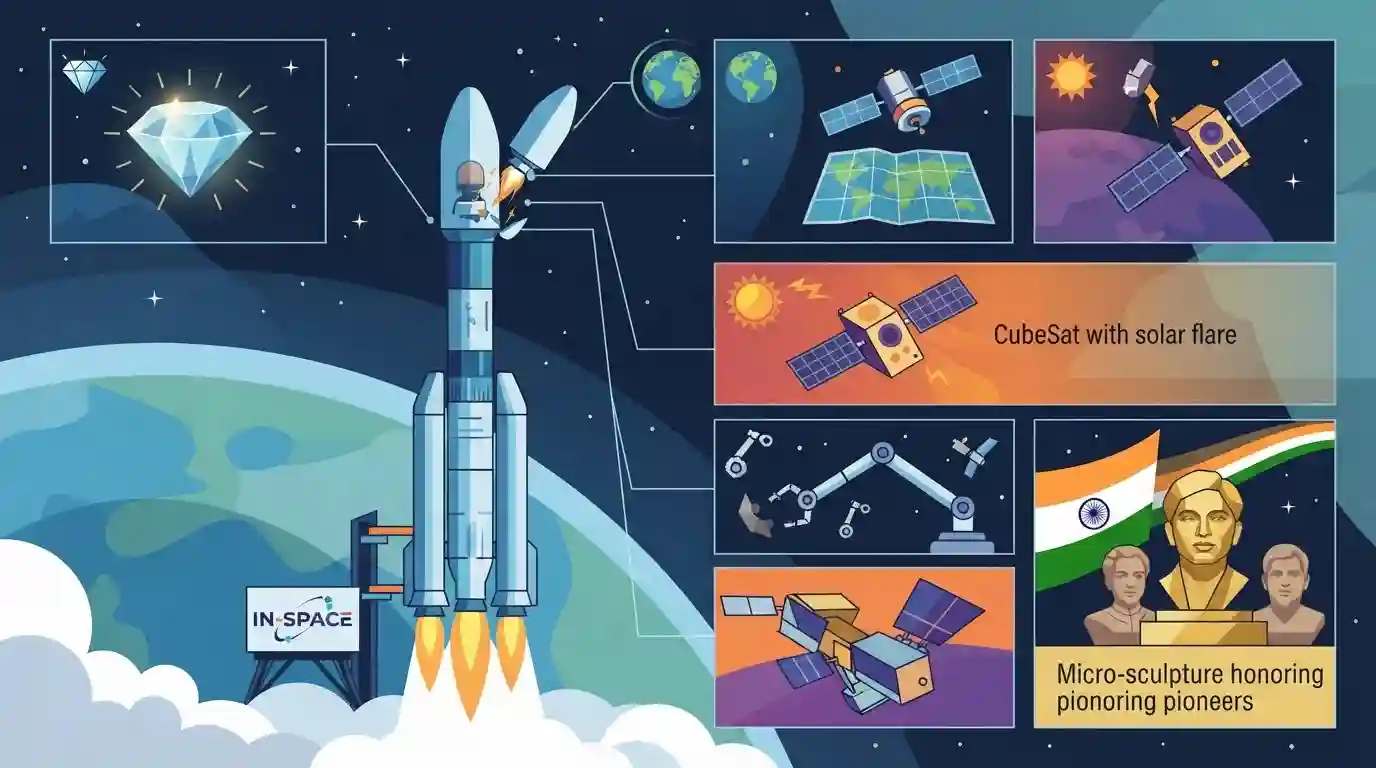
Skyroot Aerospace successfully launched India's first privately built orbital rocket, Vikram-1, carrying multiple innovative payloads. Among them was the 'Cosmos Bloom Diamond', the world's first lab-grown diamond jewel sent to space by Bengaluru start-up Cosmos Diamonds. The mission, authorised by IN-SPACe, also deployed several other cutting-edge payloads: an earth observation satellite (SCOPE), a CubeSat to study solar activity (SOLARAS), a robotic arm demonstration for space debris capture (Embrace), and a gold micro-sculpture honoring Indian space pioneers. This launch underscores the rapid evolution and commercial viability of India's private space ecosystem.
મુખ્ય મુદ્દા
- A Bengaluru-based start-up, Cosmos Diamonds, successfully sent the world's first lab-grown diamond jewel to space aboard Skyroot Aerospace's Vikram-1 rocket.
- Vikram-1 is India's first privately built orbital launch vehicle, highlighting the growing success of India's private space sector under the IN-SPACe framework.
- The rocket carried diverse payloads, including 'Embrace' by Cosmoserve Space, which is an in-orbit robotic arm designed to advance space debris capture technologies.
- Other payloads included 'SOLARAS' (a CubeSat by Grahaa Space to study solar activity) and technology demonstration payloads from German firm DCubed.
- The mission also carried an 18K gold micro-sculpture paying tribute to Indian science and space pioneers Dr. Vikram Sarabhai, Dr. A.P.J. Abdul Kalam, and Sir C.V. Raman.
મહત્વપૂર્ણ શબ્દો
Vikram-1

India's first privately developed orbital launch vehicle, built by Skyroot Aerospace. The four-stage rocket uses carbon-composite structures and 3D-printed liquid engines to place small satellites into low Earth orbit.
UPSC context
GS Paper 3 (Space Technology). Highlights India's capabilities in private orbital launches and the commercial spaceflight ecosystem.
IN-SPACe
An autonomous, single-window nodal agency under the Department of Space responsible for promoting, enabling, authorizing, and supervising space activities of non-governmental entities in India.
UPSC context
GS Paper 3 (Space Policies). Crucial for questions on space sector privatization, regulatory frameworks, and the Indian Space Policy 2023.
Mission Embrace
An in-orbit technology demonstration by Indian startup Cosmoserve Space. It utilizes a soft-robotic capture mechanism to gently latch onto uncooperative defunct satellites for active space debris removal.
UPSC context
GS Paper 3 (Science & Tech). Highly relevant for topics on active space debris management, Kessler syndrome, and orbital sustainability.
Cosmos Bloom Diamond
The world’s first lab-grown diamond jewel sent to space. Crafted by Cosmos Diamonds, this lotus-shaped payload flew aboard Vikram-1 to showcase India's technological and artisanal capabilities.
UPSC context
GS Paper 3 (S&T). Tests awareness of unique commercial payloads, lab-grown diamond technology, and India's evolving private space economy.
Skyroot Aerospace
A Hyderabad-based private aerospace startup that developed India's first private suborbital and orbital rockets. It plays a pivotal role in establishing domestic commercial launch capabilities.
UPSC context
GS Paper 3 (Indigenization of Technology). Important for examples of successful Indian space startups and private sector capacity building.
SOLARAS
A 1U nanosatellite (CubeSat) pathfinder developed by Indian startup Grahaa Space. Launched aboard Vikram-1, it is designed to study solar activity and validate next-generation satellite platforms.
UPSC context
GS Paper 3 (Space). Relevant for questions on the miniaturization of satellites (CubeSats) and private sector solar observation missions.
પ્રિલિમ્સ ટ્રેપ
Vikram-1 is India's first privately built sub-orbital rocket launched under the IN-SPACe framework.
Vikram-S (launched in 2022) was a sub-orbital demonstrator. Vikram-1 is an orbital launch vehicle. UPSC often swaps sub-orbital and orbital capabilities to confuse aspirants.
સંલગ્ન સ્થિર ખ્યાલો
What is the role of IN-SPACe in India's space ecosystem?
- Single-Window Clearance: Acts as a single-window, autonomous nodal agency under the Department of Space to promote, authorize, and supervise private space activities.
- Infrastructure Sharing: Enables non-governmental private entities to utilize ISRO's world-class facilities, launch pads, and scientific data on a commercial basis.
How do Lab-Grown Diamonds (LGDs) differ from natural diamonds?
- Identical Composition: LGDs are chemically, physically, and optically identical to mined diamonds, unlike diamond simulants such as cubic zirconia or moissanite.
- Synthesis Methods: Produced using High Pressure High Temperature (HPHT) to mimic Earth's mantle, or Chemical Vapour Deposition (CVD) to grow diamonds atom-by-atom in a vacuum.
આંતર-વિષય પેટર્ન
Active debris removal + International Liability
Debris capture tech like 'Embrace' must navigate the Liability Convention 1972, under which launching states retain absolute liability for orbital collisions and operations.
Lab-Grown Diamonds + Green Industrial Policy
LGD production aligns with green manufacturing goals, offering an energy-efficient, zero-mining alternative that supports India's climate commitments and ESG compliance.

IN-SPACe mandates and the technological transition from sub-orbital to orbital private launches are prime for a 2026 Prelims question.
સંલગ્ન PYQ · 2
સંલગ્ન PYQ · 2
- 2026PrelimsGS1
Consider the following statements with regard to involvement of private entities in India's space programme : 1. The Indian National Space Promotion and Authorisation Centre (IN-SPACe) is an autonomous agency formed to facilitate participation of private entities. 2. Agnikul Cosmos launched the world's first flight using 3D-printed rocket engine. 3. Skyroot Aerospace has developed liquid fuel for GSLV. Which of the statements given above is/are correct ?
- 2016MainsGS3
Discuss India's achievements in the field of Space Science and Technology. How the application of this technology has helped India in its socio-economic development?
