Bengaluru Stampede: Proposed Crowd Control Legislation and Safety
Source:Indian Express ↗
Why It Matters
Crowd disasters are recurring phenomena in India, often revealing administrative loopholes in public safety management. This article is relevant for Disaster Management (GS3) regarding proactive risk mitigation measures, and Governance (GS2) pertaining to the formulation of public order legislations like the proposed Crowd Control Bill.
Summary
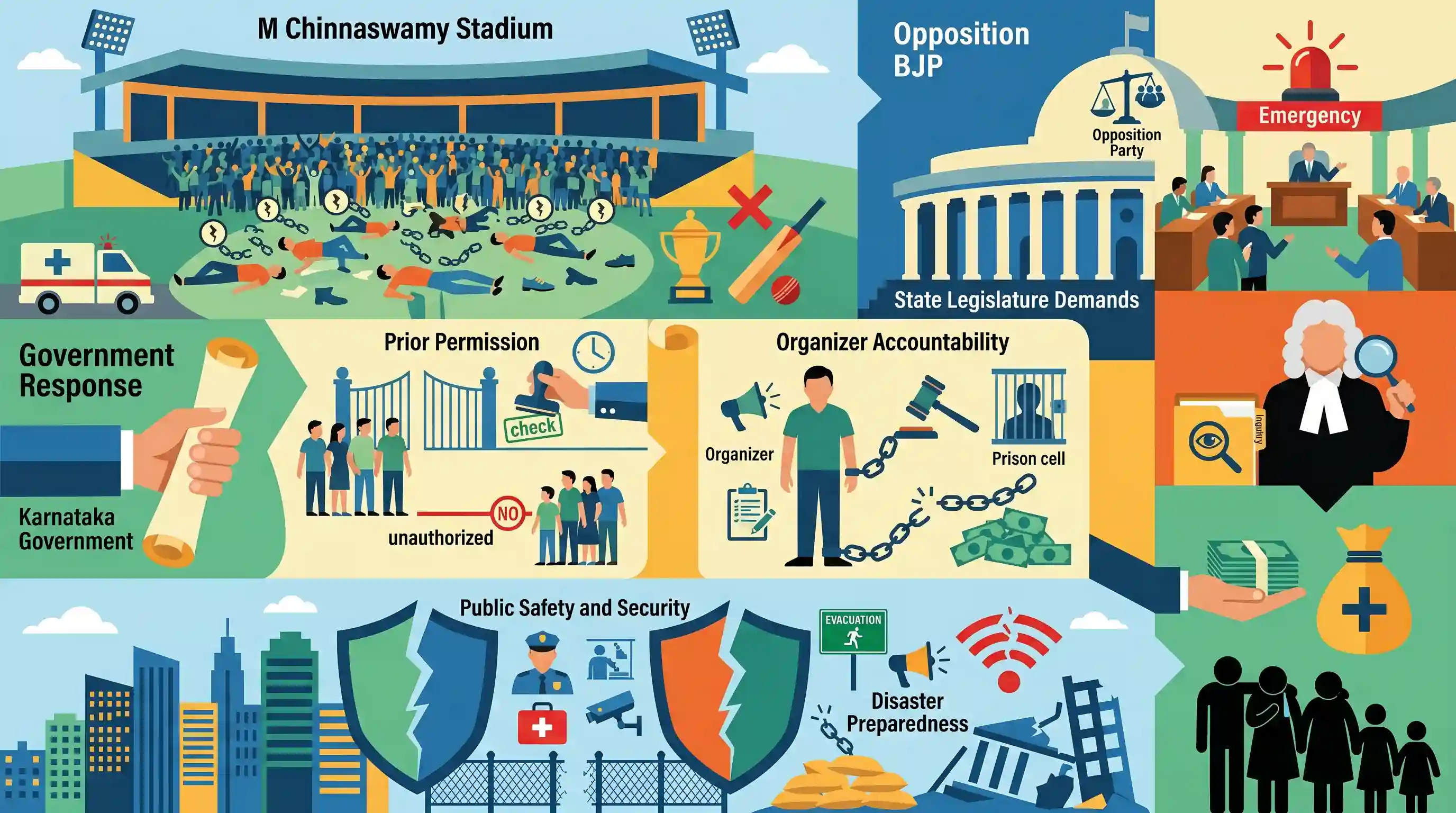
Following a stampede that claimed 11 lives during an IPL victory celebration at Bengaluru's M Chinnaswamy Stadium, the Karnataka government is drafting a new Crowd Control Bill. The proposed legislation would mandate prior permission for large gatherings and enforce accountability on organizers. Meanwhile, the Opposition BJP has demanded an emergency session of the state legislature to address the tragedy, alongside calls for a judicial probe and enhanced compensation for victims' families. The incident highlights critical gaps in urban public safety and disaster preparedness.
Key Points
- A stampede during RCB's IPL victory celebrations at M Chinnaswamy Stadium in Bengaluru resulted in 11 deaths.
- The Karnataka government is considering introducing a new Crowd Control Bill to regulate public gatherings.
- The proposed legislation aims to make prior police permission mandatory for large crowds and hold organizers accountable for safety and crowd management.
- The Opposition BJP has demanded an emergency session of the state legislature, a judicial inquiry, and higher compensation for the victims.
- The incident underscores the urgent need for robust urban disaster management frameworks and strict adherence to crowd control protocols.
Important Terms
Crowd Control Bill (proposed)

Proposed legislation aimed at regulating mass gatherings by mandating prior permissions for large crowds, conducting safety audits, and holding organizers legally and financially accountable for casualties.
UPSC context
GS II (Governance) and GS III (Disaster Management); tests legislative responses to man-made disasters and accountability frameworks.
Disaster Management
The systematic process of using administrative directives and operational skills to implement strategies to minimize the adverse impacts of hazards like stampedes.
UPSC context
GS III (Disaster Management); a core syllabus area focusing on the DM Act 2005 and NDMA safety protocols.
Urban Governance
The system through which city-level affairs are managed, involving coordination between state governments, municipal bodies, and police to ensure public order and safety.
UPSC context
GS II (Governance); relates to the 74th Constitutional Amendment and the state's responsibility for maintaining urban public safety.
Judicial Probe
A formal investigation led by a judicial officer to examine facts, determine negligence, and recommend systemic reforms following major public tragedies or administrative failures.
UPSC context
GS II (Transparency & Accountability); tests knowledge of mechanisms for executive oversight and ensuring justice for victims of negligence.
Public Safety and Security
The protection of the general public from risks such as stampedes, fire, or structural failures through state-enforced regulations and effective policing.
UPSC context
GS II and GS III; concerns the state's primary duty to protect citizens and the effectiveness of law enforcement.
Legislative Oversight
The power of the legislature to monitor and review executive actions, often exercised through emergency sessions or debates to ensure administrative accountability during crises.
UPSC context
GS II (Polity); tests understanding of the check-and-balance relationship between the executive and the legislature in a parliamentary democracy.
Prelims Trap
"The Constitution empowers the Governor to summon an 'emergency session' of the state legislature independently during disasters."
Article 174 only dictates the 6-month gap rule. The Governor summons sessions solely on the Cabinet's aid and advice, not via a constitutional 'emergency' provision or Opposition demands.
Static Concepts Connected
What are the core NDMA principles for managing crowds and preventing stampedes?
- FIST Model: Analyzes Force (pressure), Information (rumors/communication), Space (density), and Time (duration) to proactively mitigate crowd risks.
- Proactive Planning: Transitions from reactive policing to proactive capacity planning, real-time surveillance, and strict hazard mapping of event venues.
- Organizer Accountability: Mandating safety audits and holding event organizers legally responsible for crowd density and infrastructure failures.
How is the summoning of the State Legislature regulated under the Constitution?
- Governor's Power: The Governor summons, prorogues, and dissolves the legislature, but must act on the aid and advice of the Chief Minister and Council of Ministers.
- Maximum Gap: Article 174 mandates that the gap between the last sitting of one session and the first sitting of the next must not exceed six months.
Cross-Topic Patterns
Public Order vs. Disaster Management mechanisms
While 'Public Order' is exclusively a State List subject, managing disaster situations like stampedes invokes the Disaster Management Act, requiring coordination between state police and District Disaster Management Authorities (DDMAs).
Science of Stampedes: Compressive Asphyxia
UPSC often tests applied biology. In stampedes, fatalities are rarely from blunt trauma or trampling; they primarily result from 'compressive asphyxia', where intense crowd pressure physically prevents chest expansion and breathing.

Expect a 2026 Prelims question blending the DM Act's crowd management guidelines (FIST model) with 'Public Order' under the 7th Schedule.
Linked PYQs · 2
Linked PYQs · 2
- 2020MainsGS3
Discuss the recent measures initiated in disaster management by the Government of India departing from the earlier reactive approach.
- 2023MainsGS2
Discuss the role of Presiding Officers of state legislatures in maintaining order and impartiality in conducting legislative work and in facilitating best democratic practices.
