IN SPACe selects three space startups for Technology Adoption Fund
Source:The Hindu ↗
Why It Matters
It showcases the practical implementation of India's space sector privatization reforms. The development of reusable rocket engines, AI for remote sensing, and precision satellite trackers by start-ups is crucial for reducing ISRO's burden, lowering launch costs, and achieving self-reliance (Atmanirbhar Bharat) in strategic technologies.
Summary
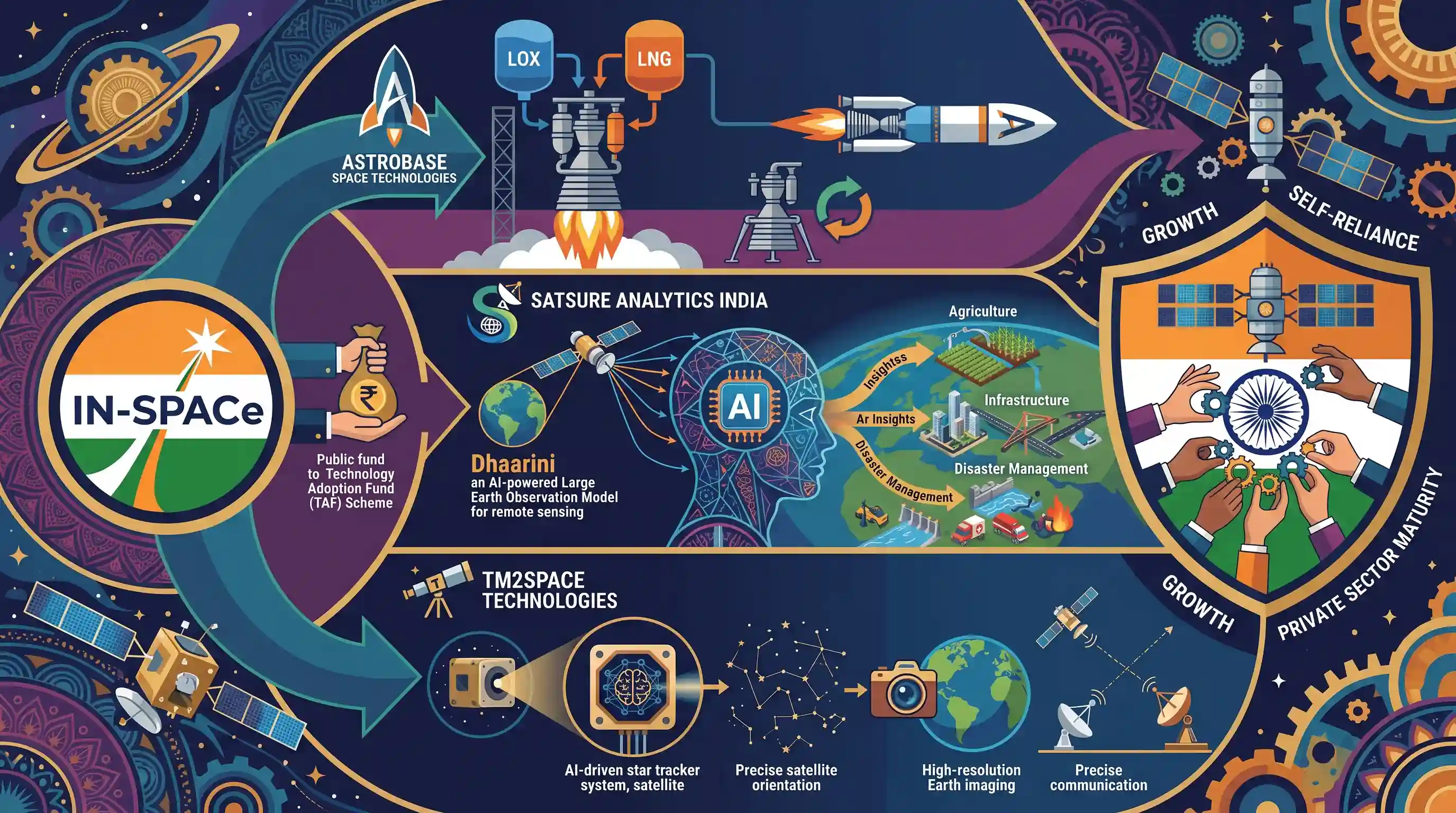
The Indian National Space Promotion and Authorisation Centre (IN-SPACe) has selected three space start-ups—Astrobase Space Technologies, SatSure Analytics India, and TM2SPACE Technologies—for funding under its Technology Adoption Fund (TAF) Scheme. The funding aims to indigenize critical space systems. The start-ups will focus on developing advanced technologies including a reusable LOX-LNG liquid rocket engine, 'Dhaarini' (an AI-powered Large Earth Observation Model for remote sensing), and AI-driven star tracker systems for satellites. This highlights the growing maturity of India's private space sector and the push for self-reliance in space technology.
Key Points
- IN-SPACe selected three Indian start-ups for financial assistance under the Technology Adoption Fund (TAF) to boost indigenous space technologies.
- Bengaluru-based Astrobase Space Technologies is developing a reusable, high-thrust (800 kN) Liquid Oxygen-Liquid Natural Gas (LOX-LNG) rocket engine for launch vehicles.
- SatSure Analytics India is building 'Dhaarini', a Large Earth Observation Model (LOM) functioning as a foundational AI platform for remote sensing applications.
- Hyderabad-based TM2SPACE Technologies is creating indigenous AI-powered star tracker systems (StarSense Lite and StarSense Pro) for precise satellite attitude determination.
Important Terms
IN-SPACe

An autonomous nodal agency under the Department of Space that acts as a single-window regulator and promoter for private sector participation in India’s space industry.
UPSC context
GS-III (Space Technology). Key for questions on private sector involvement and the Indian Space Policy 2023.
Technology Adoption Fund (TAF) Scheme
A ₹500-crore IN-SPACe initiative providing financial support (up to ₹25 crore) to startups for indigenizing critical space technologies and transitioning them from early development to commercialization.
UPSC context
GS-III (Indigenization of Technology). Tests understanding of government schemes fostering self-reliance (Atmanirbharta) in high-tech sectors.
ISRO
India's premier space agency responsible for space research, satellite development, and exploration; it provides the foundational technical expertise and ecosystem for India's emerging private space sector.
UPSC context
GS-III (Achievements of Indians in S&T). Central to any discussion on India’s institutional space framework and global standing.
Astrobase Space Technologies
A Bengaluru-based startup developing 800-kN reusable liquid rocket engines (LOX-LNG), focused on making medium-to-heavy lift launch vehicles more efficient and cost-effective.
UPSC context
GS-III (Space Technology). Represents critical developments in Reusable Launch Vehicle (RLV) technology and commercial propulsion.
SatSure Analytics India
A deep-tech startup building 'Dhaarini', an AI-powered foundational Earth Observation model designed to generate insights for agriculture, infrastructure planning, and disaster management.
UPSC context
GS-III (Applications of Remote Sensing). Illustrates the convergence of AI and space data for socio-economic development.
TM2SPACE Technologies
A Hyderabad-based startup developing indigenous AI-powered star trackers (StarSense), which are high-precision sensors used to determine a satellite's exact orientation in space.
UPSC context
GS-III (Technology Indigenization). Relates to reducing import dependence for critical satellite subsystems and high-resolution imaging.
Prelims Trap
"IN-SPACe is the commercial arm of ISRO that provides funding to private space startups."
IN-SPACe is an autonomous nodal agency under the Department of Space. The commercial arm of ISRO is NSIL (NewSpace India Limited), not IN-SPACe.
Static Concepts Connected
Why is LOX-LNG emerging as a preferred propellant for reusable rockets?
- Clean burning: It produces significantly less soot (coking) than LOX-Kerosene, reducing wear and making engine refurbishment and reuse much easier.
- Cost and efficiency: It offers high specific impulse (efficiency) and utilizes Liquefied Natural Gas, which is easily available and cost-effective.
What is the role of a 'Star Tracker' on a satellite?
- Attitude determination: It is a precise optical sensor that determines the spacecraft's 3-dimensional spatial orientation (attitude) in orbit.
- Starfield matching: It captures images of stars and compares them against an onboard catalog to orient and navigate the satellite accurately.
Cross-Topic Patterns
AI convergence with Earth Observation
AI foundational models ('Dhaarini') applied to remote sensing link GS3 Space Tech with GS3 IT, offering enhanced data capabilities for agriculture and disaster resilience.
Indian Space Policy 2023 & IN-SPACe
TAF funding operationalizes the 2023 policy's vision to transition from ISRO-led missions to an ecosystem driven by Non-Governmental Entities (NGEs) through direct state funding.

Expect a 2026 Prelims question pairing IN-SPACe's precise mandate with emerging private space tech like LOX-LNG engines and Star Trackers.
Linked PYQs · 2
Linked PYQs · 2
- 2016MainsGS3
Discuss India's achievements in the field of Space Science and Technology. How the application of this technology has helped India in its socio-economic development?
- 2018PrelimsGS1
With reference to India's satellite launch vehicles, consider the following statements: 1. PSLVs launch the satellites useful for Earth resources monitoring whereas GSLVs are designed mainly to launch communication satellites. 2. Satellites launched by PSLV appear to remain permanently fixed in the same position in the sky, as viewed from a particular location on Earth. 3. GSLV Mk III is a four-staged launch vehicle with the first and third stages using solid rocket motors; and the second and fourth stages using liquid rocket engines. Which of the statements given above is/are correct?
