ONDC Integration in Bengaluru Public Transport Network
Source:Indian Express ↗
Why It Matters
Demonstrates a real-world application of Digital Public Infrastructure (ONDC) beyond e-commerce into urban mobility, addressing critical GS3 themes like infrastructure (transport), smart cities, and GS2 themes of e-governance service delivery transparency.
Summary
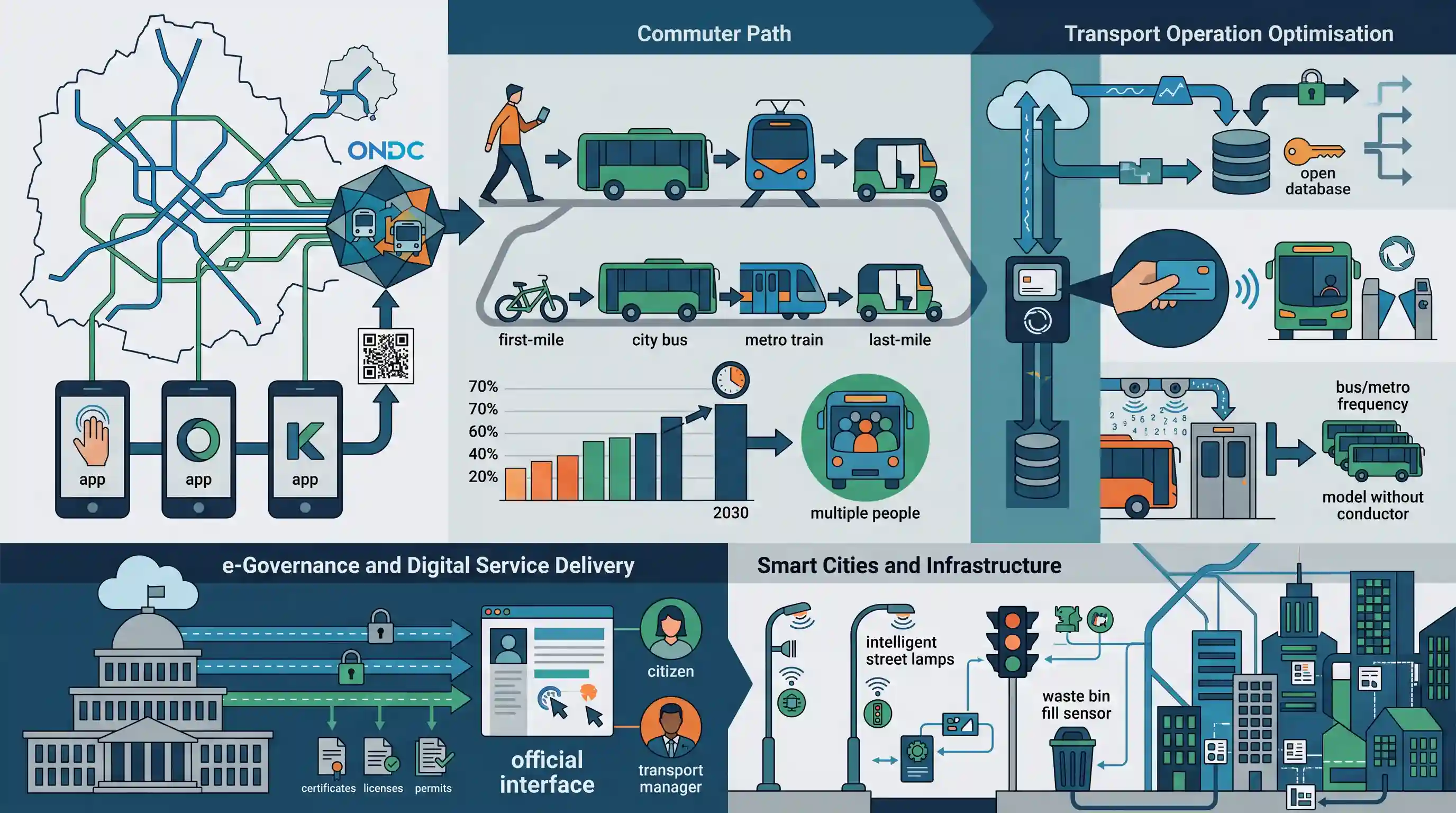
Bengaluru has pioneered a digital public transport integration by bringing its metro and bus services onto the Open Network for Digital Commerce (ONDC) platform. This initiative allows commuters to use various consumer mobility apps to book seamless QR-based tickets, fostering multimodal interoperability. Alongside ONDC integration, transport bodies are promoting open-source data sharing, open-loop smart cards, and automated passenger counting to optimize operations and work toward a conductor-less transit model. The digital transformation aims to elevate the city's public transport mode share to 70% by 2030, emphasizing first and last-mile connectivity and enhanced e-governance in service delivery.
Key Points
- Bengaluru has integrated its public transport (BMTC and BMRCL) with the Open Network for Digital Commerce (ONDC), enabling commuters to book QR-code-based tickets via multiple private mobility apps (e.g., Rapido, Namma Yatri).
- The government targets increasing the public transport modal share in Bengaluru to 70% by 2030 through infrastructure expansion, digital integration, and open-source data sharing.
- BMTC is adopting open-loop Smart Shakti Cards compatible with RuPay, Mastercard, and Visa via Electronic Ticketing Machines (ETMs).
- New systems like Automatic Passenger Counting (APC) combined with Automatic Fare Collection (AFC) aim to pave the way for a conductor-less transit model.
- Startups are leveraging open-source transit data through initiatives like the Enroute Challenge to offer seamless multimodal trip planning and improved first/last-mile connectivity.
Important Terms
Open Network for Digital Commerce (ONDC)

A government-backed open protocol designed to democratize digital commerce by moving from platform-centric models to an open-network model, enabling interoperability between diverse buyers and sellers.
UPSC context
GS Paper III: Digital Public Infrastructure (DPI). Vital for understanding e-commerce regulation, digital inclusion, and innovative service delivery models.
Smart Shakti Scheme
A digital upgrade to Karnataka's free bus travel program for women, utilizing NCMC-based smart cards to replace manual verification and ensure transparent, data-driven subsidy management.
UPSC context
GS Paper II: Welfare Schemes for vulnerable sections. Tests knowledge of e-governance in social security and leakage prevention in subsidies.
World Resources Institute (WRI) India
A global research non-profit that partners with local governments to design sustainable urban solutions, specifically focusing on multimodal integration and reorganizing bus routes around metro corridors.
UPSC context
GS Paper III: Urbanization and Sustainable Development. Relevant for discussing the role of international research organizations in urban planning.
Bengaluru Metropolitan Transport Corporation (BMTC)
The state-owned transport undertaking providing city bus services in Bengaluru, currently transitioning toward digital ticketing, open data sharing, and a conductor-less operational model.
UPSC context
GS Paper III: Infrastructure and Urban Mobility. Key for case studies on public-private digital integration and smart city transport.
Bangalore Metro Rail Corporation Limited (BMRCL)
The joint venture of the Government of India and Karnataka responsible for Bengaluru's 'Namma Metro,' pioneering the integration of metro ticketing into open digital networks.
UPSC context
GS Paper III: Infrastructure (Railways/Urban Transit). Represents the shift toward multimodal connectivity and integrated transport systems.
Villgro
An Indian social enterprise incubator that supports startups in developing 'Mobility-as-a-Service' (MaaS) solutions, facilitating collaboration between private innovators and public transport agencies.
UPSC context
GS Paper III: Indian Economy and Startups. Highlights the role of social entrepreneurship in solving public service challenges through innovation.
Prelims Trap
ONDC is a centralized government-owned mobility application for public transit.
ONDC is not an app or platform; it is an open network protocol. Commuters still use decentralized private apps (like Namma Yatri) to access the network.
Static Concepts Connected
What are the core features of ONDC (Open Network for Digital Commerce)?
- Network, not app: It is an open protocol network based on open-source methodology, acting as a decentralized facilitator rather than a centralized aggregator app.
- Interoperability: It enables interoperability, meaning a consumer on one buyer app can seamlessly purchase services from a seller registered on a completely different app.
- Section 8 Company: It is incorporated as a Section 8 (non-profit) company under the initiative of the Department for Promotion of Industry and Internal Trade (DPIIT).
How do Open-Loop mobility cards differ from Closed-Loop cards?
- Open-Loop Systems: Supported by major payment networks (like RuPay) and can be utilized for both transit ticketing and general retail or ATM transactions.
- Closed-Loop Systems: Issued by a specific transit agency and strictly limited to payments within that single agency’s ecosystem (e.g., standard legacy metro cards).
Cross-Topic Patterns
DPI's expansion from Fintech to Mobility
UPSC focuses heavily on India Stack. ONDC's integration into public transit shifts the DPI narrative from financial inclusion (UPI) to solving urban governance and multimodal logistics.
Urban Transit and NDC Commitments
Bengaluru’s 70% public transport modal share target directly intersects with India’s climate goals to reduce emission intensity through decarbonized and formalized urban mobility.

Expect a multi-statement question in 2026 linking ONDC's open-protocol architecture with urban mobility tools like NCMC.
Linked PYQs · 4
Linked PYQs · 4
- 2014MainsGS3
National Urban Transport Policy emphasises on 'moving people' instead of 'moving vehicles'. Discuss critically the success of the various strategies of the Government in this regard.
- 2016MainsGS3
What are 'Smart Cities'? Examine their relevance for urban development in India. Will it increase rural-urban differences? Give arguments for 'Smart Villages' in the light of PURA and RURBAN Mission.
- 2024MainsGS2
e-governance is not just about the routine application of digital technology in service delivery process. It is as much about multifarious interactions for ensuring transparency and accountability. In this context evaluate the role of the 'Interactive Service Model' of e-governance.
- 2020MainsGS2
The emergence of Fourth Industrial Revolution (Digital Revolution) has initiated e-Governance as an integral part of government". Discuss.
