Judicial Perspective on Energy Justice and Environment
Source:The Hindu ↗
Why It Matters
Provides significant judicial insights into the interpretation of Article 21 concerning environmental rights and traces the evolution of environmental jurisprudence in India. It also reinforces the stance of the Global South on Common But Differentiated Responsibilities (CBDR), essential for Mains answers on climate change and sustainable development.
Summary
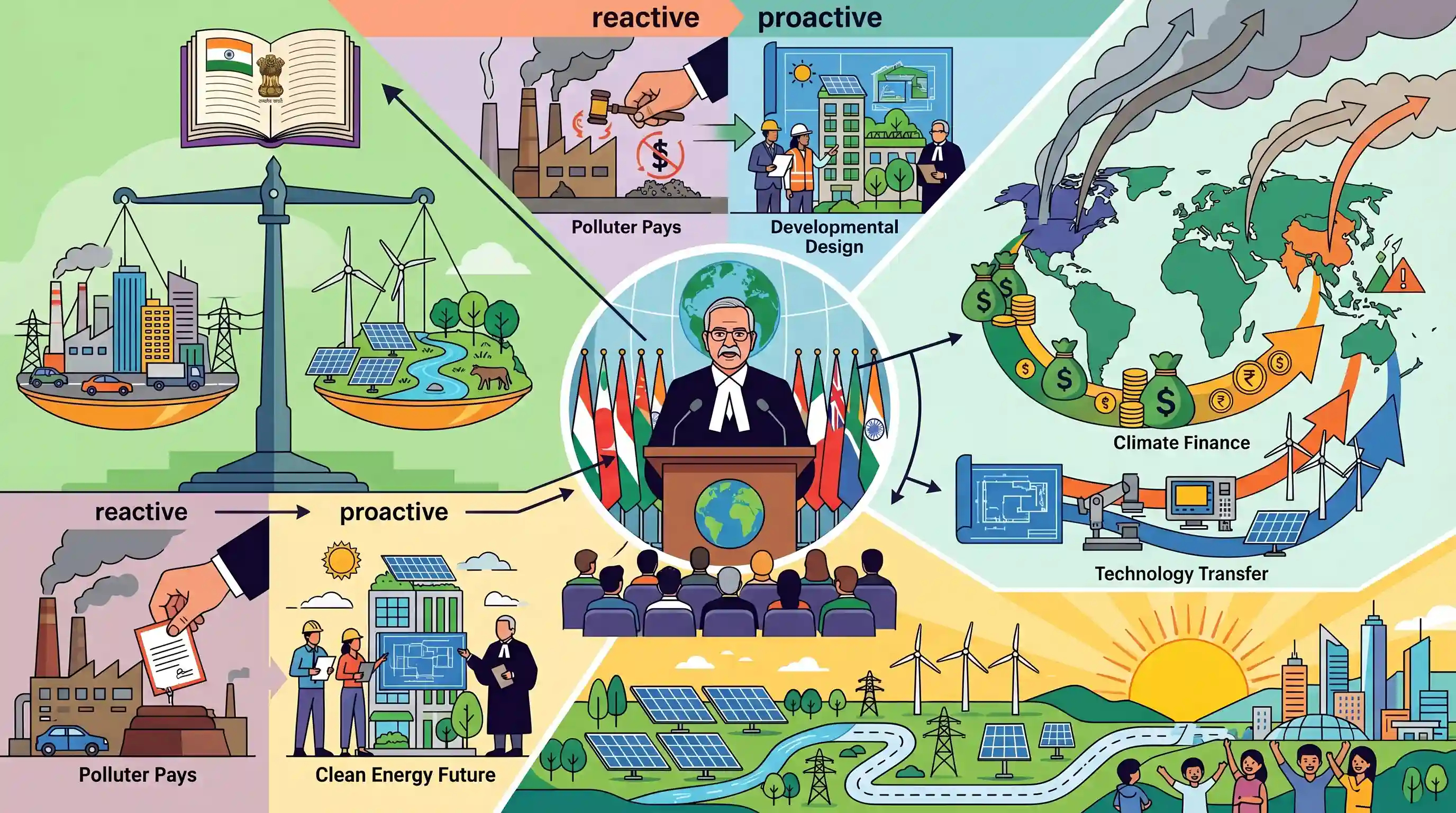
Chief Justice of India Surya Kant, addressing an international conference on sustainable energy in Bengaluru, emphasized that 'energy justice' must shape India's development trajectory toward 2047. He highlighted that Article 21 of the Constitution equally protects the right to development and the right to a clean environment. The CJI noted the judiciary's shift from a reactive 'polluter pays' doctrine to a proactive stance that integrates environmental protection into developmental design. Concurrently, Karnataka Chief Minister Siddaramaiah asserted that the global clean energy transition must be rooted in equity, urging developed nations to acknowledge their historical emissions by providing climate finance and technology transfer to developing countries.
Key Points
- CJI Surya Kant introduced 'energy justice' as a moral framework required to balance India's economic growth targets for 2047 with ecological sensitivity.
- Article 21 of the Indian Constitution guarantees both the right to development and the right to a clean environment, demanding a delicate balancing exercise.
- The Indian judiciary's approach has evolved from a reactive 'pollute and pay' mechanism to proactively emphasizing pollution prevention in the design phase of development.
- Karnataka CM Siddaramaiah highlighted the principle of historical responsibility, calling on developed nations to provide climate finance and technology transfer to support developing nations' clean energy transitions.
- Karnataka has adopted a dedicated renewable energy policy targeting over 38 GW of additional wind and solar capacity.
Important Terms
Article 21 of the Constitution

Guarantees the Right to Life and Personal Liberty. Indian courts interpret this to include the right to a clean environment, health, and development, ensuring a 'golden balance' between ecological protection and industrial growth.
UPSC context
GS Paper 2 (Polity); tests understanding of fundamental rights and judicial expansion of socio-environmental rights.
Energy Justice
A framework ensuring that the benefits and burdens of energy systems are distributed fairly, emphasizing universal access to affordable, reliable, and clean energy while remediating historical injustices against marginalized communities.
UPSC context
GS Paper 3 (Energy/Environment); tests knowledge of equitable resource distribution and India's sustainable energy transition.
Polluter Pays Principle
An environmental law doctrine holding that those responsible for pollution should bear the costs of its management, cleanup, and compensation to victims, thereby internalizing environmental externalities.
UPSC context
GS Paper 3 (Environment); tests familiarity with legal frameworks for environmental accountability and judicial doctrines.
Climate Finance
Local, national, or transnational funding—sourced from public and private sectors—that supports climate mitigation and adaptation, particularly helping developing nations manage the impacts of global warming.
UPSC context
GS Paper 2 (International Relations) & Paper 3 (Climate Change); tests understanding of global climate negotiations and equity.
Technology Transfer
The movement of environmentally sound expertise and equipment from developed to developing countries to enable low-carbon growth and help fulfill commitments under the UNFCCC and Paris Agreement.
UPSC context
GS Paper 2 (International Relations); focuses on the North-South divide in climate technology and global cooperation.
Sustainable Development
Development that meets present needs without compromising future generations' ability to meet theirs, achieved by harmonizing economic growth, social inclusion, and environmental protection.
UPSC context
GS Paper 3 (Environment); central theme for conservation, pollution, and global climate governance topics.
Prelims Trap
Article 21 of the Indian Constitution explicitly guarantees the right to a clean environment and development.
Article 21 only explicitly mentions "life and personal liberty." The rights to a clean environment, development, and energy justice are entirely products of judicial interpretation.
Static Concepts Connected
What are the core environmental doctrines applied by the Indian Judiciary?
- Polluter Pays: Imposes absolute liability on the polluting enterprise to compensate victims and bear the costs of restoring environmental degradation.
- Precautionary Principle: Asserts that a lack of full scientific certainty cannot be a reason to postpone measures to prevent environmental degradation. Burden of proof lies on the developer.
- Public Trust Doctrine: Establishes that the state acts as a trustee of natural resources (air, water, forests), which are meant for public use rather than private ownership.
What is the CBDR-RC principle in global climate negotiations?
- Origin & Meaning: Enshrined in the 1992 UNFCCC, acknowledging that while climate change is a global concern, countries have entirely different historical contributions to greenhouse gas emissions.
- Historical Responsibility: Serves as the legal and moral basis for developing nations to demand climate finance and technology transfer from industrialized countries for equitable energy transitions.
Cross-Topic Patterns
Judicial climate activism & Article 21
Builds on the recent Supreme Court ruling (M.K. Ranjitsinh case) that carved out a specific fundamental 'right against adverse impacts of climate change' derived from Articles 14 and 21.
Sub-national climate action and NDCs
Demonstrates how state-level RE targets (like Karnataka's 38 GW) are vital cogs in achieving India's centralized 'Panchamrit' commitments at the UNFCCC, linking GS2 federalism with GS3 ecology.

Mains 2026 is highly likely to feature a GS2/GS3 crossover question on how judicial interventions harmonize 'energy justice' with development.
Linked PYQs · 5
Linked PYQs · 5
- 2020MainsGS3
Explain intra-generational and inter-generational issues of equity from the perspective of inclusive growth and sustainable development.
- 2018MainsGS3
“Access to affordable, reliable, sustainable and modern energy is the sine qua non to achieve Sustainable Development Goals (SDGs).” Comment on the progress made in India in this regard.
- 2015MainsGS2
Does the right to clean environment entail legal regulations on burning crackers during Diwali? Discuss in the light of Article 21 of the Indian Constitution and Judgement(s) of the Apex Court in this regard.
- 2022MainsGS2
“The most significant achievement of modern law in India is the constitutionalization of environmental problems by the Supreme Court.” Discuss this statement with the help of relevant case laws.
- 2022MainsGS3
Discuss global warming and mention its effects on the global climate. Explain the control measures to bring down the level of greenhouse gases which cause global warming, in the light of the Kyoto Protocol, 1997.
