Urban air quality monitoring and pollution management in Bengaluru
Source:The Hindu ↗
Why It Matters
Highlights the challenges of urban pollution management in major metropolitan cities. It emphasizes the practical application of the Air Quality Index (AQI) as an administrative trigger for environmental enforcement and underscores the governance challenges surrounding waste treatment infrastructure and single-use plastics.
Summary
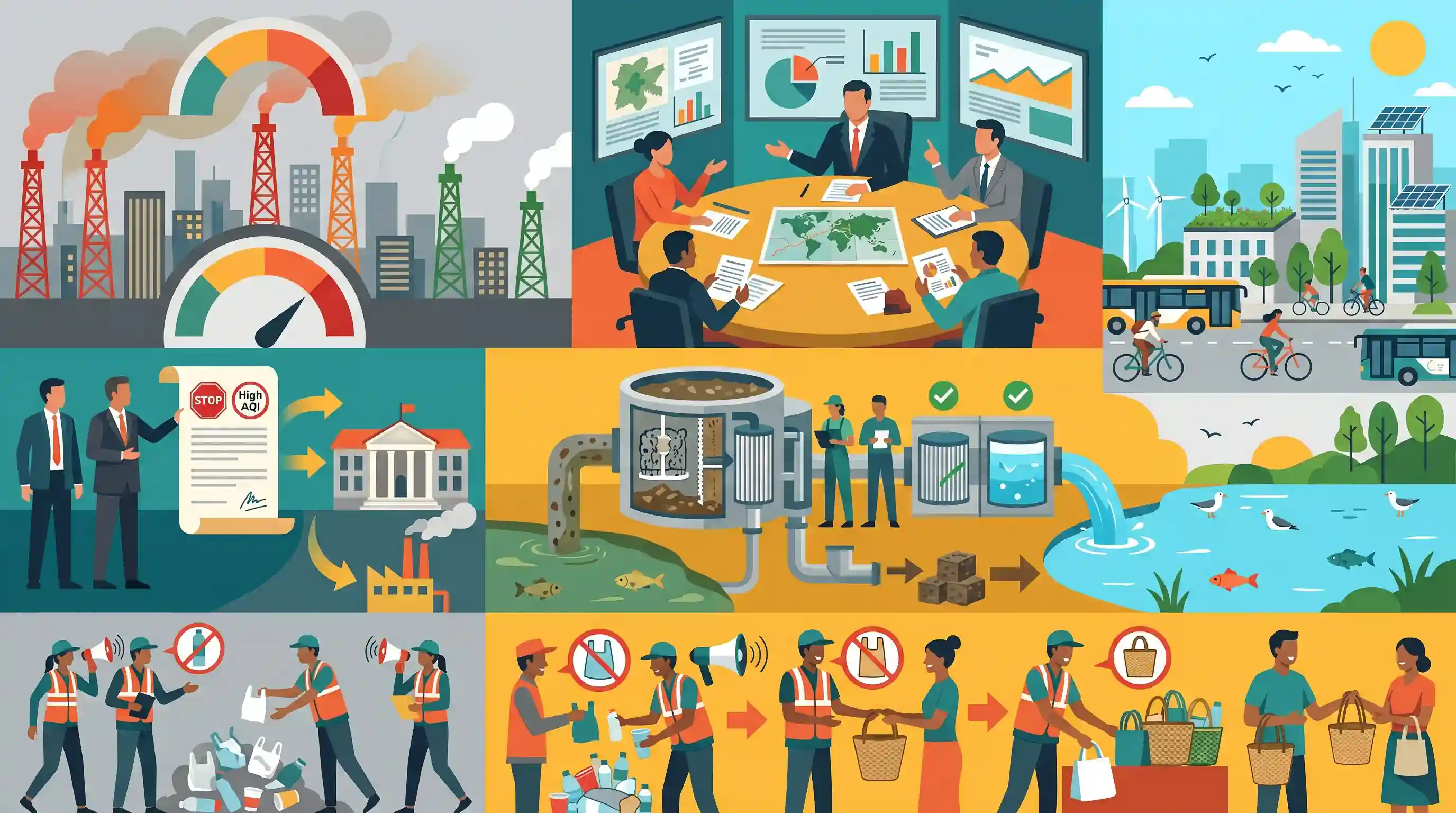
The Karnataka government is intensifying its focus on mitigating environmental degradation in Bengaluru amid rising concerns over air, water, and noise pollution. With 8 out of 11 monitoring stations recording an Air Quality Index (AQI) above 100 in January 2026, the State Environment Minister has scheduled a comprehensive review meeting with city legislators and urban local bodies. Key directives include issuing notices to local bodies if AQI crosses 100, monitoring the functional capacity of waste treatment plants to prevent untreated sewage discharge into lakes, and forming awareness squads to combat the single-use plastic menace. The initiative underscores the urgent need to prevent Bengaluru from suffering severe pollution crises comparable to Delhi.
Key Points
- Karnataka Environment Minister Eshwar Khandre is convening a meeting with Bengaluru's 28 MLAs to tackle escalating air, water, and noise pollution in the city.
- In January 2026, 8 out of 11 air quality monitoring stations in Bengaluru recorded an Air Quality Index (AQI) crossing the 100 mark.
- The AQI categorizes air quality from 0-50 (good) to 401-500 (severe), with values above 100 causing breathing discomfort for sensitive groups.
- Officials have been directed to issue notices to local bodies and enforce time-bound pollution control measures whenever the AQI exceeds 100.
- The Environment Department is mandated to review and report on the functional status of waste treatment plants and the volume of untreated liquid waste entering water bodies, alongside tackling single-use plastic waste.
Important Terms
Air Quality Index (AQI)

A numerical scale (0-500) used by the CPCB to communicate daily air quality. It monitors eight pollutants, including PM2.5, PM10, and Nitrogen Dioxide, to assess health risks.
UPSC context
GS3 (Environment). Vital for understanding urban pollution monitoring and the efficacy of public health advisories and environmental regulations.
National Clean Air Programme (NCAP)
A national strategy launched in 2019 aiming for a 40% reduction in particulate matter (PM2.5 and PM10) concentrations by 2026 across identified non-attainment cities.
UPSC context
GS3 (Environment). India’s first specific framework for air quality management, focusing on inter-ministerial coordination and city-specific action plans.
Urban Local Bodies (ULBs)
Democratic grassroots institutions, such as Municipal Corporations, constitutionalized by the 74th Amendment Act (1992). They manage 18 functions, including sanitation, waste management, and environmental protection.
UPSC context
GS2 (Polity). Tests knowledge of decentralized governance and the role of third-tier institutions in implementing environmental and urban infrastructure mandates.
Non-Attainment Cities
Cities that consistently failed to meet National Ambient Air Quality Standards (NAAQS) for five consecutive years, thus requiring mandatory interventions under the National Clean Air Programme.
UPSC context
GS3 (Environment). Key for identifying regional pollution hotspots and understanding the targeted regulatory mechanisms used to improve high-risk urban air quality.
Single-Use Plastic (SUP)
Plastics intended for one-time use before disposal. India banned 19 high-littering, low-utility items in July 2022 under the Plastic Waste Management (Amendment) Rules.
UPSC context
GS3 (Environment). Central to discussions on solid waste management, marine pollution, and the transition toward a circular economy.
Extended Producer Responsibility (EPR)
A policy approach holding producers accountable—financially or physically—for the treatment or disposal of post-consumer products, specifically regarding plastic packaging and e-waste.
UPSC context
GS3 (Environment). A critical mechanism in modern waste management rules, testing awareness of corporate environmental accountability and sustainable resource management.
Prelims Trap
The National Air Quality Index (NAQI) calculates urban pollution levels by measuring Carbon Dioxide (CO2) and Methane emissions.
CO2 and Methane are greenhouse gases driving climate change, but they are NOT among the 8 criteria pollutants measured by NAQI for local air toxicity.
Static Concepts Connected
Which 8 pollutants are measured under the National Air Quality Index (NAQI)?
- Particulate Matter: Measures PM10 and PM2.5, which are the primary drivers of urban respiratory issues and visibility reduction.
- Toxic Gases: Includes Nitrogen Dioxide (NO2), Sulphur Dioxide (SO2), Carbon Monoxide (CO), and ground-level Ozone (O3).
- Other Compounds: Tracks Ammonia (NH3) and Lead (Pb). Notably excludes standard greenhouse gases like Carbon Dioxide (CO2).
How does untreated sewage impact Biological Oxygen Demand (BOD) in lakes?
- BOD Defined: The amount of dissolved oxygen needed by aerobic bacteria to break down organic material in a given water sample.
- Sewage Spike: Discharging untreated sewage introduces massive organic loads, causing aerobic bacteria to multiply and sharply increasing BOD.
- Oxygen Depletion: High BOD directly depletes Dissolved Oxygen (DO) levels in the water, creating hypoxic 'dead zones' that suffocate fish and aquatic life.
Cross-Topic Patterns
74th CAA & Urban Pollution Governance
Urban Local Bodies draw their sanitation and public health mandates from the 12th Schedule, directly tying local decentralised governance (Polity) to frontline environmental crisis management.
Eutrophication & Urban Lake Ecology
Untreated sewage discharge connects heavily to urban wetland degradation, linking high Biological Oxygen Demand (BOD) to eutrophication, a frequent and high-yield UPSC Prelims target.

Expect a multi-statement question correlating NAQI pollutant metrics with urban wetland degradation (BOD/eutrophication) and ULB powers.
Linked PYQs · 3
Linked PYQs · 3
- 2025PrelimsGS1
Artificial way of causing rainfall to reduce air pollution makes use of
- 2017PrelimsGS1
Biological Oxygen Demand (BOD) is a standard criterion for
- 2024MainsGS3
Industrial pollution of river water is a significant environmental issue in India. Discuss the various mitigation measures to deal with this problem and also the government's initiatives in this regard.
