West Bengal Industrial Policy Proposes Landowner Stakeholder Model
Source:tripurachronicle ↗
Why It Matters
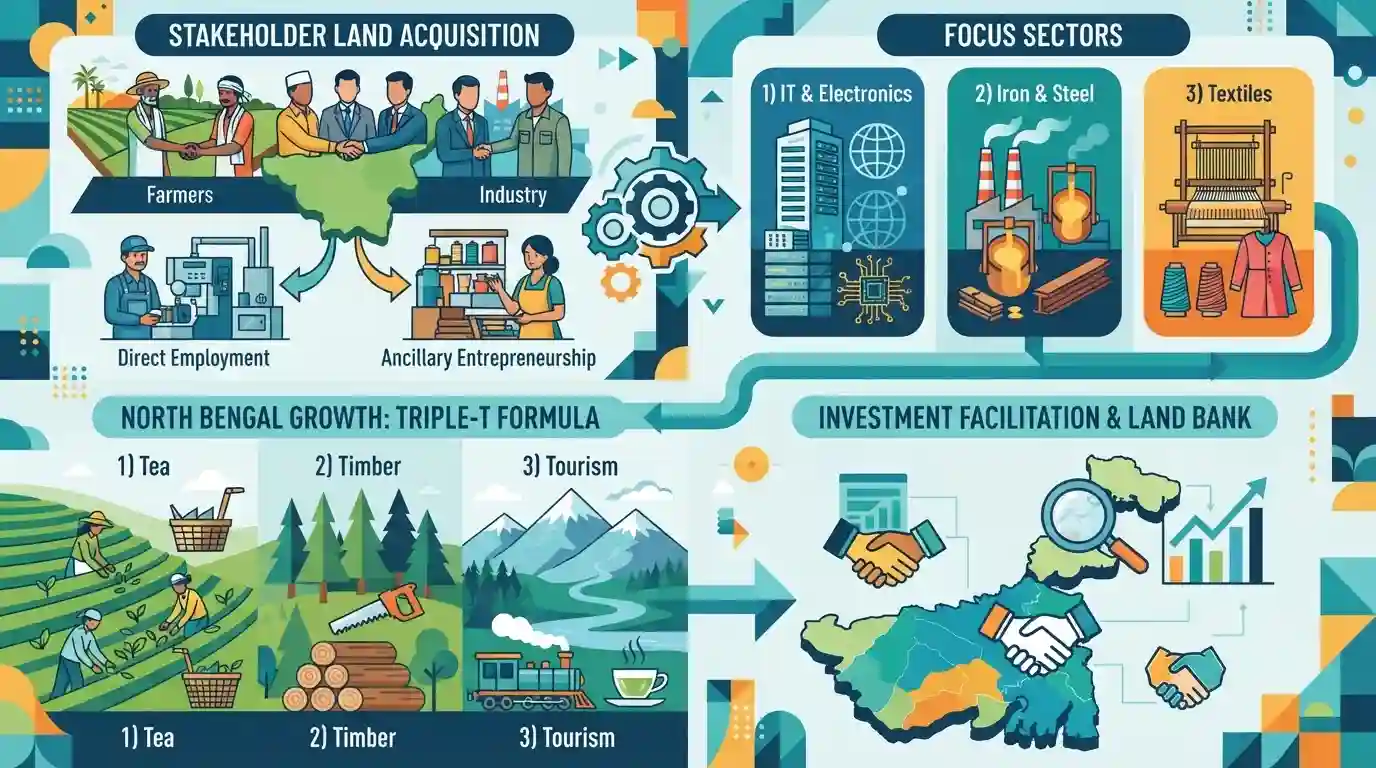
The policy is a crucial step for West Bengal's economic revival, attempting to resolve the long-standing 'land acquisition bottleneck' by directly integrating landowners into the industrial ecosystem and promoting sector-specific regional development, such as the Triple-T model in North Bengal.
Summary
West Bengal is preparing a new industrial policy designed to make landowners stakeholders in upcoming industrial projects. By offering direct employment to family members or supporting ancillary entrepreneurship (such as running canteens or tailoring unit uniforms), the state aims to bypass the political and social hurdles of land acquisition that historically plagued areas like Singur and Nandigram. Key focus sectors include IT, iron and steel, and textiles, while North Bengal will see targeted growth based on the 'Triple-T' formula: tea, timber, and tourism. A realistic update to the state's land bank map is also underway to assist potential investors.
Key Points
- West Bengal is drafting a new industrial policy that makes landowners stakeholders in new industrial units to prevent complications during land procurement.
- The policy addresses the historic challenges of land acquisition seen in Singur and Nandigram by offering alternatives such as employment for a family member or support for indirect entrepreneurship (e.g., canteens, tailoring).
- The state will focus on priority sectors, including textiles, garments, iron and steel, heavy electrical equipment, automotive, IT, and electronics.
- For North Bengal, the state government is prioritizing a 'Triple-T' economic model: tea, timber, and tourism.
- The state's land bank map is being updated to accurately represent available and usable industrial land.
Important Terms
West Bengal Industrial Policy

A new state framework prioritizing investments with strong ancillary demand. It uniquely proposes making displaced landowners stakeholders by offering them direct jobs or helping them start support businesses.
UPSC context
Crucial for WBCS Paper V (Economy of WB). Tests knowledge of current government strategies to revive industrialization without acquiring land forcibly.
Triple-T Formula
An economic development strategy specifically targeting North Bengal, which focuses on boosting three core sectors: Tea, Timber, and Tourism, as part of the state's inclusive industrial growth model.
UPSC context
Highly relevant for WBCS Paper IV (Geography of WB) and Paper V (Economy). Tests regional development initiatives for North Bengal.
Land Bank
A GIS-enabled, centralized inventory of unutilized land held by various state departments. West Bengal offers these parcels to industries to bypass the complications of private land acquisition.
UPSC context
Important for WBCS Paper V. Highlights the state government's infrastructural mechanism to attract investments while safeguarding private landowners.
Singur and Nandigram Movements
Historic anti-land acquisition protests in West Bengal over a Tata car plant (Singur) and a chemical hub (Nandigram). These events shaped the state's current stakeholder-driven industrial policies.
UPSC context
Essential for WBCS Paper III (History) and Paper V. Provides the socio-political backdrop for West Bengal's modern land acquisition reforms.
State Commerce and Industries Department
The nodal department of the West Bengal government responsible for drafting industrial policies, promoting trade, and facilitating industrial parks through agencies like WBIIDC and WBIDC.
UPSC context
Relevant for WBCS Paper V (Indian Economy & Administration). Tests knowledge of the institutional framework governing state economic development.
Ancillary Industries
Micro and small enterprises that provide direct equipment or indirect support (like canteens or tailoring) to large manufacturing units. Promoted to boost inclusive local employment.
UPSC context
Crucial for WBCS Paper V. Tests MSME development strategies and employment generation mechanisms in West Bengal's economy.
Prelims Trap
The new West Bengal industrial policy grants mandatory equity shares to landowners in upcoming industrial projects.
The "stakeholder" model focuses on direct employment or ancillary entrepreneurship (running canteens/tailoring), not mandatory corporate equity distribution.
Static Concepts Connected
What are the core principles of India's LARR Act, 2013?
- Consent Requirement: Mandates 80% landowner consent for private projects and 70% for Public-Private Partnerships before acquisition.
- SIA: Requires mandatory Social Impact Assessment to evaluate the project's effect on livelihoods and public infrastructure.
- R&R Package: Ensures comprehensive rehabilitation and resettlement, including guaranteed employment, land-for-land, or annuities for affected families.
What geographically drives the North Bengal economy?
- Tea Gardens: Concentrated in Darjeeling, Terai, and Dooars regions, generating significant local employment and export revenue.
- Timber Resources: Supported by the dense deciduous and semi-evergreen forests of the sub-Himalayan foothills.
- Eco-Tourism: Centered around hill stations, national parks like Gorumara, and wildlife sanctuaries attracting constant tourist footfall.
Cross-Topic Patterns
Singur's legacy on Land Banks
The 2006-2008 agitations forced West Bengal to abandon eminent domain for private industry, pioneering the 'land bank' model and indirectly influencing the 2013 national overhaul of land acquisition laws.
North-South industrial divergence
The policy highlights a geographic split: heavy manufacturing and IT in South Bengal versus the resource-and-service-led 'Triple-T' (Tea, Timber, Tourism) model customized for North Bengal's terrain.

Expect WBCS MCQs on North Bengal's 'Triple-T' formula, and Mains questions on how state land banks solve historical acquisition hurdles.
Linked PYQs · 3
Linked PYQs · 3
- 2019WBCS_PRELIMSGS1
West Bengal Land Reform Act came into force in
- 2018WBCS_PRELIMSGS1
In West Bengal rail wagons are manufactured at
- 2015WBCS_PRELIMSGS1
The North flowing rivers of West Bengal are
