West Bengal Official Language Policy and Bengali Mandate
Source:The Hindu ↗
Why It Matters
The article is crucial for understanding constitutional provisions related to official languages (Part XVII), specifically how states exercise autonomy under Article 345 to adopt regional languages for official purposes. It also highlights the intersection of cultural policy, federal relations, and regional political dynamics in West Bengal.
Summary
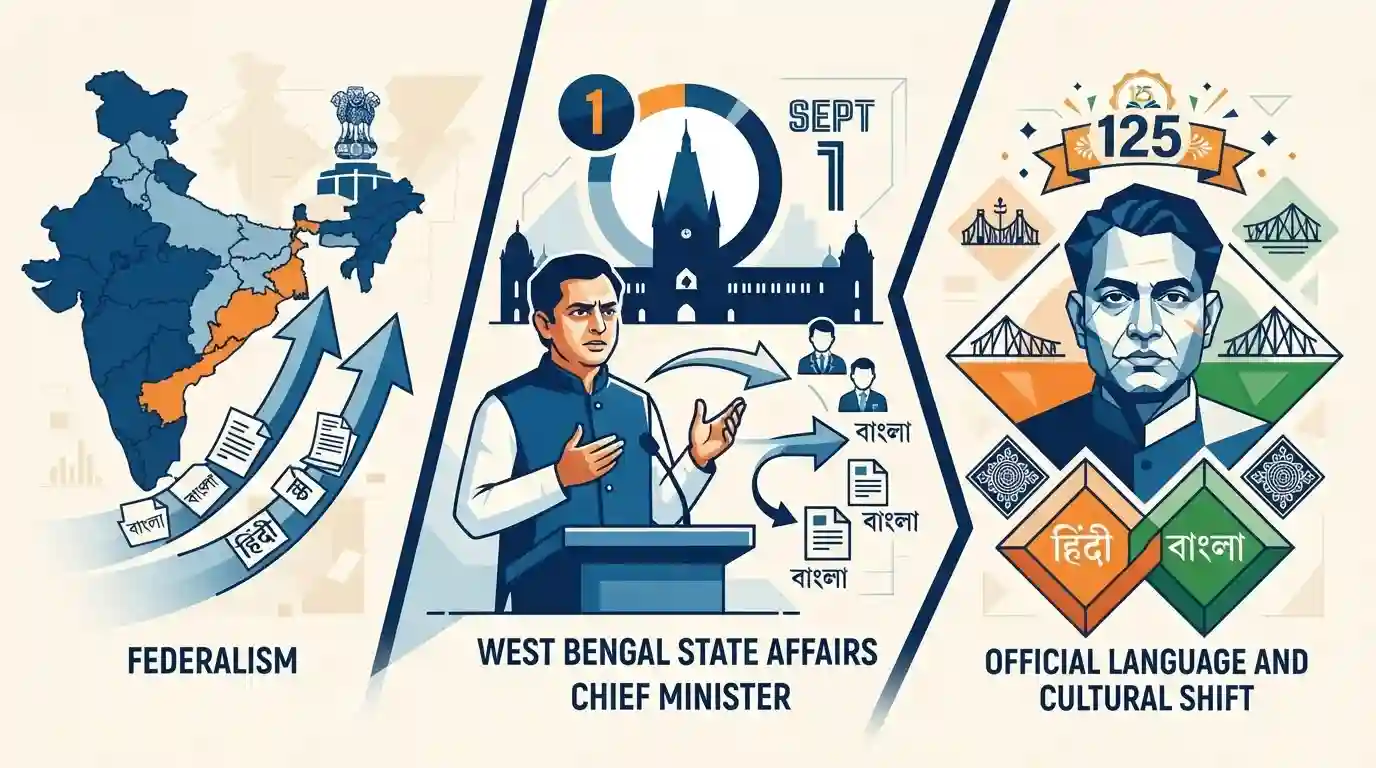
West Bengal Chief Minister Suvendu Adhikari has announced that starting September 1, Bengali will become the mandatory official language for all intra-state government communication. The move, requested by Union Home Minister Amit Shah to honor the 125th birth anniversary of Dr. Syama Prasad Mookerjee, will also see state-to-Centre communications conducted in both Bengali and Hindi. This marks a strategic cultural shift by the BJP government in West Bengal, asserting regional linguistic identity and countering former political accusations of Hindi imposition.
Key Points
- Effective September 1, 2026, Bengali will be prioritized and made mandatory for all official communications within the West Bengal state government.
- Correspondence between the West Bengal government and the Central Government will be conducted in both Bengali and Hindi.
- The policy change was requested by Union Home Minister Amit Shah to commemorate the 125th birth anniversary of Dr. Syama Prasad Mookerjee.
- This decision marks a significant political shift in the BJP-ruled state, countering past narratives by the TMC regarding alleged Hindi imposition.
Important Terms
West Bengal Official Language Act

Enacted in 1961 under Article 345, this statute designates Bengali (and Nepali in specific hill subdivisions) as the official language for West Bengal's administrative and legislative purposes.
UPSC context
GS-2 Polity (Federalism). Highlights state autonomy in linguistic policies and the constitutional framework for regional official languages.
Central Government
The Union Executive and Legislature of India (Part V of the Constitution), responsible for national administration, federal coordination, and regulating inter-state and Union-State communications under Article 346.
UPSC context
GS-2 Polity. Tests understanding of federal structure, Union powers, and constitutional protocols governing inter-governmental communication.
West Bengal Government
The state-level executive and legislative machinery of West Bengal (Part VI of the Constitution), empowered to legislate on State List subjects, including the adoption of regional official languages.
UPSC context
GS-2 Federalism. Relevant to State Executive functions, sub-national autonomy, and Centre-State dynamics in India's quasi-federal setup.
Prelims Trap
A state must restrict its choice of official language to those listed in the Eighth Schedule.
Article 345 grants legislatures absolute power to adopt 'any' language used in the state, regardless of its inclusion in the Eighth Schedule.
Static Concepts Connected
What constitutional rules govern a State's official language under Article 345?
- Legislative discretion: The State Legislature can adopt any language used in the state, or Hindi, as its official language.
- Default English status: English continues to be used for official state work until the state legislature enacts a law otherwise.
- Eighth Schedule independence: The chosen state official language does not need to be listed in the Eighth Schedule of the Constitution.
How does the Official Languages Rules, 1976 categorize states for communications?
- Region A: Includes Hindi-majority states where communications with the Union are mandated to be primarily in Hindi.
- Region B: Includes states like Gujarat and Punjab where communications with the Union are normally in Hindi.
- Region C: Includes non-Hindi states like West Bengal where communications with the Union are primarily in English.
Cross-Topic Patterns
Linguistic federalism vs Central communication rules
Mandating regional languages in state-to-Centre correspondence challenges the strict Region C designations of the Official Languages Rules, 1976.
Cultural nationalism and sub-national identity
Aligning national party agendas with local linguistic pride represents a strategic shift in managing regionalism and countering anti-Hindi narratives.

Article 345/346 mechanics and the Official Languages Rules (Region C dynamics) are highly likely targets for a conceptual polity MCQ.
Linked PYQs · 3
Linked PYQs · 3
- 2019WBCS_PRELIMSGS1
Which Schedule of the Constitution of India distributes power between the Union and the States?
- 2019WBCS_PRELIMSGS1
West Bengal Land Reform Act came into force in
- 2024WBCS_PRELIMSGS1
Which one of the following is included in acquiring foreign citizenship?
