West Bengal healthcare policy shift to Ayushman Bharat scheme
Source:business-standard ↗
Why It Matters
The shift from the state's flagship Swasthya Sathi scheme to the central Ayushman Bharat scheme is a significant policy change in West Bengal's healthcare governance. It is highly relevant for WBCS Prelims, as questions frequently focus on state government schemes, funding patterns, and health infrastructure.
Summary
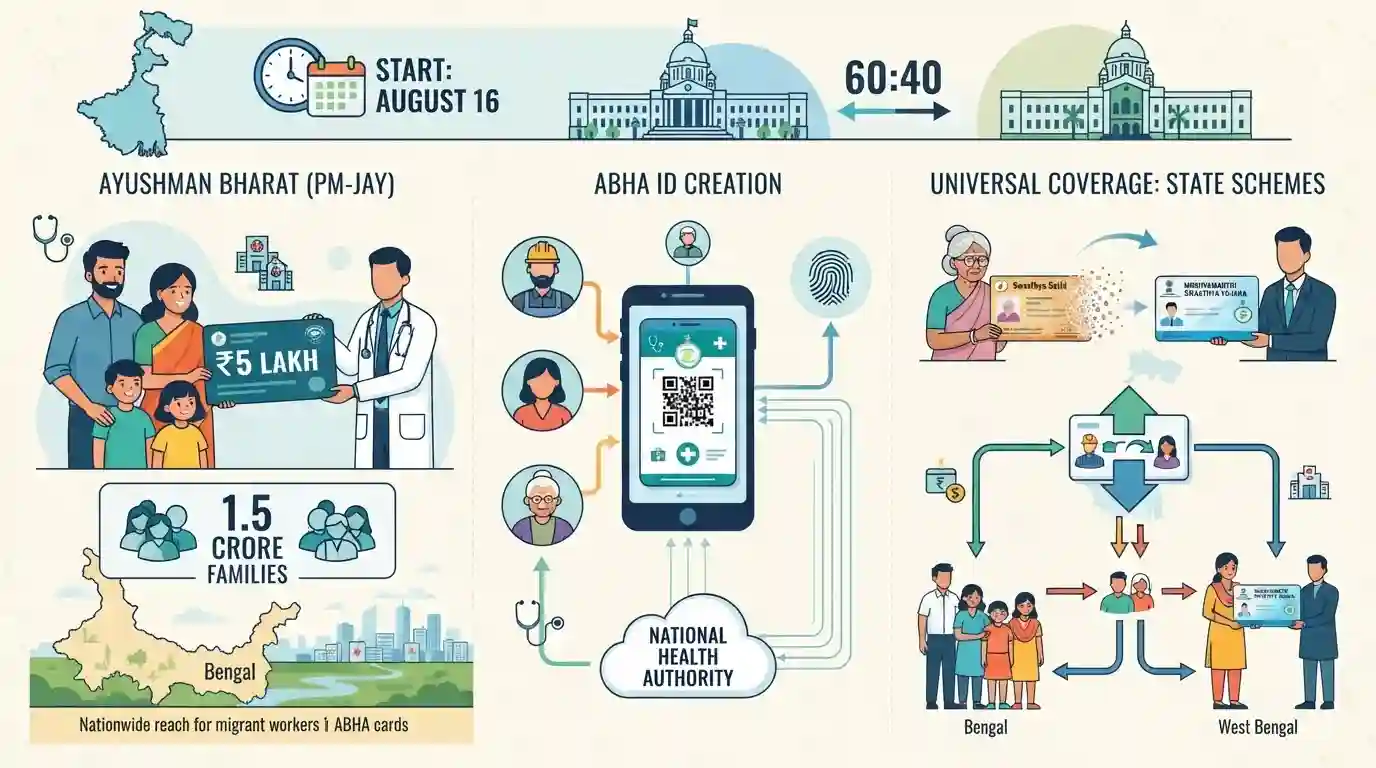
West Bengal Health Minister Sharadwat Mukherjee announced that the state will roll out the Ayushman Bharat scheme (PM-JAY) starting August 16, extending Rs 5 lakh cashless health coverage to 1.5 crore families. The scheme will operate on a 60:40 fund-sharing basis between the Centre and the State. To ensure universal coverage, the state government is introducing the 'Mukhyamantri Swasthya Yojana' for those ineligible for the central scheme, fully funded by the state. The existing state health insurance scheme, Swasthya Sathi, will be phased out after a short concurrent run. Beneficiaries must create an Ayushman Bharat Health Account (ABHA) ID to avail of services, which can also be utilized by migrant workers nationwide.
Key Points
- West Bengal will officially launch the Ayushman Bharat scheme on August 16, covering 1.5 crore families (around 6 crore beneficiaries).
- The state will also launch the 'Mukhyamantri Swasthya Yojana' to cover citizens who do not meet the central eligibility criteria for PM-JAY.
- The existing 'Swasthya Sathi' scheme will be phased out after operating concurrently with Ayushman Bharat for a short transition period.
- The Ayushman Bharat scheme in the state will operate on a 60:40 funding ratio between the Centre and the West Bengal government, providing Rs 5 lakh cashless health coverage per family annually.
- Beneficiaries will require an Ayushman Bharat Health Account (ABHA) ID to access services across 40,000 empanelled hospitals nationwide.
Important Terms
Ayushman Bharat Scheme (PM-JAY)

A centrally sponsored health assurance scheme providing Rs 5 lakh cashless coverage per family per year for secondary and tertiary care hospitalization. West Bengal recently adopted it on a 60:40 Centre-State funding basis.
UPSC context
Important for GS Paper 2 (Health, Welfare Schemes) focusing on universal health coverage, cooperative federalism, and social justice.
Mukhyamantri Swasthya Yojana
A newly introduced, fully state-funded health scheme in West Bengal providing Rs 5 lakh annual cashless coverage to residents who do not meet the eligibility criteria for the central Ayushman Bharat scheme.
UPSC context
Relevant for GS Paper 2 (State Policies) to understand how states implement parallel safety nets to ensure universal health coverage.
Swasthya Sathi Scheme
West Bengal’s existing state-sponsored universal health insurance scheme launched in 2016, providing Rs 5 lakh coverage. It is being phased out as the state transitions to the Ayushman Bharat and Mukhyamantri Swasthya Yojana frameworks.
UPSC context
Covers GS Paper 2 (Governance); illustrates policy shifts in state-center relations and the consolidation of regional healthcare frameworks into national ones.
Ayushman Bharat Health Account (ABHA)
A 14-digit unique health identifier under the Ayushman Bharat Digital Mission (ABDM). It allows citizens to securely store, access, and share their medical records digitally across healthcare providers with their consent.
UPSC context
Crucial for GS Paper 2 and 3 (Digital Health). Tests knowledge on health interoperability, digital public infrastructure, and patient data privacy.
Prelims Trap
"Ayushman Bharat PM-JAY is a Central Sector Scheme providing 100% central funding for universal health coverage."
PM-JAY is a Centrally Sponsored Scheme (60:40 or 90:10 ratio), not a Central Sector Scheme (which would be 100% funded by the Union).
Static Concepts Connected
What differentiates a Centrally Sponsored Scheme (CSS) from a Central Sector Scheme?
- Funding Pattern: CSS is jointly funded by the Centre and States (e.g., 60:40 or 90:10), whereas Central Sector Schemes are 100% funded by the Union government.
- Implementation: CSS is typically implemented by State Governments, while Central Sector Schemes are directly implemented by Central ministries.
What are the core components of the Ayushman Bharat Health Account (ABHA)?
- Unique Identifier: A 14-digit random number to uniquely identify individuals and authenticate them across healthcare providers nationwide.
- Data Portability: Enables seamless, consent-based sharing of digital health records (prescriptions, lab reports), which is crucial for migrant workers' care portability.
Cross-Topic Patterns
Cooperative federalism and welfare scheme politics
West Bengal’s parallel rollout of a state-funded scheme to cover the non-eligible population highlights how states negotiate political capital to universalize targeted Central welfare programs.
ABHA as India's Digital Public Infrastructure (DPI)
Like UPI, the Ayushman Bharat Digital Mission (ABDM) integrates state health registries into a national interoperable grid, cementing health data portability as a core DPI pillar.

Expect a 2026 Prelims statement comparing ABHA with Aadhaar, or a Mains question on cooperative federalism in health governance.
Linked PYQs · 2
Linked PYQs · 2
- 2021WBCS_PRELIMSGS1
Family Income Ceiling for Kanyashree Scheme is not applicable if
- 2021WBCS_PRELIMSGS1
How many new Government Medical Colleges have become functional in West Bengal during the last ten years?
