Maa Canteens upgrade for food security and urban welfare
Source:the-statesman ↗
Why It Matters
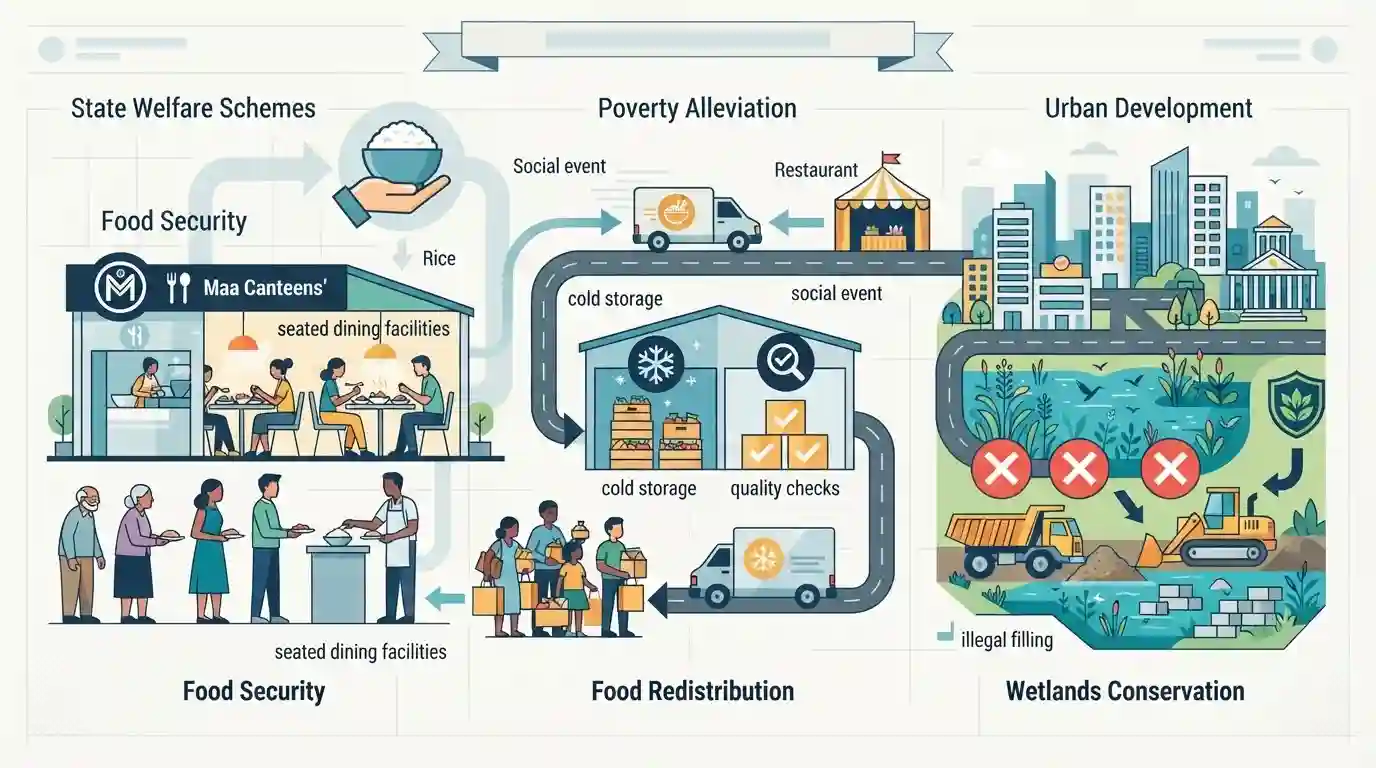
Demonstrates state-level policy interventions for food security and welfare (Maa Canteens) while simultaneously highlighting environmental governance challenges, such as the protection of crucial wetlands in urban areas.
Summary
West Bengal Urban Development and Municipal Affairs Minister Agnimitra Paul announced new initiatives for the state's 'Maa Canteens', which provide subsidized meals to the poor. The canteens will soon offer seated dining facilities. The state will also launch a food redistribution programme to collect surplus food from restaurants and social events, storing it in cold storage and thoroughly checking its quality before distributing it to impoverished individuals. During the discussion, concerns regarding the illegal filling of wetlands were also highlighted.
Key Points
- The West Bengal government will upgrade its 'Maa Canteens' to provide seated dining facilities without increasing meal prices.
- A new surplus food redistribution programme will collect leftover food from restaurants, hotels, and social events.
- Collected food will be stored in cold storage overnight and inspected by municipal food safety officers before being distributed to people living below the poverty line.
- Concerns were raised over the illegal filling of wetlands with construction debris, prompting calls for strict governmental action.
Important Terms
Maa Canteens (Maa Ahar Scheme)

A West Bengal welfare scheme providing subsidized cooked meals at ₹5 to the urban poor. Recently upgraded to offer seated dining and expanded menus, it relies on self-help groups for daily operations.
UPSC context
GS Paper 2 (Welfare Schemes for Vulnerable Sections). Illustrates state-level models for urban food security and poverty alleviation.
Food Recovery Initiative
A municipal program in West Bengal that collects surplus food from restaurants and social events. The food is preserved in cold chains, tested by safety officers, and redistributed to impoverished individuals to prevent wastage.
UPSC context
GS Paper 2 & 3 (Food Security, Waste Management). Relevant for innovative governance strategies addressing hunger and urban food waste.
East Kolkata Wetlands
A designated Ramsar site in West Bengal known for naturally treating Kolkata's sewage. The state government is actively mapping and preventing the illegal filling and encroachment of these vital water bodies.
UPSC context
GS Paper 3 (Environment & Conservation). Extremely important for Prelims and Mains regarding urban ecology, Ramsar sites, and wetland preservation.
Department of Urban Development and Municipal Affairs
The state government body in West Bengal responsible for civic administration, infrastructural development, and implementing urban welfare schemes like waste management, food recovery, and the Maa Canteens.
UPSC context
GS Paper 2 (Governance & Administration). Relevant for understanding the role of state municipal departments in implementing urban reforms and services.
Prelims Trap
The Right to Food is a standalone, explicitly drafted Fundamental Right under Part III of the Constitution.
The Right to Food is not explicitly written in the Constitution; the Supreme Court read it into Article 21 (Right to Life) in the landmark PUCL vs Union of India case.
Static Concepts Connected
What is the FSSAI's regulatory framework for surplus food redistribution?
- Statutory backing: Governed by FSSAI's Recovery and Distribution of Surplus Food Regulations, 2019.
- IFSA network: A formalized network under FSSAI connecting NGOs, businesses, and food recovery agencies to prevent waste.
- Safety compliance: Requires donors and aggregators to comply with strict hygiene benchmarks and submit to inspections.
What ecological roles do the East Kolkata Wetlands (EKW) play?
- Natural purification: Utilizes a unique, low-cost system where solar-powered algae ponds and fish naturally purify municipal wastewater.
- Ramsar status: Designated as a Ramsar Site of international importance in 2002 but faces severe real estate threats.
- Economic system: Sustains local livelihoods through extensive aquaculture (bheris) and vegetable cultivation fed by treated water.
Cross-Topic Patterns
Wetland conservation vs urban expansion
Real estate encroachment on Ramsar sites like the East Kolkata Wetlands highlights the friction between rapid urban expansion and municipal environmental compliance.
State welfare canteens vs NFSA mandates
Localized community kitchens bridge crucial gaps in urban cooked-meal delivery where grain-centric national programs like the National Food Security Act (NFSA) fall short.

FSSAI surplus food regulations and judicial reading of Right to Food under Art 21 likely to feature in a 2026 GS-II/Prelims question.
Linked PYQs · 3
Linked PYQs · 3
- 2024WBCS_PRELIMSGS1
East Kolkata Wetland has been declared as
- 2019WBCS_PRELIMSGS1
East Kolkata wetlands have been declared as
- 2021WBCS_PRELIMSGS1
How many new Government Medical Colleges have become functional in West Bengal during the last ten years?
