PM Poshan scheme school LPG adoption and clean energy transition
Source:theprint ↗
Why It Matters
Demonstrates state-level execution and supplementation of centrally sponsored schemes (PM POSHAN) while aligning with broader governance goals like clean cooking energy (LPG) and improving social security for scheme workers.
Summary
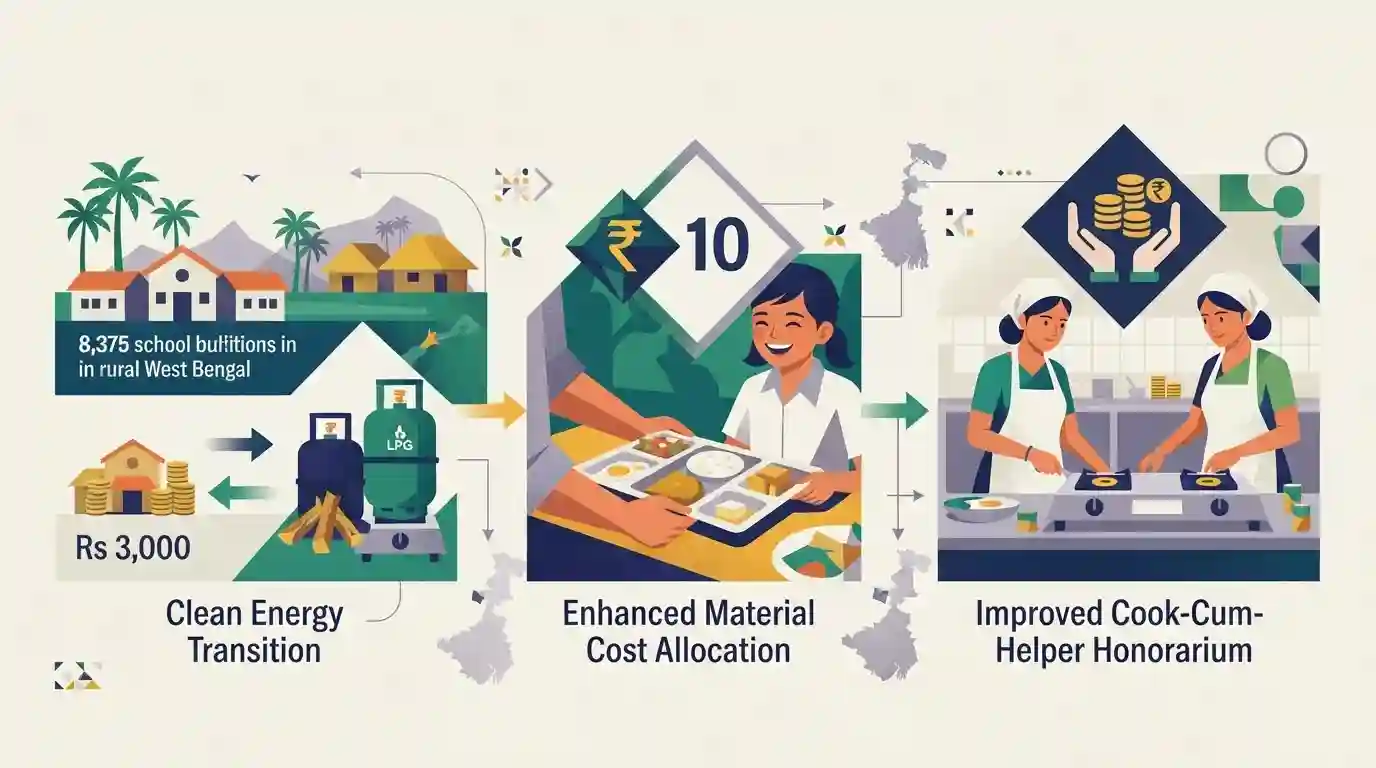
The West Bengal government has allocated Rs 3,000 each to 8,375 schools to switch from firewood to LPG for cooking under the PM POSHAN (formerly Mid-Day Meal) scheme. The initiative primarily targets districts with a high reliance on traditional fuels, enhancing clean energy access. The state has also independently raised the per-student material cost allocation to Rs 10 and doubled the honorarium for cook-cum-helpers to improve the scheme's execution amid rising costs.
Key Points
- The West Bengal government is providing Rs 3,000 to 8,375 state-run and state-aided schools to establish LPG cooking facilities under the PM POSHAN scheme.
- The move is aimed at replacing firewood, as schools in districts like Bankura, Jhargram, and Paschim Bardhaman showed high dependence on traditional fuel.
- Additionally, the state has increased the material cost per student to Rs 10 per day, up from Rs 6.78, to address inflation.
- The honorarium for cook-cum-helpers under the scheme has also been doubled, funded out of the state's own exchequer.
Important Terms
PM POSHAN

A Centrally Sponsored Scheme under the Ministry of Education providing one hot-cooked meal daily to children in Balvatikas (pre-primary) and Classes I-VIII in government and government-aided schools.
UPSC context
GS Paper II (Welfare Schemes). Tests knowledge of national food security, nutrition governance, and socio-economic interventions for vulnerable children.
Mid-Day Meal Scheme
Launched in 1995 as NP-NSPE and later renamed PM POSHAN, this school meal programme targets student nutritional status, school enrollment, attendance, and social socialization.
UPSC context
GS Paper II (Social Sector/Education/Health). Evaluates understanding of historical social safety nets, institutional hunger mitigation, and rights under the Food Security Act.
Centrally Sponsored Schemes (CSS)
Welfare schemes jointly funded by the Central and State governments (typically 60:40 or 90:10 ratios) but implemented entirely by State administrations on subjects within State or Concurrent lists.
UPSC context
GS Paper II (Polity/Federalism). Examines cooperative federalism, devolution of financial resources, and implementation structures of public policies across states.
Rural Energy Transition
The shift in rural areas from traditional, polluting biomass fuels (like firewood and crop residues) to clean, modern cooking and lighting alternatives such as LPG and solar power.
UPSC context
GS Paper III (Environment & Infrastructure). Tests policies addressing energy poverty, sustainable development, clean energy access, and public health outcomes.
Prelims Trap
PM POSHAN is a Central Sector Scheme where 100% of material costs and cooking honorariums are funded by the Union.
PM POSHAN is a Centrally Sponsored Scheme, not a Central Sector Scheme; non-foodgrain costs are shared (typically 60:40) with states, not fully funded by the Centre.
Static Concepts Connected
What are the core design and funding structures of the PM POSHAN scheme?
- Target coverage: Covers government and government-aided school children from Balvatika (pre-school) up to Class VIII.
- Funding split: Operates as a Centrally Sponsored Scheme with a 60:40 cost-sharing ratio (90:10 for Himalayan/NE states) for non-food components.
- Nutritional norms: Mandates 450 calories and 12g protein for primary, and 700 calories and 20g protein for upper primary students.
What is the chemical composition and environmental utility of LPG over biomass?
- Hydrocarbon composition: Consists primarily of propane and butane, which are easily liquefied under moderate pressure for distribution.
- Safety odorant: Ethyl mercaptan is blended with LPG to impart a distinct odor for safety and leak detection.
- Emission reduction: Combusts cleanly into carbon dioxide and water, eliminating hazardous indoor emissions like PM2.5, black carbon, and carbon monoxide.
Cross-Topic Patterns
Clean energy + Pediatric health transition
Replacing school kitchen firewood with LPG reduces chronic respiratory illness for women helpers and children, directly linking rural clean energy transition to public health targets.
Fiscal federalism & social schemes
States topping up central PM POSHAN allocations from their own exchequer illustrates the regional fiscal adaptations and cooperative federalism dynamics of Centrally Sponsored Schemes.

PM POSHAN's coverage criteria (Balvatika) and the shared fiscal architecture of CSS are high-probability targets for Prelims 2026.
Linked PYQs · 2
Linked PYQs · 2
- 2006WBCS_PRELIMSGS1
Mid-day meal Scheme was launched in
- 2022WBCS_PRELIMSGS1
Which of the following is chiefly present in LPG?
