West Bengal Industrial Policy: Stakeholder Consultation Scheduled
Source:theprint ↗
Why It Matters
The shift from investment-centric to employment-centric incentives represents a crucial strategic change in West Bengal's economic governance, aiming to tackle unemployment while fostering industrialization. This is highly relevant for questions on state economic planning and industrial development.
Summary
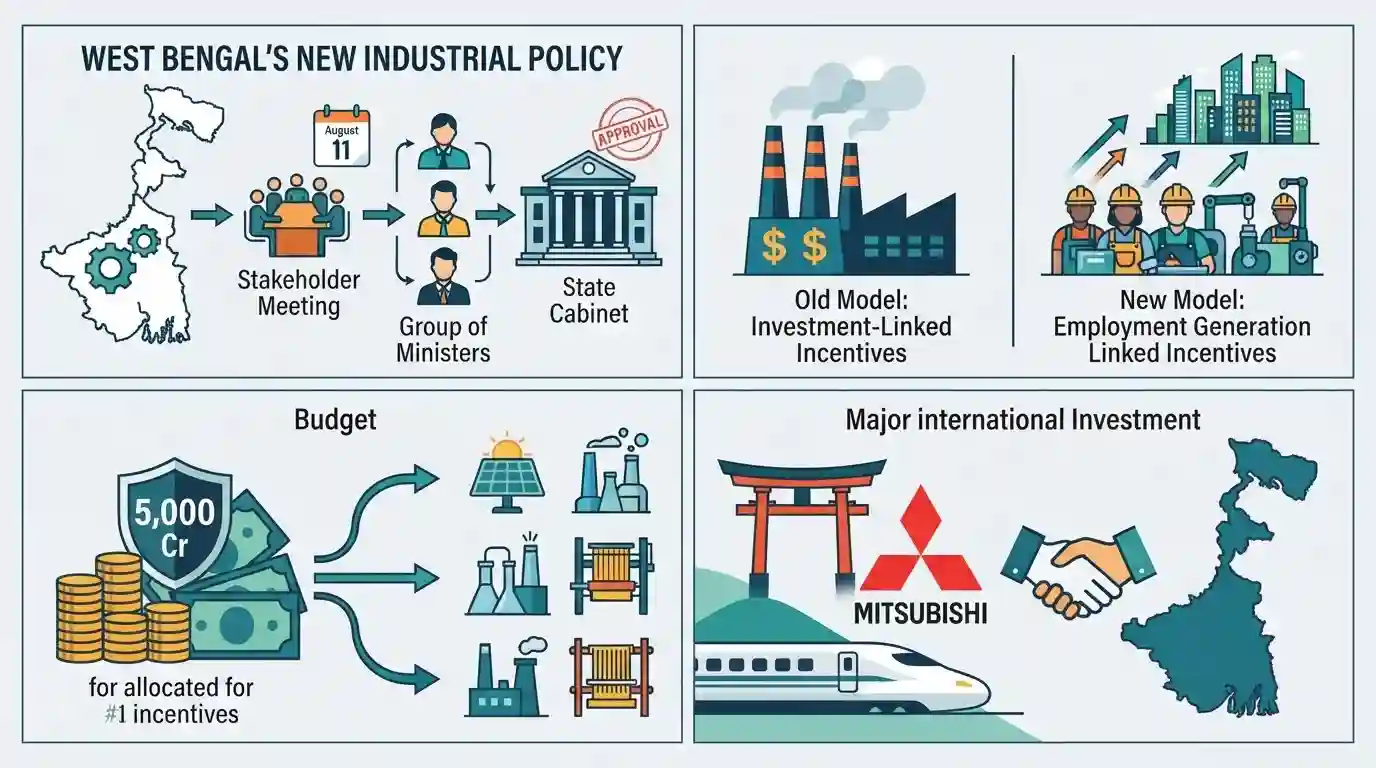
West Bengal is in the final stages of drafting its new industrial policy, which aims to attract large-scale investments and drive economic growth. The state government plans to move away from traditional investment-linked incentives to those linked more closely to employment generation. A stakeholder meeting is scheduled for August 11, after which the policy will seek approval from a Group of Ministers (GoM) and the State Cabinet. Additionally, Rs 5,000 crore has been allocated for industrial incentives in the current fiscal, and a major investment is expected from the Japanese firm Mitsubishi.
Key Points
- The West Bengal government is set to finalise its new industrial policy after a stakeholder consultation on August 11.
- Following the consultation, the policy will be reviewed by a Group of Ministers (GoM) and subsequently placed before the Cabinet.
- The new policy marks a shift from conventional investment-linked incentives to an approach focused more closely on employment generation.
- An allocation of Rs 5,000 crore has been earmarked for industrial incentives in the current fiscal year.
- The state is also anticipating a significant investment from the Japanese engineering major, Mitsubishi.
Important Terms
West Bengal Industrial Policy

A drafted policy framework of the West Bengal government aimed at attracting investments, establishing industrial land banks, and transitioning from capital-linked incentives to job-linked industrial growth.
UPSC context
GS Paper III (Indian Economy), testing state-level industrial policy, investment models, and employment generation strategies.
Group of Ministers (GoM)
An ad hoc or standing committee comprising select ministers appointed by the executive to examine specific, complex policy issues and build consensus before final Cabinet approval.
UPSC context
GS Paper II (Polity and Governance), testing executive decision-making, Cabinet committees, and administrative coordination mechanisms.
State Cabinet
The core executive body of a state government in India, headed by the Chief Minister, which acts as the supreme policy-making and decision-making authority.
UPSC context
GS Paper II (State Legislature and Executive), testing the constitutional provisions, functions, and collective responsibility of the state-level Cabinet.
Hindu Economic Forum
A global platform bringing together Hindu entrepreneurs, business leaders, and professionals to foster economic collaboration, share business expertise, and encourage wealth creation.
UPSC context
GS Paper I & III (Society and Economy), testing the role of non-state actors and community networks in trade and entrepreneurship.
World Hindu Economic Forum
A global non-profit organization established in 2010 that connects business professionals, technocrats, and investors within Hindu society to facilitate capital access, global partnerships, and economic development.
UPSC context
GS Paper III (Indian Economy), testing diaspora networks, international trade cooperation, and community-led developmental initiatives.
World Hindu Congress
A global platform that brings together Hindus from all over the world to share experiences, build connections, and collaborate on areas of economy, education, and human rights.
UPSC context
GS Paper II & III, testing the role of international diaspora and cultural networks in India's soft power and global standing.
Mitsubishi
A prominent Japanese multinational engineering and electronics conglomerate expected to make major industrial investments in West Bengal under the state's new industrial policy.
UPSC context
GS Paper III (Indian Economy), testing foreign direct investment, bilateral economic ties, and industrial development.
Prelims Trap
Industrial policy and economic planning are exclusively State List subjects under the Seventh Schedule of the Indian Constitution.
While 'Industries' is Entry 24 of the State List (subject to Union control), 'Economic and social planning' falls under Entry 20 of the Concurrent List.
Static Concepts Connected
How do Employment-Linked Incentives (ELI) differ from traditional Investment-Linked Incentives (ILI)?
- Core focus: ILI rewards capital expenditure like machinery and land, whereas ELI directly links fiscal incentives to the volume of formal jobs created.
- Macroeconomic goal: ILI fosters capital-intensive industrial asset creation; ELI actively combats jobless growth by subsidizing payrolls and encouraging labor-intensive sectors.
What is the constitutional and administrative status of a Group of Ministers (GoM)?
- Constitutional standing: GoMs are extra-constitutional, ad-hoc bodies formed under executive Transaction of Business Rules to resolve complex inter-ministerial policy differences.
- Executive role: They lessen the Cabinet's workload by debating technical details, submitting recommendations, or making decisions if specifically empowered.
Cross-Topic Patterns
Competitive federalism and FDI routing
States competing horizontally through customized industrial policies to secure foreign investments (like Mitsubishi) highlights how sub-national diplomacy drives national FDI inflows.
Labor formalization via fiscal policy
By structuring state incentives around employment generation rather than plant size, states align local fiscal policy with central goals of expanding EPFO coverage.

State-level shifts from capital-subsidy to Employment-Linked Incentives (ELI) likely to be tested under Mains GS-3 job-creation strategies.
Linked PYQs · 2
Linked PYQs · 2
- 2022WBCS_PRELIMSGS1
West Bengal Industrial Development Corporation Ltd. (WBIDC) was established in
- 2023WBCS_PRELIMSGS1
Socio-economic planning is a part of
