West Bengal Expedites CAA Hearings and Citizenship Certificates
Source:rediff ↗
Why It Matters
The article highlights the practical execution of the Citizenship Amendment Act (CAA) at the state level and introduces a state-specific law containing preventive detention measures, which directly relates to Constitutional provisions under Part II (Citizenship) and Part III (Article 22 - Protection against arrest and detention).
Summary
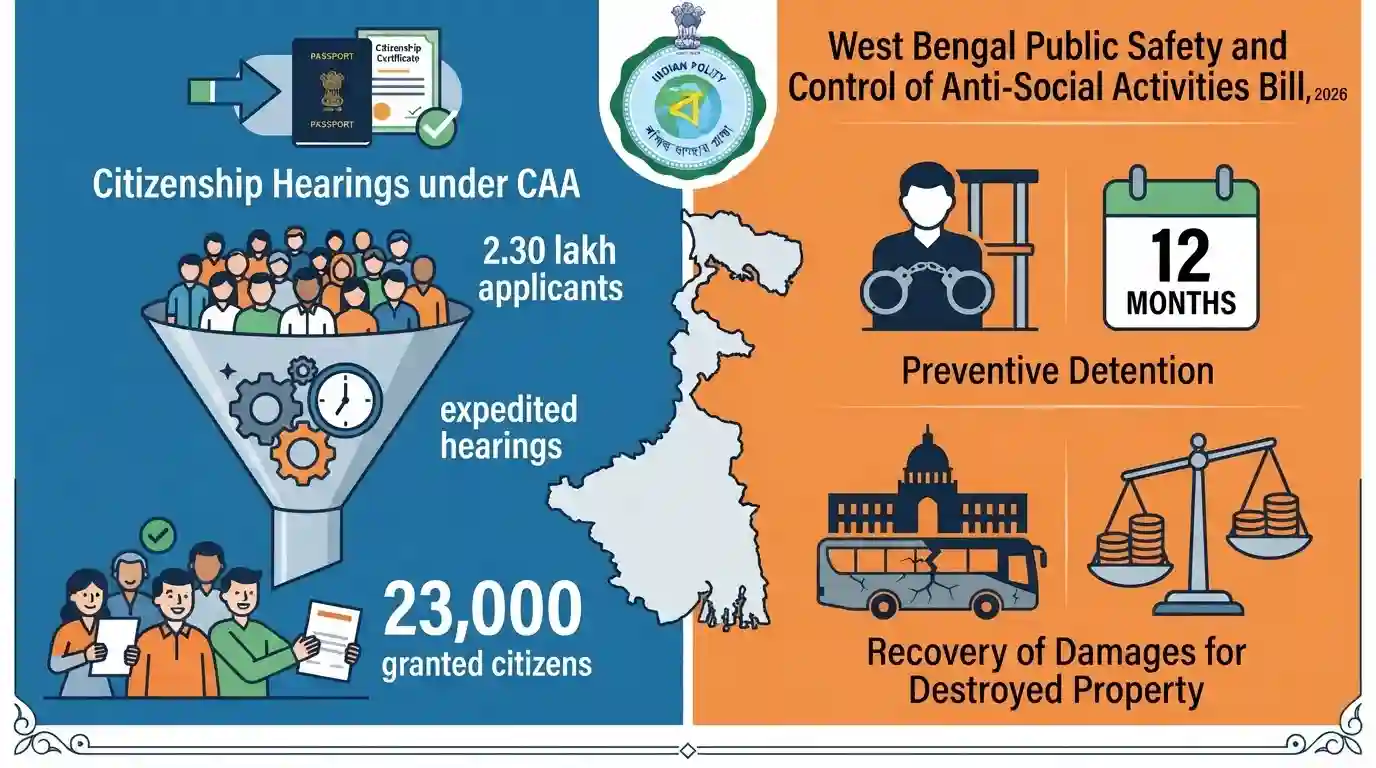
West Bengal has expedited citizenship hearings under the Citizenship Amendment Act (CAA), resulting in 23,000 applicants receiving Indian citizenship out of 2.30 lakh applications. Additionally, the state has implemented provisions of the newly passed West Bengal Public Safety and Control of Anti-Social Activities Bill, 2026, which empowers authorities to impose preventive detention for up to 12 months on individuals deemed a threat to public safety and provides a framework for recovering damages for destroyed government property.
Key Points
- West Bengal has fast-tracked hearings under the Citizenship Amendment Act (CAA), with 23,000 applicants out of 2.30 lakh already granted citizenship certificates.
- The CAA grants expedited Indian citizenship to persecuted minorities (Hindus, Sikhs, Buddhists, Jains, Parsis, Christians) from Pakistan, Bangladesh, and Afghanistan who entered India before December 31, 2014.
- The state assembly recently passed the West Bengal Public Safety and Control of Anti-Social Activities Bill, 2026, aimed at curbing anti-social elements and ensuring public order.
- This new legislation includes stringent provisions for preventive detention (up to 12 months) and enables the recovery of damages from those destroying government property.
Important Terms
Citizenship Amendment Act (CAA)

A central law fast-tracking Indian citizenship for undocumented religious minorities (Hindus, Sikhs, Buddhists, Jains, Parsis, Christians) fleeing persecution in Pakistan, Bangladesh, and Afghanistan who entered India before December 31, 2014.
UPSC context
Crucial for Indian Polity, testing constitutional citizenship provisions (Part II), federal implementation dynamics, and fundamental rights debates.
West Bengal Public Safety and Control of Anti-Social Activities Bill, 2026
A state bill empowering authorities to place individuals deemed threats to public order in preventive detention for up to 12 months without trial, targeting organized crime and anti-social activities.
UPSC context
Highly relevant for State Legislation and Indian Polity, testing knowledge of Article 22, civil liberties, and state executive powers.
West Bengal Maintenance of Public Order (Amendment) Bill, 2026
A state legislative amendment that permits the recovery of compensation and confiscation of property from individuals held liable for damaging public or private property during violent protests or riots.
UPSC context
Tests topics on state law and order administration, right to protest, and deterrence of public property destruction in GS Paper II.
Preventive Detention
The practice of incarcerating individuals without a formal trial based on executive apprehension that they might commit future offenses or threaten national security and public order.
UPSC context
A vital concept in Indian Polity evaluating Fundamental Rights (Article 22), advisory board safeguards, and executive vs. judicial powers.
Prelims Trap
State governments have the independent statutory power to grant citizenship under the CAA.
Citizenship is exclusively a Union List subject. District Magistrates grant citizenship only as delegated authorities under the MHA's Central Rules, not via independent state-level legislative or executive powers.
Static Concepts Connected
How is Indian citizenship acquired under the Citizenship Act, 1955?
- Five Statutory Methods: Citizenship can be acquired through five pathways: Birth (Jus Soli), Descent (Jus Sanguinis), Registration, Naturalisation, and Incorporation of Territory.
- CAA Exception: CAA amends the naturalisation process, reducing the mandatory residency requirement from 11 years to 5 years for specified persecuted religious minorities from three neighbouring countries.
What are the constitutional limits on Preventive Detention?
- Article 22(4) Limit: Under Article 22(4), standard preventive detention cannot exceed three months without an Advisory Board (consisting of High Court judges or equivalent) reporting sufficient cause.
- Legislative Competence: Both Parliament and State Legislatures have concurrent powers to enact preventive detention laws for reasons connected to security, public order, or maintenance of essential supplies.
- State Safeguards: State acts (like the WB 2026 Bill) may mandate a faster review timeline (e.g., three weeks) to comply with constitutional safeguards while allowing up to 12 months of detention.
Cross-Topic Patterns
Delegated Legislation & Art 258
Empowering DMs to grant citizenship showcases Article 258, where the Union entrusts executive functions to state officers, bypassing older multi-agency committees to streamline CAA implementation.
Public Order & State List
The new West Bengal safety bill falls strictly under 'Public Order' (State List, Entry 1), echoing recent laws in UP and Haryana regarding the recovery of damages for destroyed public property.

Expect a multi-statement question testing Art 22(4) Advisory Board timelines against state detention acts and CAA naturalisation criteria.
Linked PYQs · 4
Linked PYQs · 4
- 2023WBCS_PRELIMSGS1
Which neighboring country of India has passed its first Citizenship Amendment Bill?
- 2021WBCS_PRELIMSGS1
In the Constitution of India, ‘Protection of Life and Personal Liberty’ is guaranteed under Article No.
- 2020WBCS_PRELIMSGS1
'Indian Constitution' is adopted by the Constituent Assembly on
- 2018WBCS_PRELIMSGS1
The Constitution of India was adopted on
