West Bengal Policy Reforms to Bring Sand Ghats Under Legal Framework
Source:millenniumpost ↗
Why It Matters
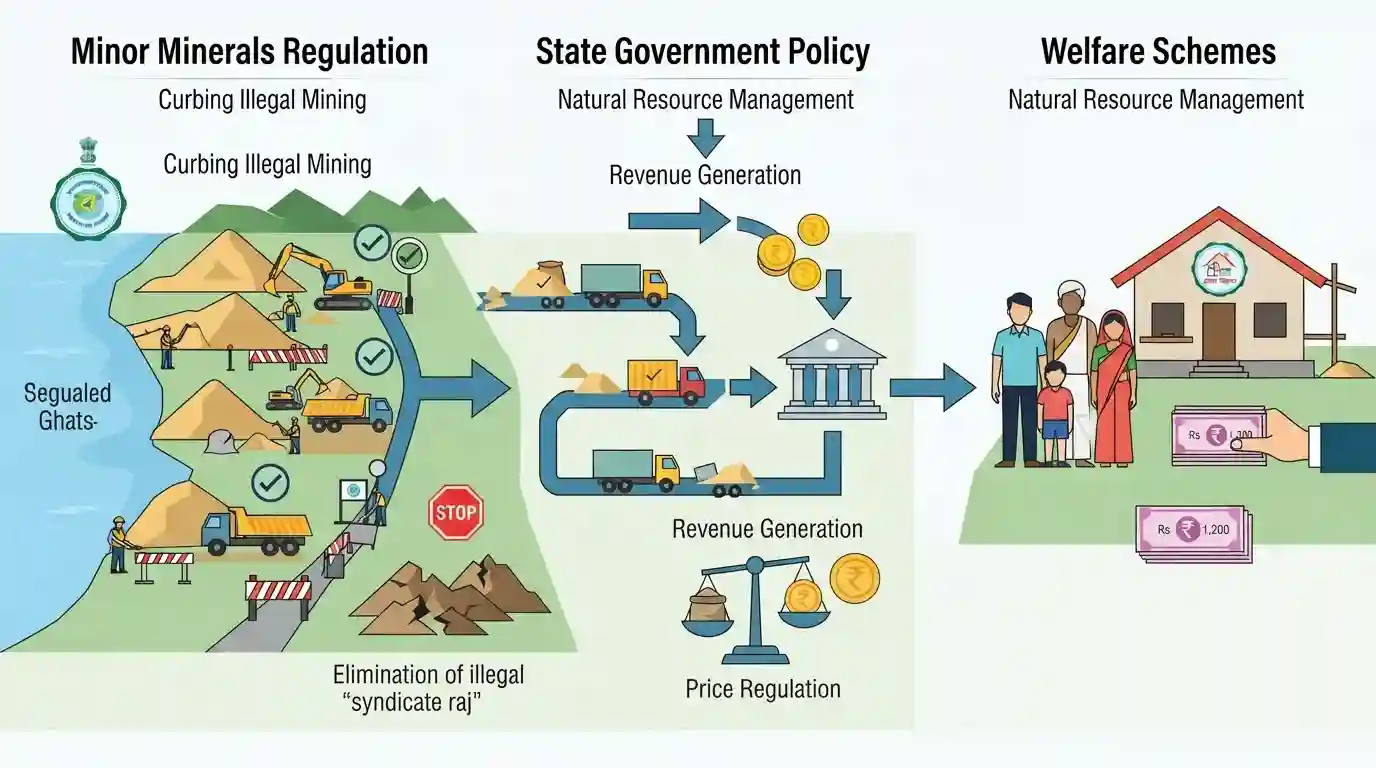
The regulation of minor minerals like sand is a critical state subject that impacts both environmental sustainability and government revenue. Curbing illegal mining tackles organized crime (syndicates) while linking sand provision to housing schemes demonstrates a holistic approach to governance and welfare delivery.
Summary
West Bengal is set to bring all sand ghats in the state under a stringent legal framework to curb illegal sand mining, eliminate syndicate raj, and regulate sand prices. The state government aims to boost its revenue from minor minerals while ensuring affordability. Furthermore, beneficiaries constructing houses under the Awas Yojana will be provided Rs 1,200 as financial assistance to procure sand, linking natural resource regulation with social welfare.
Key Points
- The West Bengal government announced a policy shift to bring all sand ghats under a legal framework to eliminate illegal sand mining and extortion by syndicates.
- The regulation is expected to lower the market price of sand and simultaneously boost state revenue from minor minerals.
- As part of the initiative, beneficiaries of the Awas Yojana will receive financial assistance of Rs 1,200 specifically earmarked for the cost of sand.
Important Terms
Minor Minerals

Minerals like ordinary sand and gravel, classified under the MMDR Act, 1957. State governments possess exclusive administrative and regulatory control over their extraction, policy framing, and revenue collection.
UPSC context
Tested in WBCS Paper 3 (Geography) and Paper 5 (Economy) concerning state vs. central jurisdiction over natural resources.
West Bengal Mineral Development and Trading Corporation (WBMDTC)
A state-owned enterprise overseeing the exploration, extraction, and management of West Bengal's mineral resources. It manages centralized online auctions for sand mining to ensure transparency and curb illegal operations.
UPSC context
Essential for WBCS Paper 3 (Geography of West Bengal) and Paper 5 regarding state-level institutional resource management.
Awas Yojana
Government welfare programs (e.g., PM Awas Yojana) providing housing assistance to the poor. West Bengal is aiding beneficiaries by providing Rs 1,200 to procure regulated sand for their housing construction.
UPSC context
Crucial for WBCS Paper 5 (Economy - Welfare Schemes) to test knowledge of rural development and state-subsidized resource allocation.
Sand Ghats
Designated riverbank extraction sites for sand. West Bengal is bringing all such sites under a stringent legal framework to eradicate local mafia control, stop extortion, and regulate construction material prices.
UPSC context
Relevant for WBCS Paper 3 (Geography of WB) and Paper 6 (Governance), testing awareness of environmental regulation and anti-corruption measures.
Syndicate Raj
A colloquial term for illegal cartels and local mafias that historically monopolized the supply and pricing of construction materials like sand in West Bengal through unauthorized extortion networks.
UPSC context
Relevant for WBCS Paper 6 (Polity and Governance). Highlights law and order, administrative hurdles, and state governance reforms.
Prelims Trap
"Sand is a major mineral, and its excavation rules are exclusively framed by the Union Government."
Under the MMDR Act 1957, sand is classified as a 'minor mineral'. State Governments, not the Centre, hold the exclusive authority to frame rules for its excavation and revenue collection.
Static Concepts Connected
How are minor minerals defined and regulated under Indian Law?
- Legal Classification: Sand, clay, and building stones are legally classified as 'minor minerals' under Section 3(e) of the MMDR Act, 1957.
- State Authority: Under Section 15 of the MMDR Act, State Governments have exclusive authority to frame rules for concessions, excavation, and revenue collection of minor minerals.
- Union Government Role: While States regulate the mining process, the Union Government retains the power to notify and declare which minerals are categorized as 'minor'.
What is the role of WBMDTCL in West Bengal's mining sector?
- Nodal Agency: The West Bengal Mineral Development and Trading Corporation Limited acts as the state's designated nodal agency overseeing the legal excavation, transportation, and sale of sand.
- Digital Monitoring: It implements the state's Sand Mining Policy using centralized e-challans, 24/7 CCTV surveillance, and GPS tracking to ensure transparent revenue collection.
Cross-Topic Patterns
Resource regulation subsidizing rural welfare
Tying regulated sand prices to the Awas Yojana demonstrates a cross-sectoral policy where state resource management and revenue stabilization directly subsidize rural housing schemes.
E-governance targeting ecological crimes
The mandate for RFID, GPS, and centralized e-challans reflects a broader governance pattern: leveraging e-governance tools to curb ecological damage and organized illegal mining syndicates.

Expect a multi-statement question distinguishing State vs Centre powers over minor minerals, paired with the Awas Yojana sand subsidy.
Linked PYQs · 2
Linked PYQs · 2
- 2013WBCS_PRELIMSGS1
Panchayats in West Bengal are authorised to collect
- 2020WBCS_PRELIMSGS1
Arundhoti Swarna Yojana by Assam Govt. starting from 1st January 2020 aims to
