West Bengal Panchayat Law Amendment and Signatory Authority
Source:the-statesman ↗
কেন এটি গুরুত্বপূর্ণ
This development highlights the ongoing tensions between the goals of the 73rd Constitutional Amendment (democratic decentralisation) and practical administrative challenges, demonstrating how state legislatures exercise control over local body governance.
সারসংক্ষেপ
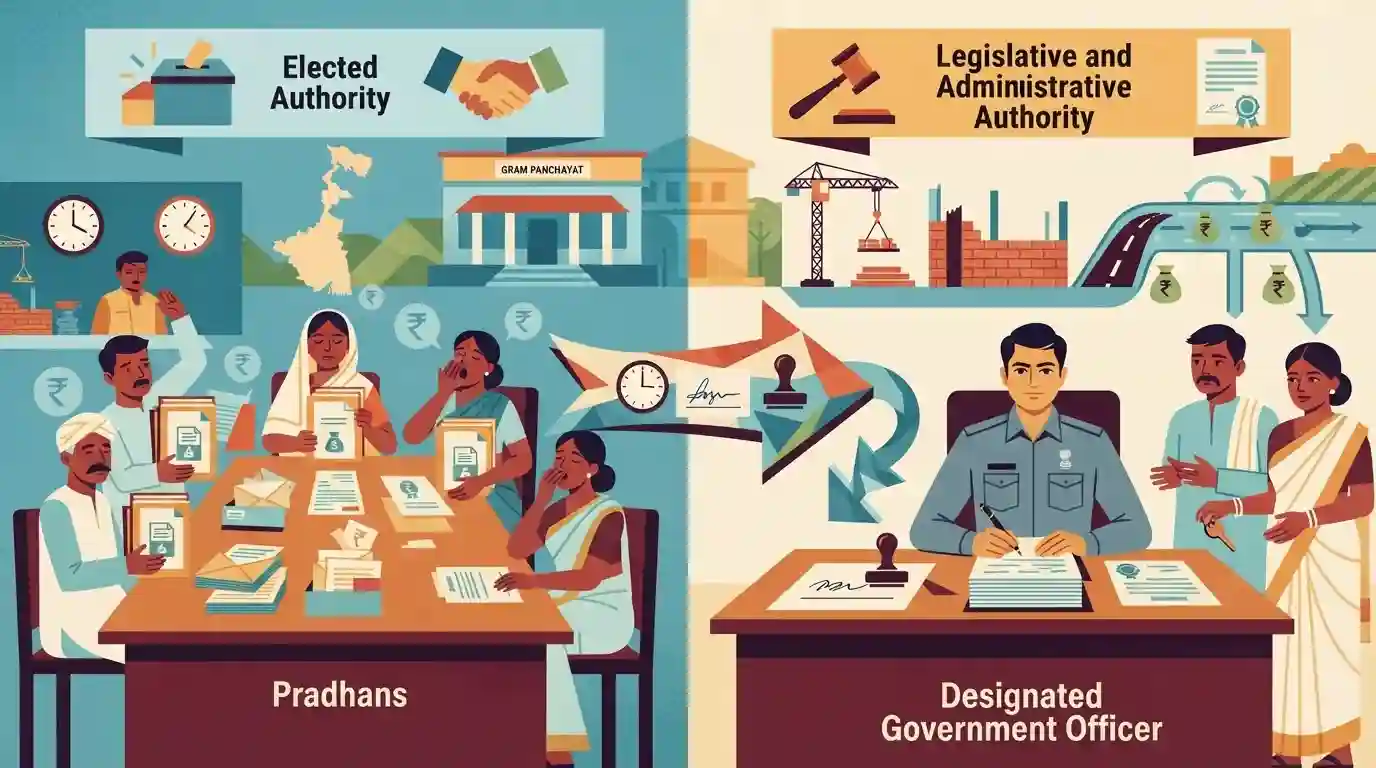
The West Bengal government announced plans to amend the state's Panchayat law, transferring signatory authority for financial and official files from elected panchayat pradhans to designated government officers due to widespread absenteeism among elected heads stalling rural projects.
মূল বিষয়
- The West Bengal government plans to amend the state's Panchayat law to shift signatory authority for financial and official documents from elected panchayat heads (pradhans) to government officers.
- Panchayat and Rural Development Minister Dilip Ghosh stated the amendment was necessary because the prolonged absence of nearly 2,000 elected pradhans had halted rural development projects and wage payments.
- The amendment reflects a shift in rural governance, moving certain executive and financial powers from democratically elected local representatives to state bureaucracy.
- The state government also plans to fill approximately 11,000 vacant posts through the West Bengal Public Service Commission (WBPSC) to improve administrative efficiency.
গুরুত্বপূর্ণ শব্দ
West Bengal Public Service Commission

The constitutional body managing state civil service recruitment. It has been tasked with filling 11,000 vacant Panchayat Department posts to ensure transparent and merit-based administrative hiring.
UPSC context
Relevant to GS Paper 2 (Constitutional Bodies), testing the role of State Public Service Commissions in building institutional capacity.
Bharatiya Janata Party
A major Indian political party. In this context, it leads the incumbent West Bengal government, which is amending panchayat laws to transfer financial powers from elected heads to appointed officials.
UPSC context
Connects to GS Paper 2 (State Legislature Powers), testing the scope of state intervention in local self-governance.
Trinamool Congress
A prominent Indian political party. Following the 2026 state assembly elections, it serves in opposition at the state level but continues to control the majority of West Bengal's gram panchayats.
UPSC context
Pertinent to GS Paper 2 (Polity), highlighting how political friction between state and local governments impacts decentralized administration.
প্রিলিমস ফাঁদ
The 73rd Amendment mandates uniform devolution of financial and executive powers to PRIs.
Article 243G makes the devolution of powers to Panchayats a voluntary provision, leaving the extent of autonomy entirely to the discretion of the State Legislature.
সংযুক্ত স্থির ধারণা
How does the Constitution handle the devolution of powers to Panchayats?
- Article 243G: Empowers the State Legislature to endow Panchayats with powers and authority necessary to function as institutions of self-government.
- Voluntary Provision: The devolution of executive and financial powers is not automatic; it remains entirely at the discretion of the state government.
- Eleventh Schedule: Contains 29 functional items over which state legislatures may choose to devolve powers and responsibilities to PRIs.
What are the provisions for appointment and removal of SPSC members?
- Appointment: The Chairman and members of a State Public Service Commission (like WBPSC) are appointed by the Governor of the state.
- Removal by President: Despite being appointed by the Governor, they can only be removed from office by the President of India.
- Grounds for Removal: Can be removed for misbehaviour (after a Supreme Court inquiry), insolvency, or engaging in paid employment outside their office duties.
আন্তঃবিষয় প্যাটার্ন
Bureaucratisation of PRIs
Replacing elected pradhans with officials connects to the broader governance debate where parallel bodies and bureaucratic overreach undermine genuine democratic decentralisation.
Article 243G vs State Control
Demonstrates how states retain structural control over PRIs. This mirrors urban local bodies under the 74th Amendment, where municipal councils face similar state-level reluctance to devolve financial autonomy.

Mains 2026 could feature a 15-marker on how uneven devolution under Article 243G has led to the bureaucratisation of PRIs across states.
সংযুক্ত PYQ · 4
সংযুক্ত PYQ · 4
- 2019WBCS_PRELIMSGS1
The fundamental object of 'Panchayati Raj' system is to ensure which among the following?
- 2022WBCS_PRELIMSGS1
Which of the following constitutional amendments gives a constitutional status to the Panchayati Raj institutions?
- 2018WBCS_PRELIMSGS1
Which Amendment of the constitution provided constitutional status to the Panchayats?
- 2022WBCS_PRELIMSGS1
Members of the State Public Service Commission are appointed by
