West Bengal Issues Deadline for Tea Gardens to Clear Dues
Source:thestatesman ↗
Why It Matters
Crucial for aspirants focusing on West Bengal's regional economy, agriculture, plantation industries, and labour welfare policies.
Summary
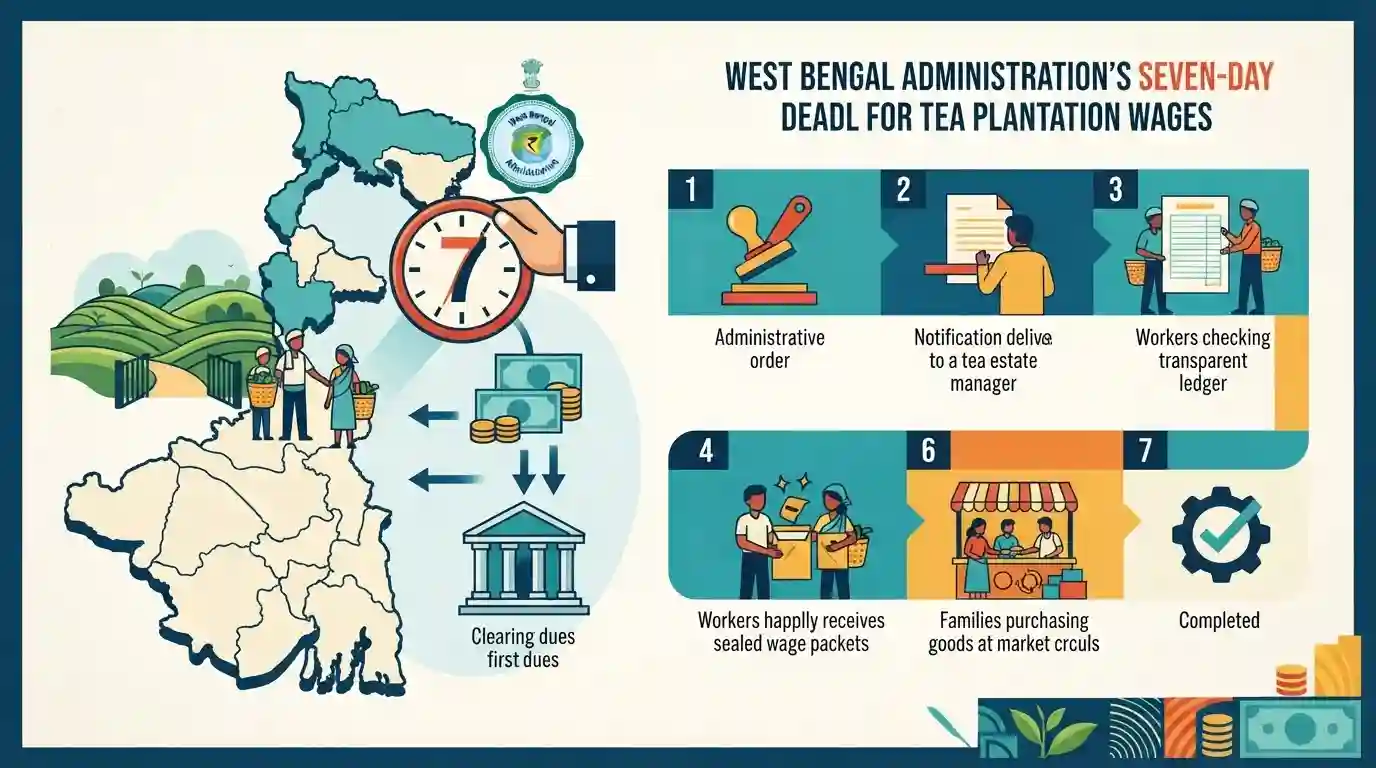
The West Bengal administration has imposed a strict seven-day deadline on tea gardens across the region to clear pending dues and wage arrears of tea plantation workers, addressing chronic labour and welfare concerns in North Bengal's plantation economy.
Key Points
- The West Bengal government has issued a seven-day deadline for tea gardens to clear pending dues and wages of workers.
- The move targets plantation owners to ensure compliance with statutory obligations and worker welfare in North Bengal's prominent tea industry.
- Issues concerning tea garden workers' provident fund, gratuity, and regular wage payments frequently trigger labour unrest in the region.
Important Terms
North Bengal Tea Plantation Economy

The regional economy of North Bengal centered around vast tea plantations in districts like Darjeeling, Jalpaiguri, and Alipurduar, employing lakhs of workers and serving as a critical pillar of West Bengal's rural livelihoods.
UPSC context
WBCS Paper IV (Economy of West Bengal and Regional Development): Tests awareness of agrarian challenges, agro-industries, and regional economic disparities.
FAWLI Scheme
A state-level welfare initiative providing monthly financial assistance to workers rendered unemployed due to the closure, lock-out, or suspension of industrial establishments like tea gardens.
UPSC context
WBCS Paper IV (Labour Welfare and Social Security Schemes): Important for questions on state social safety nets for distressed plantation workers.
Multi-Departmental Task Force
A joint institutional mechanism comprising state departments and central bodies like Tea Board India tasked with reviewing closed tea estates and resolving pending wage, gratuity, and provident fund liabilities.
UPSC context
WBCS Paper III/IV (Governance and Administration): Evaluates administrative coordination in executing policy directives and resolving labor disputes.
North Bengal Region
The submontane region of West Bengal encompassing Darjeeling, Kalimpong, Jalpaiguri, Alipurduar, and Cooch Behar districts, characterized by a unique agro-climatic profile, heavy concentration of tea gardens, and distinctive socio-economic issues.
UPSC context
WBCS Paper III (Geography of West Bengal): Essential for questions on regional geomorphology, plantation agriculture, and regional planning.
Static Concepts Connected
What are the key statutory provisions under the Plantation Labour Act, 1951?
- Statutory Objective: Enacted to provide for the welfare of labour and to regulate the conditions of workers in plantations.
- Welfare Provisions: Employers are legally bound to provide housing, medical facilities, drinking water, and educational facilities.
- Enforcement Authority: Enforced by the State Government through Chief Inspectors of Plantations appointed under the Act.
Cross-Topic Patterns
Plantation Labour Act and Statutory Welfare Obligations
The Plantation Labour Act, 1951 regulates welfare measures, housing, and medical facilities, linking labour welfare directly with industrial licensing and state monitoring.
North Bengal Economy and Regional Political Dynamics
North Bengal's tea economy is deeply intertwined with hill politics, Gorkhaland autonomy movements, and regional economic backwardness debates.

Expect a question on statutory welfare under the Plantation Labour Act, 1951 or issues facing North Bengal's tea plantation economy.
Linked PYQs · 1
Linked PYQs · 1
- 2015WBCS_PRELIMSGS1
West Bengal has international boundaries on
