Supreme Court Intervention in West Bengal Electoral Discrepancies
Source:Indian Express ↗
Why It Matters
The article demonstrates the practical application of Article 142 by the Supreme Court to ensure the integrity of the electoral process. It also highlights the operational challenges faced by the Election Commission and raises critical internal security concerns regarding the misuse of Aadhaar by illegal immigrants for electoral enrollment.
Summary
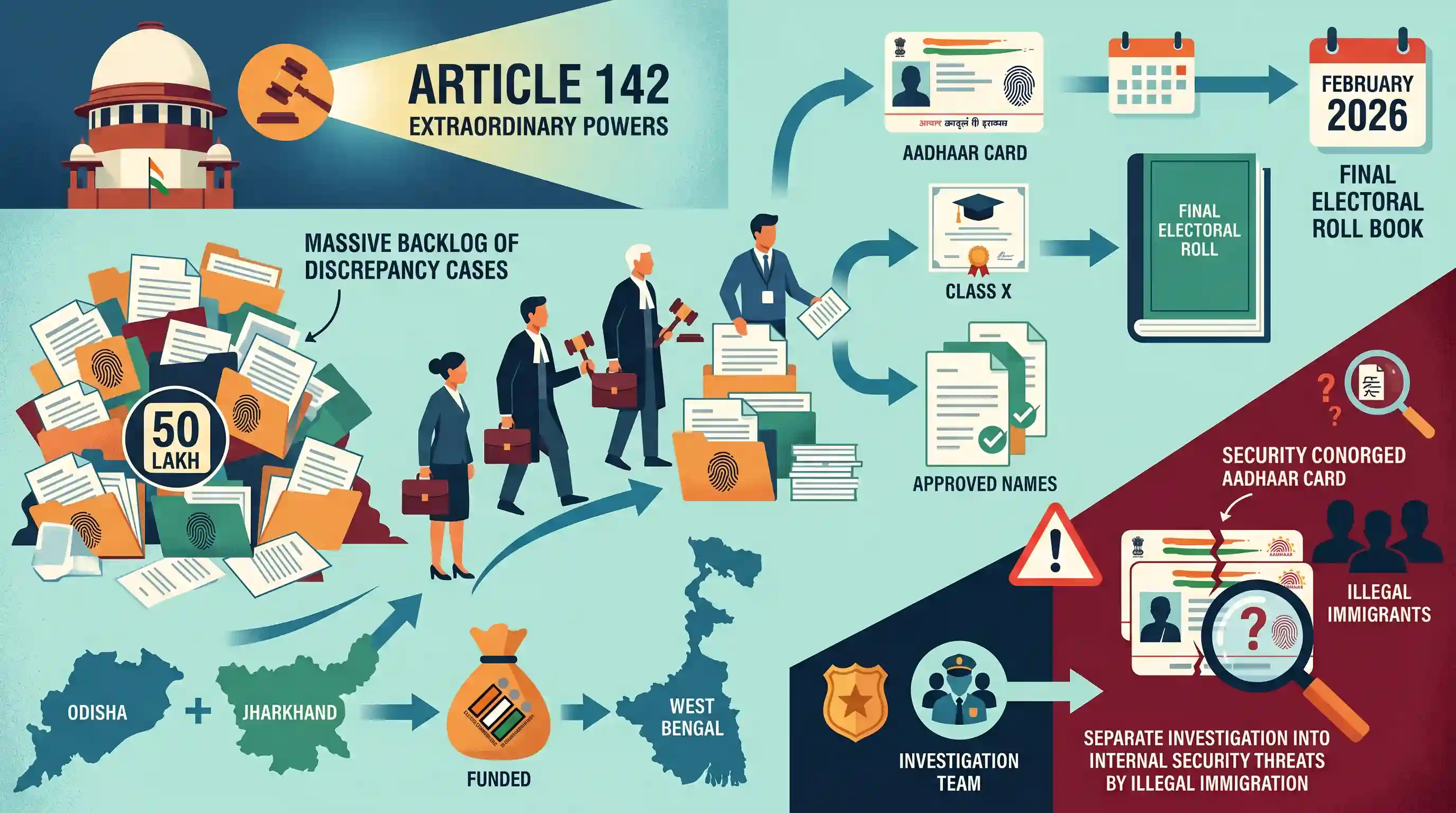
The Supreme Court has invoked its extraordinary powers under Article 142 to allow judicial officers from Odisha and Jharkhand to resolve 50 lakh 'discrepancy' cases in West Bengal's Special Intensive Revision of electoral rolls. Funded by the Election Commission of India (ECI), this move aims to clear a massive backlog in voter verification, integrating approved names into the final electoral roll by February 2026. While permitting the use of Aadhaar and Class X certificates as proof of identity, the Court also flagged serious allegations regarding forged Aadhaar cards being used by illegal immigrants, emphasizing that such internal security threats warrant a separate investigation.
Key Points
- The Supreme Court authorized the deployment of judicial officers from Odisha and Jharkhand to West Bengal to resolve 50 lakh electoral roll discrepancies under the Special Intensive Revision (SIR).
- Invoking extraordinary powers under Article 142, the Court directed that names cleared in supplementary lists will be legally deemed part of the final electoral roll published on February 28, 2026.
- The Election Commission of India (ECI) will fund the deployment of these judicial officers, and acceptable proofs of identity include ECI-notified documents, Aadhaar cards, and Class X certificates.
- The Court acknowledged concerns regarding illegal immigrants using forged Aadhaar cards to enroll as voters, noting that this broader internal security issue requires a separate, deeper probe.
Important Terms
Article 142 of the Constitution

Empowers the Supreme Court to pass any decree or order necessary for doing 'complete justice' in any cause or matter pending before it, granting it plenary powers.
UPSC context
GS-II (Indian Judiciary): Tests understanding of extraordinary judicial powers and the principle of 'complete justice.'
Special Intensive Revision (SIR)
A comprehensive, house-to-house verification and ground-up revision of electoral rolls by the Election Commission to ensure accurate voter lists by removing duplicates and ineligible entries.
UPSC context
GS-II (Electoral Reforms): Relevant for topics on the integrity of the electoral process and the Representation of the People Act.
Election Commission of India (ECI)
The permanent constitutional body established under Article 324 responsible for the superintendence, direction, and control of elections to Parliament and State Legislatures.
UPSC context
GS-II (Constitutional Bodies): A core topic involving the powers and independence of the poll panel.
Representation of the People Act, 1950 (RPA)
The primary legislation providing for the allocation of seats, delimitation of constituencies, and the qualification of voters and preparation of electoral rolls in India.
UPSC context
GS-II (Salient features of RPA): Directly tests statutory provisions governing Indian democracy and elections.
Logical Discrepancy
A category of electoral roll errors such as parent-child age gaps, name mismatches, or impossible birth dates that require formal adjudication to verify voter eligibility.
UPSC context
GS-II (Electoral Administration): Focuses on the technical and administrative challenges of maintaining accurate voter rolls.
Aadhaar
A 12-digit unique identity number issued to residents; used as identity proof in voter rolls, though it is not conclusive proof of Indian citizenship.
UPSC context
GS-II (Governance): Important for debates on digital identity, citizenship, and social security benefits.
Prelims Trap
An Aadhaar card can serve as definitive proof of citizenship for inclusion in the electoral roll.
Section 9 of the Aadhaar Act explicitly states that Aadhaar is only proof of identity, not citizenship or domicile. Non-citizens cannot vote under the Constitution.
Static Concepts Connected
What is the scope of 'Complete Justice' under Article 142?
- Extraordinary Power: Allows the Supreme Court to pass any decree or order necessary for doing complete justice in any cause or matter pending before it.
- Statutory Override: It can override ordinary statutory laws to achieve justice, but cannot be used to violate fundamental rights or basic constitutional provisions.
- Pan-India Enforceability: Orders are enforceable throughout India in a manner prescribed by Parliament or by Presidential order until Parliament enacts a law.
How are electoral rolls regulated under Indian law?
- Constitutional Mandate: Article 324 vests the superintendence, direction, and control of the preparation of electoral rolls in the Election Commission of India.
- Non-discrimination: Article 325 ensures no person is ineligible for inclusion in the electoral roll on grounds only of religion, race, caste, or sex.
- Statutory Framework: The Representation of the People Act, 1950 provides the statutory framework for voter qualifications, disqualifications, and the preparation/revision of electoral rolls.
Cross-Topic Patterns
Electoral Integrity + Border Security
The use of forged Aadhaar cards by illegal immigrants links the ECI's constitutional mandate of fair elections with border security and demographic threats in eastern states.
Article 142 + Executive Functions
The Supreme Court invoking Article 142 to deploy judicial officers for electoral roll revision highlights the fine line between judicial activism and superseding executive/ECI domains.

Expect a 2026 prelims question merging Article 142's limits, ECI's mandate under RPA 1950, and Aadhaar's explicit non-citizenship status.
Linked PYQs · 4
Linked PYQs · 4
- 2017PrelimsGS1
For election to the Lok Sabha, a nomination paper can be filed by
- 2022MainsGS2
Discuss the role of the Election Commission of India in the light of the evolution of the Model Code of Conduct.
- 2014MainsGS2
Two parallel run schemes of the Government, viz. the Adhaar Card and NPR, one as voluntary and the other as compulsory, have led to debates at national levels and also litigations. On merits, discuss whether or not both schemes need run concurrently. Analyse the potential of the schemes to achieve developmental benefits and equitable growth.
- 2023MainsGS2
“Constitutionally guaranteed judicial independence is a prerequisite of democracy.” Comment.
