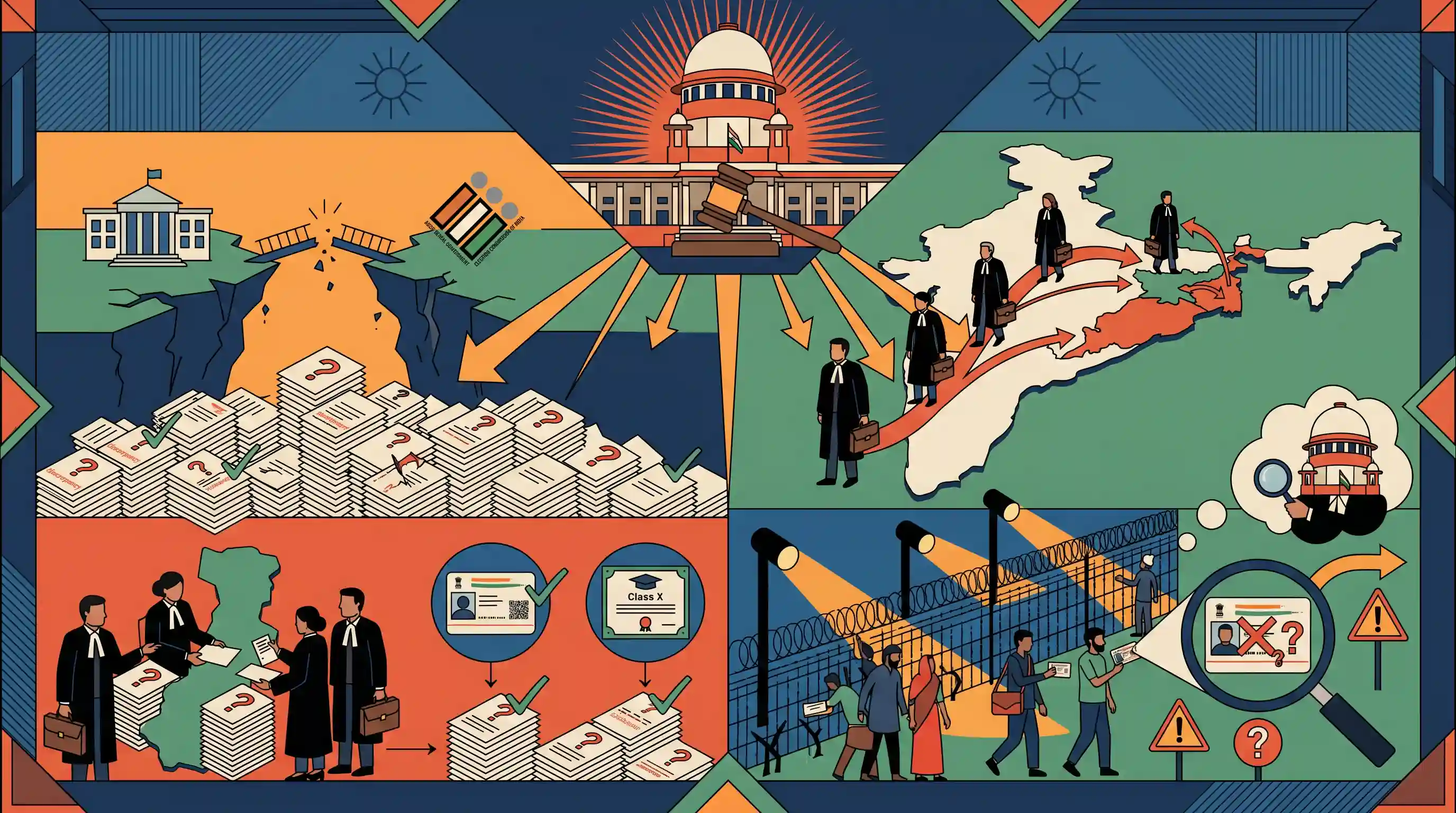
Supreme Court deployment of external judges for voter verification
Source:Indian Express ↗
Why It Matters
The article highlights critical governance themes: the independent functioning of the ECI, conflict between state governments and constitutional bodies, the Supreme Court's use of Article 142 to ensure free and fair elections, and internal security challenges regarding identity documentation (Aadhaar) in border states.
Summary
The Supreme Court, invoking its extraordinary powers under Article 142, permitted the deployment of judicial officers from Odisha and Jharkhand to clear a backlog of 50 lakh 'discrepancy' voter claims during the Special Intensive Revision (SIR) of electoral rolls in West Bengal. This unprecedented move was prompted by a severe 'trust deficit' between the West Bengal government and the Election Commission of India (ECI). While the Court permitted the use of Aadhaar and Class X certificates as valid identity proofs for voter verification, concerns were raised regarding the potential misuse of forged Aadhaar cards by illegal immigrants in border districts, an issue the Court noted might require deeper investigation later.
Key Points
- The Supreme Court intervened to address a massive backlog of 50 lakh 'discrepancy' or unmapped voter claims in West Bengal's electoral rolls.
- To bypass a trust deficit between the State Government and the ECI, the Court allowed deputing civil judges from Odisha and Jharkhand to assist the process.
- The Election Commission of India will bear the travel and honorarium expenses for the deputed judicial officers.
- The SC invoked its extraordinary powers under Article 142 to declare that supplementary voter lists would be legally deemed part of the final roll published in February 2026.
- The use of Aadhaar as an identity proof for verification sparked concerns over forged IDs allegedly enabling illegal immigrants in border districts to enter the electoral rolls.
Important Terms
Article 142 of the Constitution

Constitutional provision granting the Supreme Court plenary power to pass any decree or order necessary for doing 'complete justice' in any matter pending before it.
UPSC context
GS-II (Judiciary); tests understanding of the Supreme Court's extraordinary discretionary powers and judicial activism.
Special Intensive Revision (SIR)
A rigorous, house-to-house enumeration process by the ECI to verify every entry in the electoral roll, aimed at removing 'ghost voters' and ensuring list accuracy.
UPSC context
GS-II (Electoral Reforms); tests knowledge of mechanisms to ensure free and fair elections and electoral roll integrity.
Representation of the People Act, 1950 (RPA)
The primary legislation governing the allocation of seats, delimitation of constituencies, and the preparation and revision of electoral rolls in India.
UPSC context
GS-II (Statutory Bodies/Elections); a core topic for Paper II regarding the legal framework of Indian democracy.
Election Commission of India (ECI)
An autonomous constitutional body under Article 324 responsible for the superintendence, direction, and control of elections to Parliament and State Legislatures.
UPSC context
GS-II (Constitutional Bodies); tests mandate, powers, and role in maintaining electoral integrity.
Aadhaar (Electoral Verification)
A 12-digit unique identity number used as a valid document for identity verification under Section 23 of RPA, but not considered proof of citizenship.
UPSC context
GS-II (Governance/Citizenship); tests the legal distinction between identity and citizenship in the context of voter registration.
Prelims Trap
Aadhaar card serves as conclusive proof of Indian citizenship for inclusion in the electoral rolls.
Under Section 9 of the Aadhaar Act, Aadhaar only proves identity and residence, not citizenship, making its use controversial for verifying voters in border districts.
Static Concepts Connected
What is the scope and limitation of Article 142 of the Constitution?
- Complete Justice: Empowers the Supreme Court to pass any decree or order necessary for doing "complete justice" in any pending cause or matter.
- Statutory Limits: While it can bypass procedural bottlenecks and fill legislative gaps, it generally cannot be used to contravene explicit statutory laws.
- Judicial Overreach: Invoking it to perform administrative executive tasks (like voter verification) often invites criticism regarding the blurring of separation of powers.
How is the preparation of electoral rolls managed constitutionally?
- ECI Mandate: Article 324 vests the superintendence, direction, and control of preparing and revising electoral rolls in the Election Commission of India.
- State Machinery Reliance: Despite the ECI's ultimate control, the actual on-ground revision relies entirely on state government administrative staff designated as Electoral Registration Officers.
Cross-Topic Patterns
Border demographics and electoral integrity
The alleged use of forged Aadhaar cards by illegal immigrants links internal security (border management) directly with electoral reforms and the subversion of democratic processes.
Trust deficits triggering judicial overreach
Deploying out-of-state judges for executive voter verification highlights how severe Centre-State federal friction forces the judiciary to blur the separation of powers.

The intersection of Article 142, ECI's powers under Art 324, and Aadhaar's citizenship validity is highly probable for Prelims 2026.
Linked PYQs · 4
Linked PYQs · 4
- 2022MainsGS2
Discuss the role of the Election Commission of India in the light of the evolution of the Model Code of Conduct.
- 2023MainsGS2
“Constitutionally guaranteed judicial independence is a prerequisite of democracy.” Comment.
- 2018PrelimsGS1
Consider the following statements: 1. Aadhaar card can be used as a proof of citizenship or domicile. 2. Once issued, Aadhaar number cannot be deactivated or omitted by the Issuing Authority. Which of the statements given above is/are correct?
- 2016MainsGS3
Border management is a complex task due to difficult terrain and hostile relations with some countries. Elucidate the challenges and strategies for effective border management.
