West Bengal introduces Panchayat Second Amendment Bill for governance
Source:the-statesman ↗
Why It Matters
Local governance and the Panchayati Raj system are critical components of the Polity syllabus for WBCS Prelims. Recent amendments to the West Bengal Panchayat Act, 1973, highlight the state's approach to administrative stability and financial transparency in rural local bodies, making it highly relevant for exam questions on local self-government.
Summary
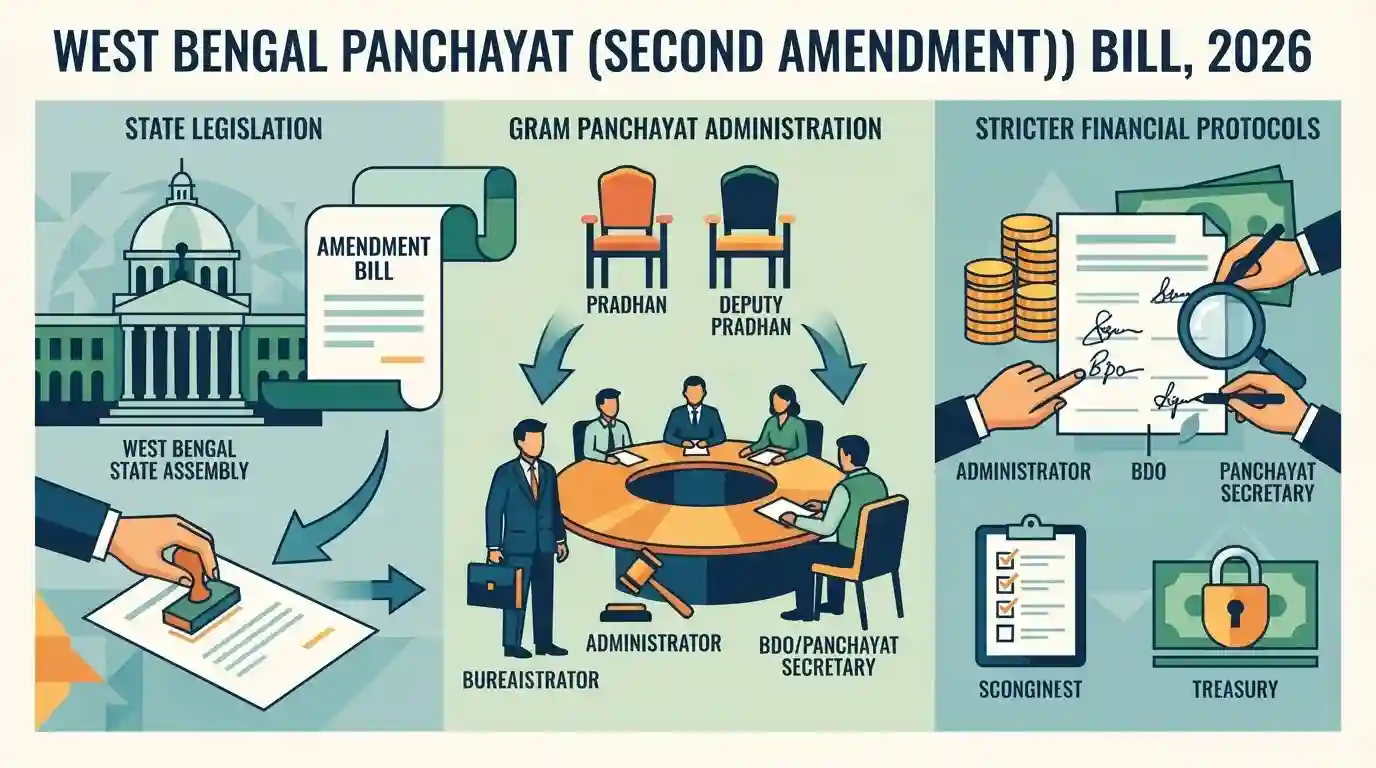
The West Bengal government is set to introduce the West Bengal Panchayat (Second Amendment) Bill, 2026 in the state assembly to ensure administrative continuity in gram panchayats. The amendment targets situations where the pradhan and deputy pradhan are absent for extended periods, allowing for the appointment of an Administrator and empowering bureaucrats like the BDO and Panchayat Secretary to convene meetings. It also introduces stricter financial protocols by making specific signatures mandatory on payment orders and cheques, thereby strengthening the financial administration and overall functioning of local self-government bodies in the state.
Key Points
- The West Bengal government will introduce the West Bengal Panchayat (Second Amendment) Bill, 2026, to amend the West Bengal Panchayat Act, 1973.
- The bill allows the appointment of an Administrator (an Extension Officer or higher) for up to 30 days if the pradhan and deputy pradhan are absent for over 15 days.
- It enables the Panchayat Secretary to convene a gram panchayat meeting with the BDO's approval if no meeting is held for two consecutive months.
- For financial transparency, payment orders will require the Executive Assistant's signature, and cheques will require joint signatures of the Executive Assistant and Secretary.
- Gram Sabha meetings can be presided over by a senior member nominated by the Administrator if elected representatives are absent.
Important Terms
West Bengal Panchayat (Second Amendment) Bill, 2026

A legislative bill to amend the West Bengal Panchayat Act, 1973, ensuring administrative continuity in local rural bodies during prolonged absences of their heads by appointing administrators and streamlining financial oversight.
UPSC context
GS Paper II (Governance/Local Self-Government); tests state legislative measures for reforming and stabilizing local bodies.
West Bengal Panchayat Act, 1973
The primary legislation organizing and empowering rural local self-governing bodies in West Bengal, which established the state's three-tier Panchayati Raj structure.
UPSC context
GS Paper II (Polity/Local Governance); essential for understanding state-specific statutory frameworks implementing decentralization.
Gram Panchayat
The directly elected executive council of the Panchayati Raj system at the village level, responsible for executing rural development plans and local administration.
UPSC context
GS Paper II (Polity/Local Self-Government); crucial for evaluating grassroots democracy, rural development, and execution of local welfare schemes.
Gram Sabha
A permanent statutory assembly comprising all registered voters of a village, acting as the foundational forum for direct democracy and local accountability.
UPSC context
GS Paper II (Polity/Governance); tests knowledge of citizen participation, social audits, and direct democracy mechanisms at the grass roots.
West Bengal Legislative Assembly
The unicameral state legislature of West Bengal, comprising 294 directly elected members responsible for passing laws, budgets, and holding the state executive accountable.
UPSC context
GS Paper II (State Legislature); tests understanding of sub-national legislative processes, executive oversight, and federal division of powers.
Prelims Trap
The 73rd Constitutional Amendment mandates that only elected representatives can preside over Gram Sabha meetings and manage local funds.
Articles 243A and 243H leave the exact procedures for meetings, presidency, and financial management of Panchayats to be determined by laws made by State Legislatures.
Static Concepts Connected
What are the constitutional limits of state legislative control over Panchayati Raj Institutions (PRIs)?
- Article 243G: Gives state legislatures the authority to endow Panchayats with powers and responsibilities to prepare economic development plans.
- Article 243H: Empowers states to authorize Panchayats to levy/collect taxes and establish consolidated funds, dictating specific financial control mechanisms.
- Administrative Oversight: The Constitution does not restrict states from appointing administrators during vacancies or specifying signature authorities for local funds.
What is the constitutional status and role of the Gram Sabha under Part IX?
- Definition: Under Article 243(b), it comprises all registered voters within the area of the Gram Panchayat.
- Functional Autonomy: Article 243A allows it to perform functions determined by state law, meaning rules regarding who presides are state-legislated.
Cross-Topic Patterns
Decentralization vs Bureaucratic control
State laws appointing administrative officials to manage local bodies during crises highlight the ongoing tension between executive control and the 73rd Amendment's vision of local autonomy.
PRI fiscal governance and accountability
Mandating dual-officer signatures for panchayat fund releases showcases structural attempts to reform local fiscal discipline while potentially intensifying red tape at the village level.

Expect 2026 questions on state legislature's authority to alter administrative & financial protocols of PRIs under Art 243G/243H.
Linked PYQs · 4
Linked PYQs · 4
- 2022WBCS_PRELIMSGS1
Which of the following constitutional amendments gives a constitutional status to the Panchayati Raj institutions?
- 2014WBCS_PRELIMSGS1
Panchayat system in India was introduced by the
- 2018WBCS_PRELIMSGS1
Which Amendment of the constitution provided constitutional status to the Panchayats?
- 2013WBCS_PRELIMSGS1
Panchayats in West Bengal are authorised to collect
