West Bengal industrial policy shifts toward direct land acquisition
Source:rediff ↗
কেন এটি গুরুত্বপূর্ণ
The shift in West Bengal's industrial and land acquisition policies under the new administration is critical for understanding the state's economic landscape, investment climate, and legislative reforms. These topics are highly relevant for WBCS Prelims questions on the West Bengal economy and geography.
সারসংক্ষেপ
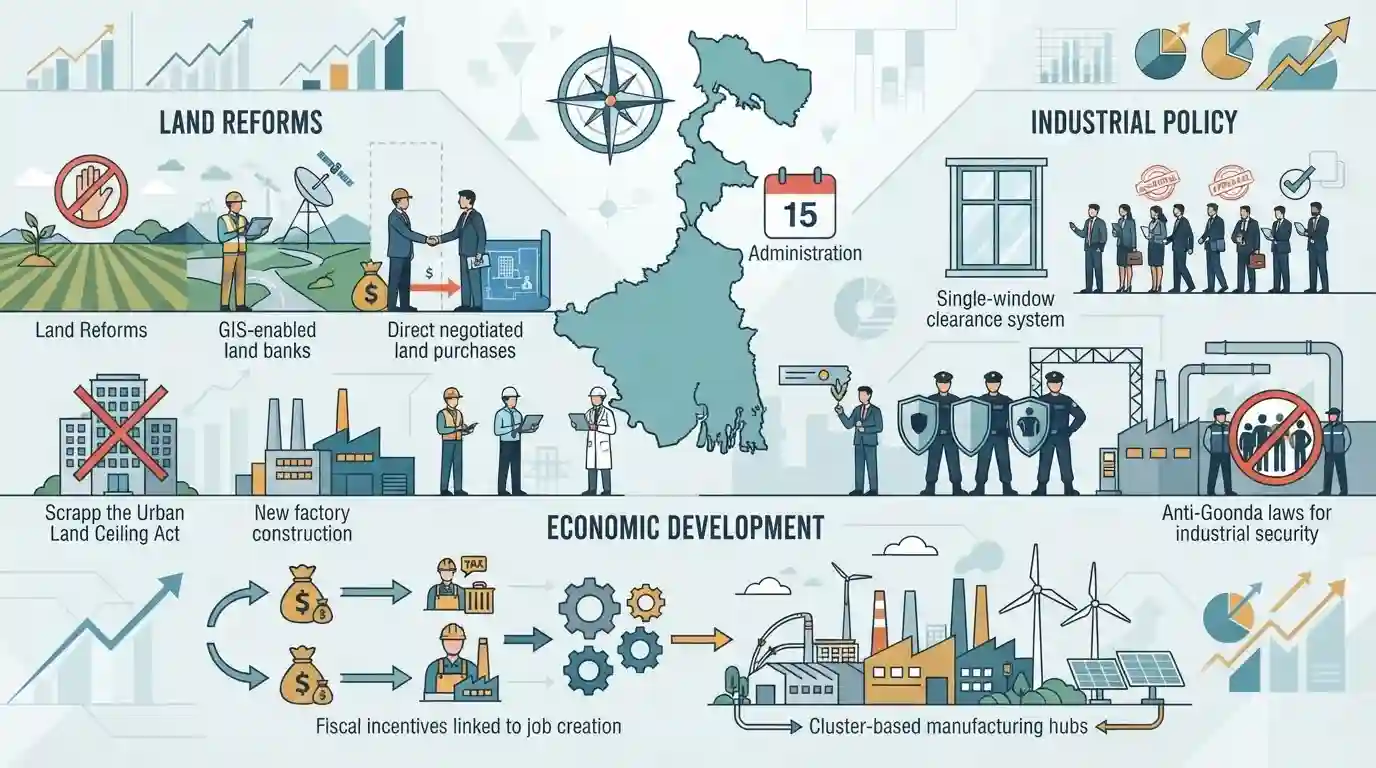
West Bengal's new administration is preparing to unveil its industrial policy on August 15, signaling a major strategic shift in economic development. Moving away from the previous hands-off approach to land acquisition, the policy introduces GIS-enabled land banks, allows direct negotiated land purchases, and proposes the scrapping of the Urban Land Ceiling Act to aid industrial expansion. Key features of the policy include a single-window clearance system, the introduction of anti-Goonda laws for industrial security, and fiscal incentives directly linked to job creation. The overall focus is on revitalizing idle industrial land and establishing cluster-based manufacturing hubs to boost the state's economy.
মূল বিষয়
- The newly elected West Bengal government, led by CM Suvendu Adhikari, is set to announce a comprehensive new industrial policy on August 15.
- The policy marks a departure from the previous administration's hands-off land acquisition approach by introducing GIS-enabled land banks and permitting negotiated purchases directly from landowners.
- Key reforms include scrapping the Urban Land Ceiling Act to facilitate factory expansion and repurposing idle industrial land for new projects.
- To improve the ease of doing business, the government plans to implement a single-window clearance mechanism and enact strict anti-Goonda laws for legal protection.
- Fiscal incentives under the new policy will be closely tied to employment generation, focusing on cluster-based industrial growth across specific districts.
গুরুত্বপূর্ণ শব্দ
Urban Land Ceiling Act

A 1976 Central Act enacted to prevent urban land concentration by capping private vacant land holdings, repealed nationally in 1999 but retained by West Bengal until its planned abolition in 2026.
UPSC context
GS Paper II (Government Policies) and GS Paper III (Land Reforms); tests land-use legislation and its impact on urban and industrial growth.
anti-Goonda laws
State-level legislations (such as West Bengal's Public Safety Act of 2026) that grant law enforcement sweeping powers like preventive detention and property confiscation to combat organized crime, extortion, and industrial disruption.
UPSC context
GS Paper III (Internal Security & Organized Crime); tests the legal frameworks used by states to ensure public order and industrial security.
Confederation of Indian Industry (CII)
A premier, non-government, industry-led, and industry-managed advisory organization in India that partners with government bodies to shape industrial, trade, and economic policies.
UPSC context
GS Paper III (Indian Economy); tests the role of business associations and non-state stakeholders in economic policymaking and development.
Tata Motors
A leading Indian multinational automotive manufacturer whose relocated car project in Singur, West Bengal, sparked a historic anti-land-acquisition struggle, profoundly shaping the state's subsequent industrial and land politics.
UPSC context
GS Paper III (Land Reforms & Industrialization); tests understanding of eminent domain, displacement, and compensation controversies in industrial projects.
BJP
The Bharatiya Janata Party; one of India's two major national political parties, characterized by a center-right platform emphasizing cultural nationalism, pro-business economic reforms, and infrastructure development.
UPSC context
GS Paper II (Polity - Electoral Politics); tests the role, ideology, and impact of national political parties on state-level development policies.
TMC
The All India Trinamool Congress; a prominent regional political party in India that governed West Bengal from 2011 to 2026, championing pro-farmer, anti-forcible-land-acquisition policies.
UPSC context
GS Paper II (Polity - Federalism & Regional Parties); tests the influence of regional political parties on state economic planning and land acquisition strategies.
প্রিলিমস ফাঁদ
The Central Government's repeal of the Urban Land Ceiling Act in 1999 automatically and uniformly abolished the ceiling across all Indian states.
Because ULCRA was enacted under Article 252(1), its 1999 repeal by Parliament only applied to states that passed a resolution adopting the repeal. West Bengal retained it until this policy shift.
সংযুক্ত স্থির ধারণা
How is legislative power over land and land acquisition distributed in the Constitution?
- State List: Entry 18 gives states exclusive power over land, rights in or over land, land tenures, landlord-tenant relations, and agricultural loans.
- Concurrent List: Entry 42 covers the "acquisition and requisitioning of property," allowing both the Union and State governments to legislate on land acquisition procedures.
- Ninth Schedule: Provides a constitutional shield to various state-level land reform and ceiling laws, protecting them from judicial review on the grounds of violating Fundamental Rights.
What was the purpose of the Urban Land (Ceiling and Regulation) Act, 1976?
- Preventing Concentration: Enacted to prevent the concentration of urban land in the hands of a few and to bring about an equitable distribution of land in urban agglomerations.
- Prescribing Limits: It imposed strict ceilings on the ownership and possession of vacant land in specified urban areas.
- Industrial Bottleneck: Over time, it severely restricted land aggregation for large-scale industrial and infrastructure projects, prompting the Union Government to repeal it in 1999.
আন্তঃবিষয় প্যাটার্ন
GIS Land Banks & DILRMP Integration
Integrating state-level GIS land banks with the Digital India Land Records Modernization Programme (DILRMP) reduces title disputes, directly accelerating infrastructure rollout and boosting state-level Ease of Doing Business rankings.
Law & Order as an Economic Input
The explicit framing of anti-Goonda laws as an industrial policy tool highlights how regional law and order (State List) acts as a critical bottleneck for industrial corridors and FDI aggregation.

Expect a Mains GS3 question analyzing how divergent state-level land acquisition frameworks and ceiling laws create regional FDI disparities.
সংযুক্ত PYQ · 4
সংযুক্ত PYQ · 4
- 2022WBCS_PRELIMSGS1
West Bengal Industrial Development Corporation Ltd. (WBIDC) was established in
- 2003WBCS_PRELIMSGS1
West Bengal's own industrial policy was declared in the year
- 2019WBCS_PRELIMSGS1
West Bengal Land Reform Act came into force in
- 2021WBCS_PRELIMSGS1
In West Bengal, Export Processing Zone (EPZ) has started functioning at
