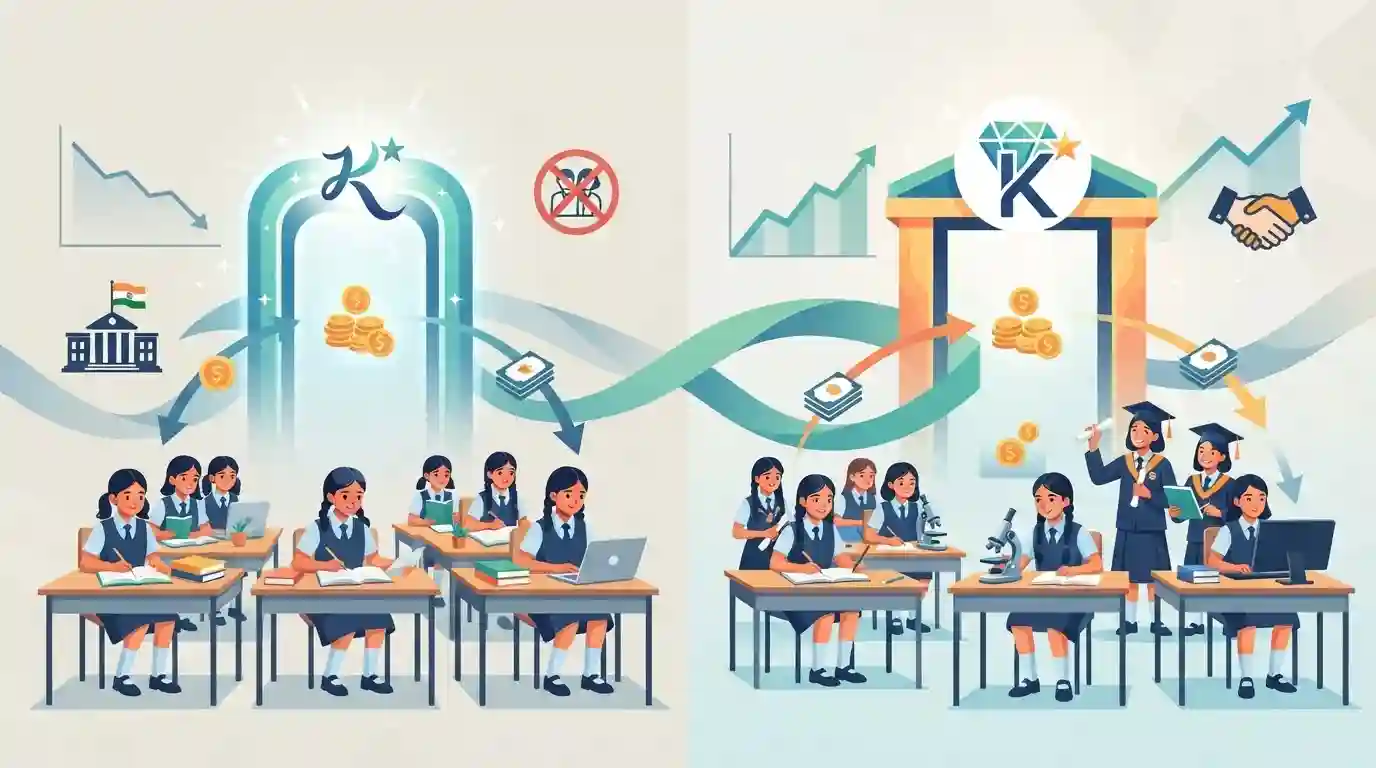
West Bengal Kanyashree scheme renaming as Kanyaratna
Source:the-statesman ↗
Why It Matters
State-specific welfare schemes like Kanyashree (now Kanyaratna) are frequently asked in the WBCS Prelims and Mains. Understanding the objectives, target beneficiaries, and structural changes of these flagship programs is crucial for aspirants.
Summary
West Bengal has decided to rename its internationally acclaimed flagship cash transfer scheme for schoolgirls, 'Kanyashree', to 'Kanyaratna'. The scheme has been pivotal in reducing dropout rates among girls and preventing early marriages by providing financial incentives for continuing education. Such initiatives highlight the state's ongoing policy interventions in human development, women's empowerment, and education, making it a critical focus area for state civil services.
Key Points
- The West Bengal government is renaming its flagship conditional cash transfer scheme for girls from 'Kanyashree' to 'Kanyaratna'.
- The renaming indicates an evolution or restructuring of the state's flagship women empowerment and student welfare initiative.
- Such state-level welfare initiatives often intersect with or complement central schemes like 'Beti Bachao, Beti Padhao'.
Important Terms
Kanyashree

A flagship West Bengal Conditional Cash Transfer scheme providing annual scholarships and one-time grants to unmarried schoolgirls (aged 13-18) to reduce dropout rates and prevent early marriages.
UPSC context
GS-2 (Welfare Schemes). Illustrates successful state-level interventions for women's empowerment and acts as a model for social justice policies.
Kanyaratna
The new name for West Bengal's flagship Kanyashree scheme, announced in 2026. It continues offering financial assistance to schoolgirls with planned increases in annual disbursements to promote continued education.
UPSC context
GS-2 (Government Policies). Tests awareness of recent updates to major state welfare schemes targeting female education and empowerment.
Beti Bachao, Beti Padhao
A Government of India initiative launched in 2015 to address the declining Child Sex Ratio and promote the survival, protection, and education of girl children through multi-sectoral action.
UPSC context
GS-2 (Social Justice). Critical for analyzing national policies on gender equality, child welfare, and demographic challenges.
Conditional Cash Transfer (CCT)
Welfare schemes that transfer cash directly to poor households, provided they fulfill specific behavioral conditions like ensuring children's school attendance, undergoing health check-ups, or avoiding early marriage.
UPSC context
GS-2 & GS-3 (Governance/Economy). Key concept for analyzing the efficiency of direct benefit transfers versus unconditional freebies.
Swami Vivekananda Merit-cum-Means Scholarship
A West Bengal state initiative providing financial assistance to meritorious but economically disadvantaged students pursuing higher studies, encouraging continued academic progression.
UPSC context
GS-2 (Education). Demonstrates state-level efforts in building human capital and reducing financial barriers to higher education.
Prelims Trap
"Beti Bachao Beti Padhao is a Conditional Cash Transfer scheme providing direct financial assistance to girls."
BBBP is primarily an advocacy and awareness campaign, not a direct cash transfer scheme. Aspirants often confuse it with state-level CCTs or the Sukanya Samriddhi account (which is a savings scheme).
Static Concepts Connected
What defines a Conditional Cash Transfer (CCT) scheme in governance?
- Targeted behavioral conditions: They provide direct financial assistance to vulnerable groups strictly upon meeting defined behavioral conditions (e.g., school attendance).
- DBT mechanism: Funds are routed directly into the beneficiary's bank account, reducing leakages and bypassing intermediaries.
- Versus Unconditional Transfers: Unlike Universal Basic Income or PM-KISAN, CCTs are not unconditional and require active compliance from the beneficiary.
What are the core structural features of Beti Bachao Beti Padhao (BBBP)?
- Tri-ministerial convergence: It is a joint initiative of the Ministries of Women & Child Development, Health & Family Welfare, and Education.
- Core objective: Focuses on improving the Child Sex Ratio (CSR), enforcing the PC&PNDT Act, and enabling girl child education.
- No cash component: It focuses on community mobilization and mindset change, without any provision for direct individual cash transfers.
Cross-Topic Patterns
State CCTs and SDG 5 (Gender Equality)
State schemes like Kanyaratna (WB) and Ladli Laxmi (MP) form the empirical backbone for Mains answers on achieving SDG 5 and preventing child marriage.
Education CCTs & Maternal Health linkages
Delaying marriage via school-retention CCTs has a compounding demographic effect, directly lowering the Maternal Mortality Ratio (MMR) and improving inter-generational nutritional outcomes.

Expect a Prelims question swapping features of central advocacy campaigns (BBBP) with state conditional cash transfers to test scheme nuances.
Linked PYQs · 2
Linked PYQs · 2
- 2021WBCS_PRELIMSGS1
Sabooj-Sathi is a scheme for distribution of Bicycles to students of Government/Government Aided Schools/Madrasahs reading in
- 2020WBCS_PRELIMSGS1
Literacy rate in West Bengal census 2011 —
