West Bengal panchayat department withdraws tax SOP and clarifies
Source:thestatesman ↗
Why It Matters
Understanding the financial autonomy and taxation powers of Panchayati Raj Institutions is crucial for WBCS Prelims. The intersection of Finance Commission recommendations, conditional performance grants, and local tax collection highlights the practical challenges of fiscal decentralization in India.
Summary
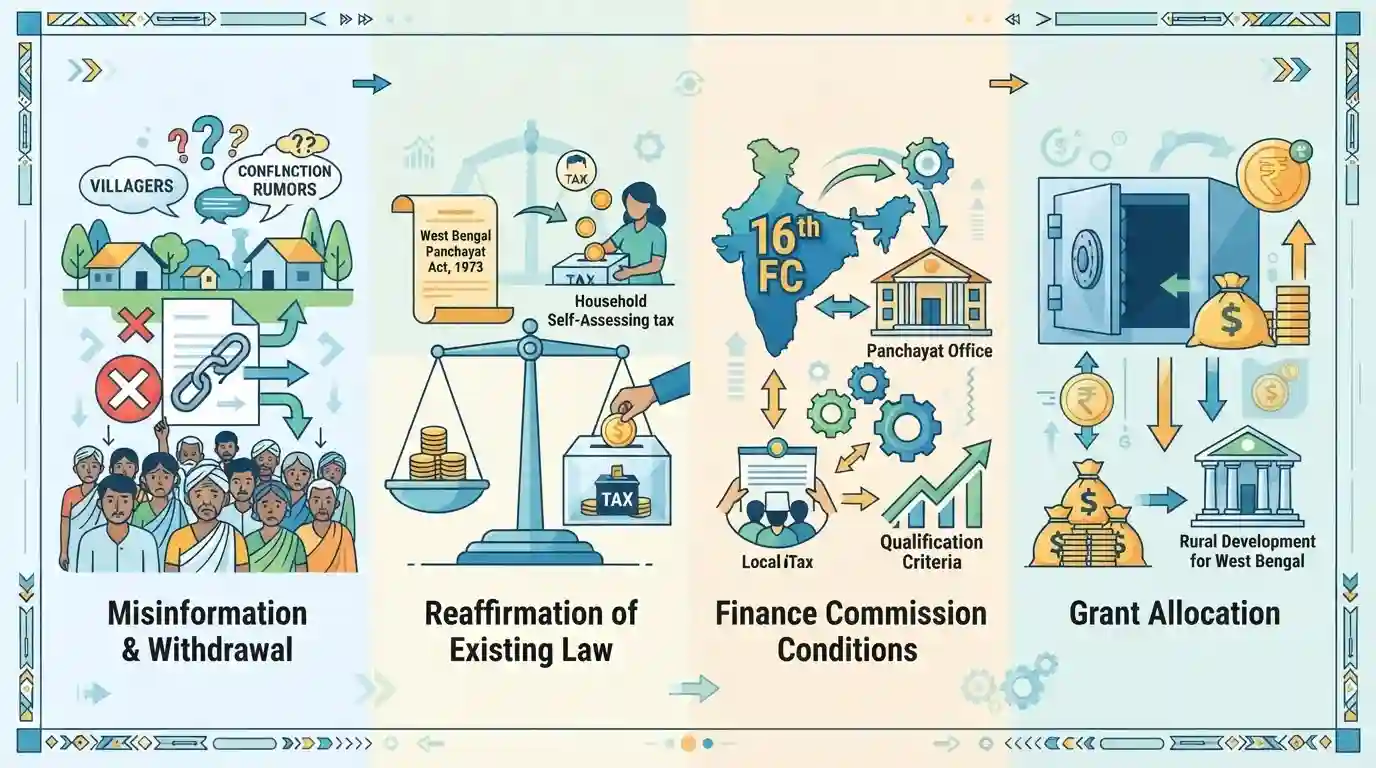
The West Bengal Panchayat and Rural Development Department has withdrawn a recently issued Standard Operating Procedure (SOP) concerning tax structures in panchayat areas. The move comes after widespread rumors claimed that the state planned to enforce a flat Rs 1,200 tax per household. The department clarified that the tax system remains fundamentally unchanged, operating on self-assessment principles under the West Bengal Panchayat Act, 1973. The SOP was originally conceptualized to align with the 16th Finance Commission's conditions, which require local bodies to boost property tax collections in order to qualify for significant performance grants. West Bengal expects to receive Rs 2,521 crore in such grants over the upcoming fiscal years.
Key Points
- The West Bengal government withdrew a Standard Operating Procedure (SOP) regarding panchayat taxation to counter rumors of a steep tax hike to Rs 1,200 per household.
- The existing property tax system in rural areas relies on self-assessment by property owners, under the provisions of the West Bengal Panchayat Act, 1973.
- The withdrawn SOP was initially drafted in response to the 16th Finance Commission's recommendations, which tied performance grants to improvements in local revenue generation.
- West Bengal anticipates Rs 2,521 crore in performance grants from the 16th Finance Commission for the period between 2028-29 and 2030-31.
Important Terms
West Bengal Panchayat Act, 1973

State legislation establishing the Panchayati Raj framework in West Bengal, governing local body constitution, functions, and taxation rules, including the 'self-assessment' system for local property tax collection.
UPSC context
GS-2 (Local Governance). Tests knowledge of state-level variations in democratic decentralization and local taxation empowerment.
Finance Commission
A constitutional body established under Article 280 to recommend tax devolution between the Union and states, and principles governing grants-in-aid to local bodies, including performance-based conditions.
UPSC context
GS-2 and GS-3. Crucial for understanding fiscal federalism, resource devolution, and center-state-local financial relations.
Panchayati Raj Institutions
A constitutional system of rural local self-government in India. PRIs rely on local taxation powers and Finance Commission grants to fund grassroots administration and development projects.
UPSC context
Core GS-2 topic. Tests knowledge of democratic decentralization, rural empowerment, and the financial autonomy of local bodies.
73rd Constitutional Amendment Act
A 1992 amendment that granted constitutional status to Panchayati Raj Institutions, adding Part IX to mandate regular elections, reservations, and the devolution of financial and administrative powers.
UPSC context
GS-2 (Polity). Frequently tested regarding constitutional provisions for grassroots democracy and local government empowerment.
Article 280
The constitutional provision mandating the establishment of a Finance Commission every five years to dictate the distribution of tax revenues and recommend financial grants to states and municipalities.
UPSC context
GS-2 (Constitutional Provisions). Essential for questions examining the framework of fiscal federalism and constitutional bodies.
Prelims Trap
The Constitution directly empowers Panchayats to levy and collect property taxes.
Article 243H leaves it entirely to the State Legislature to authorize Panchayats to levy taxes. Taxation power is delegated by the state, not inherently granted by the Constitution.
Static Concepts Connected
How do Panchayats derive their taxation powers under the Constitution?
- State Legislature Discretion: Under Article 243H, State legislatures may authorize Panchayats to levy, collect, and appropriate taxes, duties, tolls, and fees.
- Not Inherent: Unlike the Union and States (Schedule VII), PRIs do not possess direct constitutional taxation powers; they depend on state devolution.
- Asymmetric Devolution: Because it is left to states, the actual fiscal autonomy and tax base of PRIs vary drastically across India.
What is the role of the Central Finance Commission (FC) regarding local bodies?
- Article 280(3)(bb) & (c): Mandates the FC to recommend measures to augment a State's Consolidated Fund to supplement Panchayat and Municipality resources.
- State FC Linkage: Central FC recommendations for local bodies are constitutionally meant to be based on the respective State Finance Commission's recommendations.
- Conditional Grants: Recent FCs (like the 15th and 16th) split funds into basic and performance grants, tying the latter to property tax collection and audited accounts.
Cross-Topic Patterns
Local Fiscal Autonomy + 16th FC
The struggle for PRI fiscal independence links polity (Article 243H) with macroeconomics, as successive Finance Commissions use performance grants to force states to decentralize actual tax powers.
Urban vs Rural Fiscal Capacity
While urban bodies digitize property tax, rural panchayats rely on rudimentary self-assessment. This creates a massive local fiscal capacity gap often questioned in UPSC Mains GS2.

Expect a multi-statement question on Article 243H taxation powers and the 16th FC's performance grant conditions for PRIs.
Linked PYQs · 4
Linked PYQs · 4
- 2022WBCS_PRELIMSGS1
Which of the following constitutional amendments gives a constitutional status to the Panchayati Raj institutions?
- 2019WBCS_PRELIMSGS1
The fundamental object of 'Panchayati Raj' system is to ensure which among the following?
- 2019WBCS_PRELIMSGS1
Article 280 of the Indian Constitution lays down the establishment of the
- 2024WBCS_PRELIMSGS1
Which of the following is matched incorrectly?
