Defence Ministry Lays Foundation for Naval Shipyard Expansion
Source:The Hindu ↗
Why It Matters
Developing domestic shipbuilding and defence manufacturing infrastructure is critical to reducing import dependency, achieving strategic autonomy, strengthening national security, and driving industrial growth under the 'Make in India' initiative.
Summary
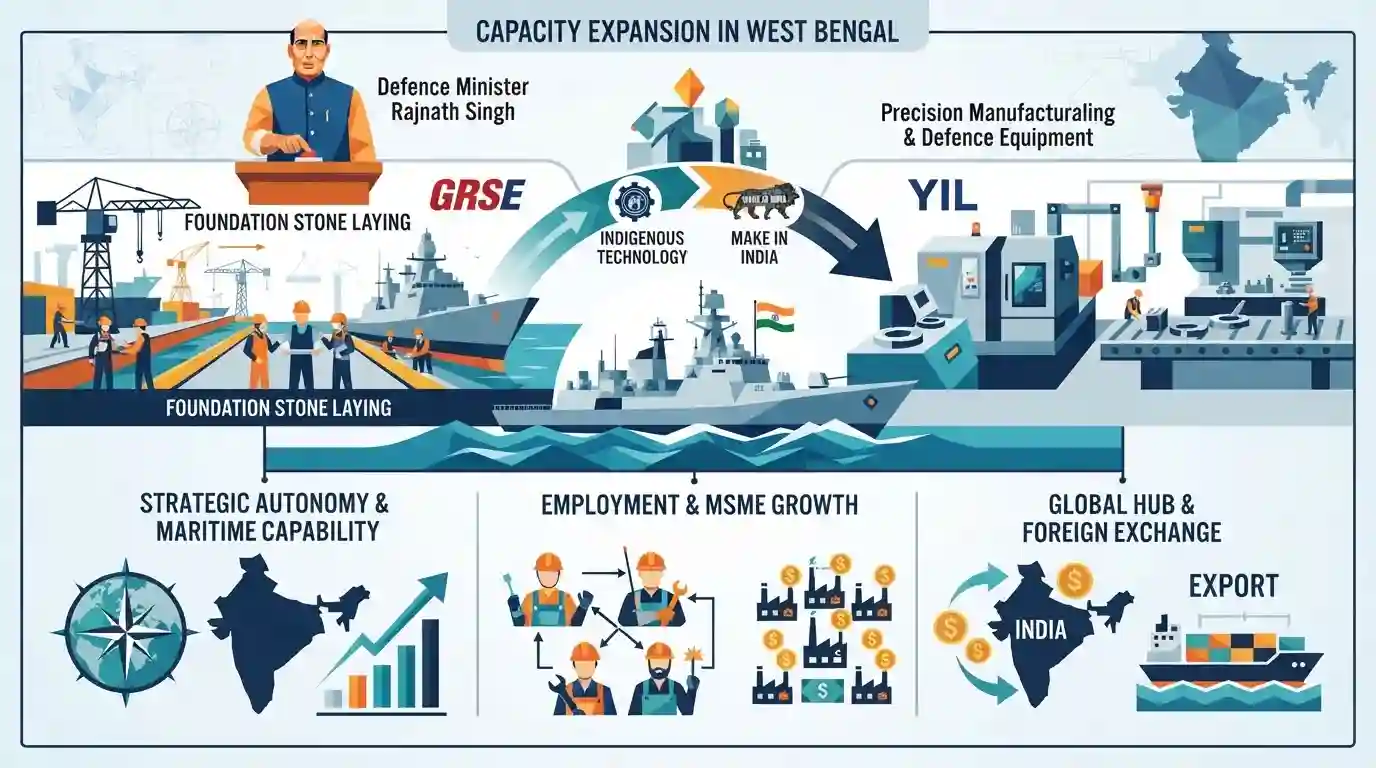
Union Defence Minister Rajnath Singh laid the foundation for major capacity expansion projects at Defence Public Sector Undertakings (DPSUs) Garden Reach Shipbuilders & Engineers (GRSE) and Yantra India Limited (YIL) in West Bengal. Highlighting a global vacuum in traditional shipbuilding, Singh underscored the strategic opportunity for India to become a global shipbuilding hub. These infrastructure investments align with the national agenda for 'Aatmanirbharta' (self-reliance) and the 'Make in India, Make for the World' initiative. By enhancing indigenous capabilities in shipbuilding, ship repair, and precision metallurgical manufacturing for armaments, the projects will strengthen India's strategic autonomy, create employment, support the local MSME ecosystem, and save foreign exchange.
Key Points
- Defence Minister Rajnath Singh initiated expansion projects for GRSE and YIL in Kolkata, emphasizing India's potential to become a global shipbuilding hub.
- The government's focus is on scaling up indigenous defence production to achieve strategic autonomy and export under the 'Make in India, Make for the World' vision.
- A vacuum in global traditional shipbuilding presents an opportunity for Indian shipyards to capture a larger share of the international market.
- The ₹2,500+ crore infrastructure expansion is expected to bolster MSMEs, generate employment, and conserve foreign exchange by reducing import dependency.
- Enhanced metallurgical and precision manufacturing facilities at YIL will support advanced ammunition and gun barrel production.
Important Terms
Aatmanirbhar Bharat

A national vision for a self-reliant India, focusing on reducing import dependence and building robust indigenous manufacturing capabilities, particularly to achieve strategic autonomy and export competitiveness in the defence sector.
UPSC context
GS Paper 3 (Economy/Defence). Crucial for questions on indigenization of technology, defense sector reforms, and import substitution.
Make in India
An initiative aimed at transforming India into a global manufacturing and design hub. In the defence context, it promotes domestic weapons production and private sector participation to boost exports.
UPSC context
GS Paper 3 (Industrial Policy/Growth). Tests awareness of government initiatives driving domestic manufacturing and foreign direct investment.
Make for the World
An extension of the Make in India policy emphasizing manufacturing for global markets. It focuses on ensuring globally trusted quality and competitive costs to establish India as a premier defense exporter.
UPSC context
GS Paper 3 (Economy/Exports). Relevant for topics detailing India's transition from an arms importer to a net exporter.
Garden Reach Shipbuilders & Engineers (GRSE)
A Kolkata-based Miniratna Defence Public Sector Undertaking (DPSU). It specializes in building and repairing modern warships, commercial vessels, and marine engines for domestic and export markets.
UPSC context
GS Paper 3 (Defence/Infrastructure). Relevant for understanding India's maritime security infrastructure and defense shipbuilding capabilities.
Yantra India Limited (YIL)
A Miniratna Category-I Defence PSU created in 2021 following the corporatization of the Ordnance Factory Board. It manufactures high-end armament components, artillery guns, and composites to strengthen defence supply chains.
UPSC context
GS Paper 3 (Defence Reforms). Important for evaluating the outcomes of OFB corporatization and modernizing defense production.
Micro, Small and Medium Enterprises (MSMEs)
Micro, Small and Medium Enterprises are critical supply-chain partners in defense production. They provide essential sub-systems, drive agility in emerging technologies, and help reduce reliance on foreign imports.
UPSC context
GS Paper 3 (Economy). Tests the importance of small enterprises in fostering localized defense manufacturing ecosystems and employment generation.
Prelims Trap
"Yantra India Limited is a newly formed private sector enterprise under the Make in India initiative."
YIL is actually a 100% government-owned Miniratna DPSU formed in 2021 following the corporatization of the Ordnance Factory Board, not a private entity.
Static Concepts Connected
What was the core rationale behind the 2021 corporatization of the Ordnance Factory Board (OFB)?
- Corporate Structure: Shifted the OFB from a subordinate government department to seven 100% government-owned corporate entities (DPSUs).
- Autonomy & Efficiency: Granted operational and financial autonomy to these new entities to enhance efficiency, quality, and export competitiveness.
- Pricing Mechanism: Moved away from the traditional 'cost-plus' mechanism to a competitive pricing model to reduce the defence import bill.
What are the fundamental criteria for granting 'Navratna' status to a CPSE like GRSE?
- Miniratna Prerequisite: The enterprise must already hold Miniratna Category - I status and have four independent directors on its Board.
- MoU Rating: Must have secured an 'Excellent' or 'Very Good' rating under the Memorandum of Understanding system in three of the last five years.
- Composite Score: Must achieve a composite score of 60 or above out of 100 across six financial and operational performance parameters.
Cross-Topic Patterns
Maritime Vision 2047 & Industrial Hubs
The push for shipbuilding capacity aligns with Maritime Amrit Kaal Vision 2047, signaling a shift from simple port development (Sagarmala) toward building holistic maritime industrial ecosystems and global ship-repair hubs.
MSMEs in Defence Corridors
DPSU capacity expansions structurally mandate local vendor integration, connecting this shipbuilding push directly to the strategic goals of the UP and Tamil Nadu Defence Industrial Corridors.

Expect a multi-statement question combining OFB corporatization (DPSUs like YIL), CPSE status criteria, and global shipbuilding shares.
Linked PYQs · 3
Linked PYQs · 3
- 2014MainsGS3
Foreign Direct Investment (FDI) in the defence sector is now set to be liberalized. What influence this is expected to have on Indian defence and economy in the short and long run?
- 2023MainsGS3
Faster economic growth requires increased share of the manufacturing sector in GDP, particularly of MSMEs. Comment on the present policies of the Government in this regard.
- 2025MainsGS3
Why is maritime security vital to protect India's sea trade? Discuss maritime and coastal security challenges and the way forward.
