Gram panchayat revenue and tax collection SOP issued
Source:the-statesman ↗
কেন এটি গুরুত্বপূর্ণ
WBCS Prelims frequently tests the statutory powers of Panchayats in West Bengal, specifically their authorized revenue sources (like tolls and water taxes) and constitutional backing (Article 243-H, 73rd Amendment). This development highlights the practical challenges of fiscal decentralization and the conditional nature of Finance Commission grants to local bodies.
সারসংক্ষেপ
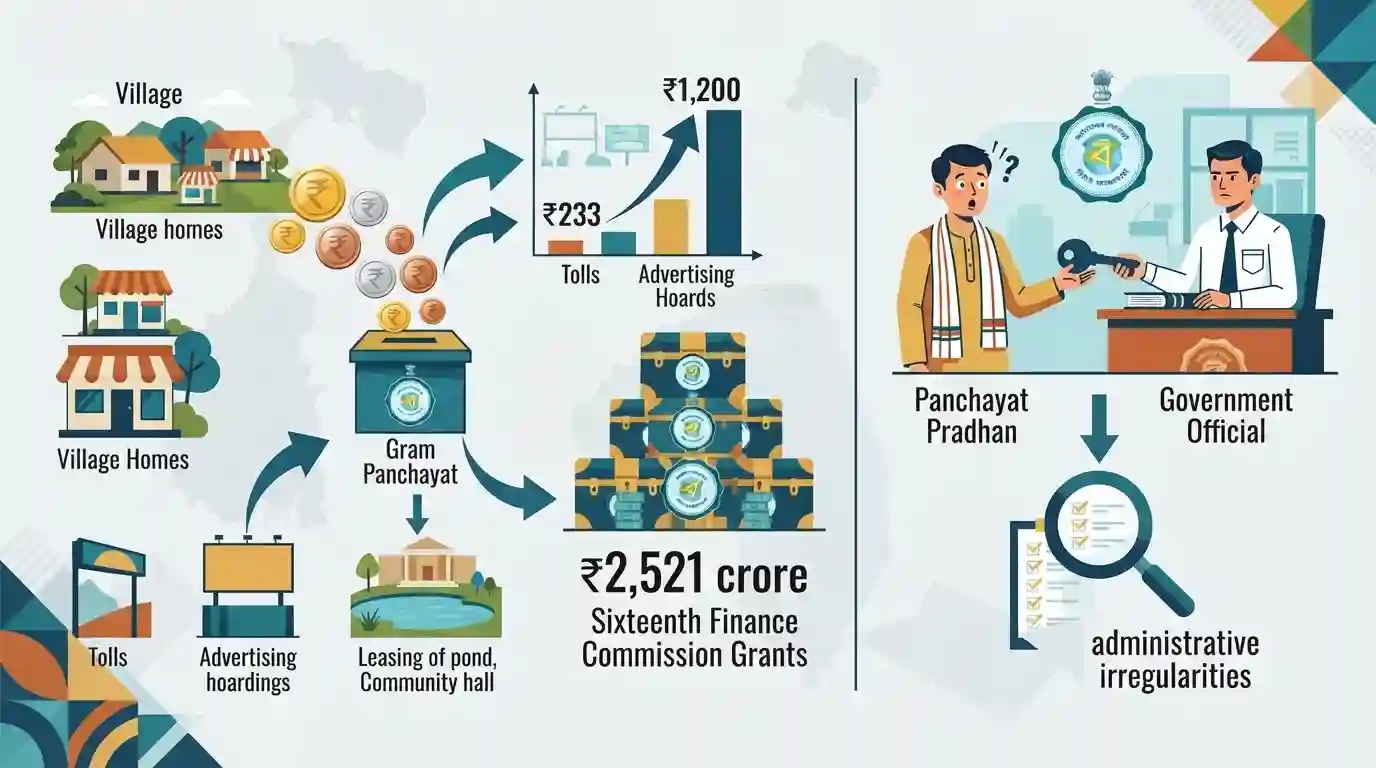
The West Bengal government has issued a Standard Operating Procedure (SOP) mandating Gram Panchayats to strictly enforce tax collections and boost own-source revenue from an average of Rs 233 to Rs 1,200 per household. By generating alternative income through tolls, advertising, and asset leasing, the state aims to meet the fiscal discipline criteria required to receive Rs 2,521 crore in performance-based grants from the Sixteenth Finance Commission. In a related move to curb administrative irregularities, financial transaction powers at the village level have been transferred from elected Panchayat Pradhans to appointed government officials.
মূল বিষয়
- The West Bengal Panchayat Department issued an SOP to Gram Panchayats to enhance tax collection and own-source revenue generation through tolls, advertising, and leasing of assets.
- The state aims to increase the average annual earning of Gram Panchayats from Rs 233 per household to approximately Rs 1,200.
- Improving own-source revenue is crucial for West Bengal to remain eligible for an estimated Rs 2,521 crore in performance-based grants from the Sixteenth Finance Commission (2028-2031).
- To enforce fiscal discipline, the state government amended local laws to transfer financial transaction powers at the Gram Panchayat level from elected Pradhans to state government officials.
গুরুত্বপূর্ণ শব্দ
Sixteenth Finance Commission

A constitutional body constituted under Article 280 to recommend the distribution of tax revenues between the Union and States, and grants-in-aid to strengthen local bodies like Panchayats.
UPSC context
GS Paper 2/3. Tests knowledge of constitutional bodies, fiscal federalism, and local government financing mechanisms.
Gram Panchayats
The grassroots tier of rural local self-government in India, empowered by the 73rd Constitutional Amendment to administer local development, collect basic taxes, and deliver public services.
UPSC context
GS Paper 2. Core topic for local self-government, democratic decentralization, and the functioning of Panchayati Raj Institutions.
Own-Source Revenue (OSR)
Independent income generated by local bodies through local taxes, tolls, user fees, and asset leasing, reducing their over-reliance on tied central or state grants.
UPSC context
GS Paper 2/3. Critical for analyzing the financial autonomy, viability, and capacity constraints of local self-governments.
Performance-Based Grants
Financial transfers awarded to local bodies contingent upon meeting specific governance or financial benchmarks, such as boosting local revenue generation or improving service delivery.
UPSC context
GS Paper 2/3. Tests understanding of fiscal decentralization, conditional funding mechanisms, and institutional reforms in local governance.
প্রিলিমস ফাঁদ
"Gram Panchayats derive direct autonomous constitutional power to levy local taxes and tolls."
Under Article 243H, State Legislatures must pass laws to authorize PRIs to levy taxes. The Constitution does not automatically or independently grant taxation powers directly to Panchayats.
সংযুক্ত স্থির ধারণা
How does the Constitution provide for the financial resources of Panchayats?
- Article 243H: It authorizes State Legislatures to empower Panchayats to levy, collect, and appropriate taxes, duties, tolls, and fees.
- State Assignments: It allows the State Legislature to assign State-levied taxes to Panchayats and provide grants-in-aid from the State Consolidated Fund.
- State Finance Commission: Constituted every five years to review the financial position of Panchayats and recommend tax devolution and grant principles.
What is the role of the Central Finance Commission in local body finances?
- Article 280(3)(bb): It recommends measures to augment the Consolidated Fund of a State to supplement the resources of the Panchayats.
- Performance Grants: FC allocations are typically split into basic (untied) grants and performance grants tied to specific criteria like audited accounts and improved revenue.
- SFC Dependency: The Central FC bases its recommendations on the reports submitted by the respective State Finance Commissions.
আন্তঃবিষয় প্যাটার্ন
Bureaucratization vs Democratic Decentralization
Stripping elected Pradhans of financial powers in favor of state-appointed officials highlights the persistent 'bureaucratization' challenge, undermining the spirit of democratic decentralization envisioned under Article 243G.
RBI's scrutiny of Local Body Finances
RBI reports on municipal and PRI finances consistently highlight their over-reliance on grants (OSR < 1.5%). This data is critical evidence for GS2 Mains answers on fiscal federalism and local governance.

16th FC conditionality on PRI Own Source Revenue, paired with Article 243H nuances, is highly likely as a 2026 Prelims multi-statement Q.
সংযুক্ত PYQ · 4
সংযুক্ত PYQ · 4
- 2013WBCS_PRELIMSGS1
Panchayats in West Bengal are authorised to collect
- 2011WBCS_PRELIMSGS1
Panchayats
- 2005WBCS_PRELIMSGS1
Which of the following is not one of the sources of revenue of the village panchayat ?
- 2022WBCS_PRELIMSGS1
Which of the following constitutional amendments gives a constitutional status to the Panchayati Raj institutions?
