Annapurna Yojana direct benefit transfer payouts announced
Source:theprint ↗
Why It Matters
State-level social welfare schemes (like Kanyashree, Sabooj Sathi, and Lakshmir Bhandar/Annapurna Yojana) are frequently tested in WBCS Prelims. Understanding target demographics, payout amounts, and the administrative mechanism (DBT) is crucial.
Summary
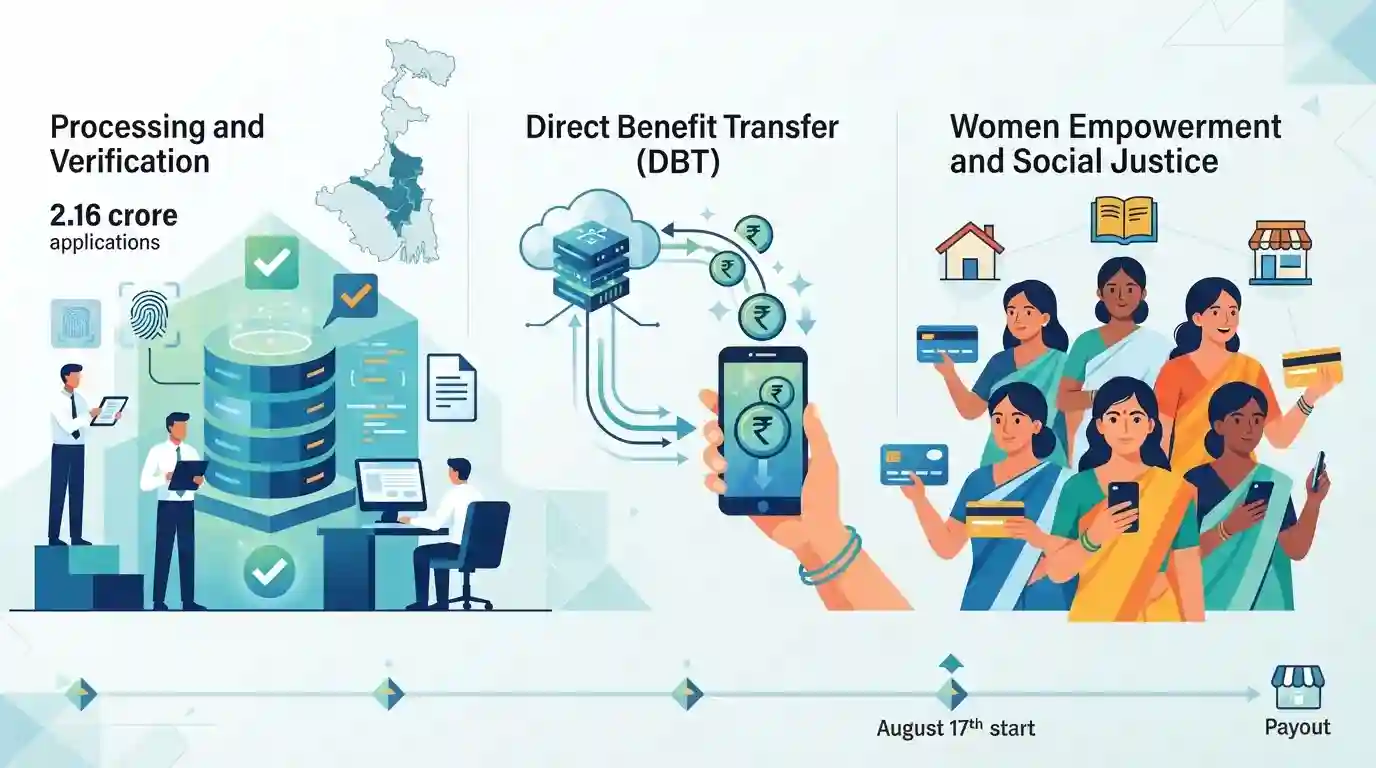
The West Bengal government has announced the commencement of payouts under the 'Annapurna Yojana', a flagship Direct Benefit Transfer (DBT) scheme. Eligible women aged 25 to 60 will receive Rs 3,000 per month starting August 17. The administration has processed 2.16 crore applications, prioritizing verified beneficiaries for the initial rollout of this major financial assistance program.
Key Points
- The West Bengal government is launching the Annapurna Yojana, providing a monthly cash assistance of Rs 3,000 to eligible women.
- The scheme targets women between the ages of 25 and 60, acting as a major social welfare and financial inclusion initiative.
- Payouts will be made via Direct Benefit Transfer (DBT) to verified beneficiaries starting August 17.
- The state received approximately 2.16 crore applications for the program, reflecting its massive scale.
Important Terms
Annapurna Yojana

A West Bengal government welfare scheme effective June 2026, replacing the Lakshmir Bhandar initiative. It provides an assured monthly financial assistance of Rs 3,000 via Direct Benefit Transfer to eligible women aged 25 to 60.
UPSC context
GS Paper 2 (Welfare Schemes). Tests awareness of sub-national social justice programs and women's financial empowerment.
Direct Benefit Transfer (DBT)
A targeted governance reform that transfers welfare subsidies directly into beneficiaries' Aadhaar-linked bank accounts. By leveraging the JAM trinity, it bypasses intermediaries, ensures fiscal transparency, and curtails financial leakages.
UPSC context
GS Paper 2 & 3 (Governance & Economy). Evaluates knowledge of digital service delivery and public distribution reforms.
Government of West Bengal
The elected provincial administration of the Indian state of West Bengal. It exercises executive authority over state subjects, implementing localized public policies and welfare schemes tailored to regional socio-economic needs.
UPSC context
GS Paper 2 (State Executive). Relevant for understanding Indian federalism, state-led policy innovations, and sub-national governance frameworks.
Prelims Trap
The Annapurna Yojana is a central government scheme providing free food grains to senior citizens who do not receive a pension.
Do not confuse West Bengal's state-level cash transfer scheme (Annapurna Yojana) with the old Union Ministry of Rural Development's 'Annapurna Scheme' (2000) for senior citizens.
Static Concepts Connected
What are Conditional Cash Transfers (CCTs) and how do they differ from Unconditional Cash Transfers (UCTs)?
- Mechanism: CCTs provide monetary assistance on the condition that beneficiaries meet specific criteria, like child immunization or school enrollment, whereas Unconditional Cash Transfers (UCTs) have no behavioral requirements.
- Human Capital: By linking cash to health and education, CCTs aim to break intergenerational poverty cycles, unlike UCTs which focus purely on immediate consumption support.
- Implementation: CCTs require robust administrative infrastructure to verify compliance, leading to higher targeting and monitoring costs compared to simpler UCTs.
What is the economic debate surrounding 'Committed Revenue Expenditure' vs 'Capital Expenditure' in state budgets?
- Committed liabilities: Revenue expenditure on salaries, pensions, and non-asset-creating cash transfers represents committed liability, reducing a state's fiscal space for development.
- Multiplier effect: Capital expenditure has a much higher fiscal multiplier (often >2.0) compared to revenue expenditure (usually <1.0), fostering long-term economic growth.
- FRBM constraints: Uncontrolled growth in revenue deficits limits a state's ability to borrow under FRBM rules, as borrowing should ideally fund capital asset creation.
Cross-Topic Patterns
Welfare spending vs Fiscal Federalism
Massive state cash transfers consuming high shares of revenue receipts intensify the Finance Commission's debate over state debt sustainability and borrowing caps.
DBT + Social behavioral change
Linking DBT benefits to immunization and government school attendance uses behavioral nudges to achieve national healthcare and primary education (SDG 3 and 4) goals.

Mains 2026 may ask to critique state-level conditional cash transfers vs capital asset creation under the lens of fiscal federalism.
Linked PYQs · 2
Linked PYQs · 2
- 2021WBCS_PRELIMSGS1
Sabooj-Sathi is a scheme for distribution of Bicycles to students of Government/Government Aided Schools/Madrasahs reading in
- 2021WBCS_PRELIMSGS1
What is the maximum Government Subsidy that can be availed by a beneficiary under the Gatidhara Scheme?
