West Bengal industrial policy drafting and investment promotion
Source:theprint ↗
Why It Matters
The formulation of industrial policies and the promotion of investment are central to West Bengal's economic development, a core topic in the WBCS syllabus. Knowledge of the state's traditional industries (tea, silk/textiles), industrial bodies (WBIDC), and historical land reform contexts are frequently tested in WBCS Prelims.
Summary
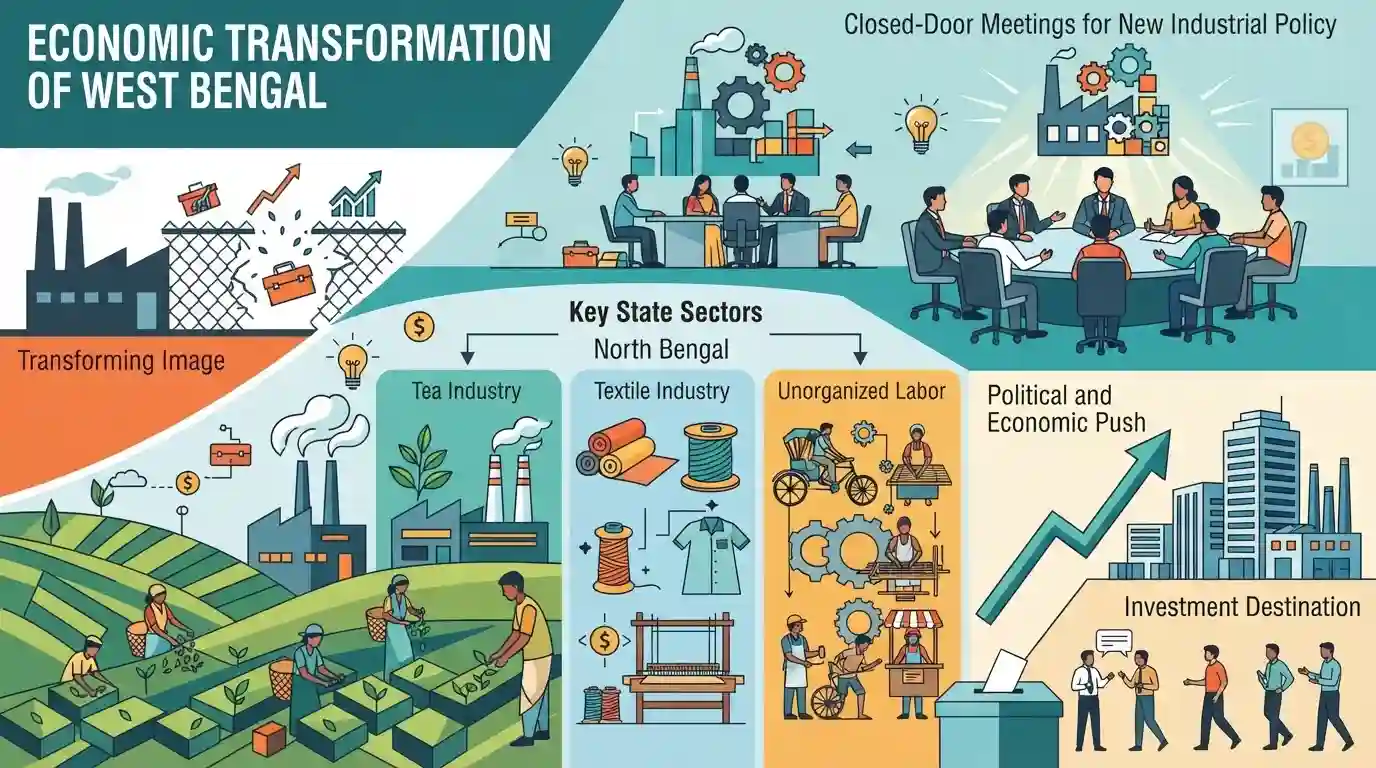
The West Bengal government is holding closed-door meetings with business leaders to gather inputs for a new state industrial policy. The initiative is designed to transform the state's perceived anti-industry image—a legacy of the Singur land acquisition protests—and position it as a prime investment destination. The upcoming policy is expected to focus on vital state sectors like tea, textiles, and unorganized labor, especially in North Bengal. This economic push is also politically motivated, aimed at countering opposition narratives regarding unemployment and industrial stagnation ahead of the assembly elections.
Key Points
- The West Bengal government is consulting industrialists and businessmen to draft a new industrial policy aimed at attracting investment and generating employment.
- The state is actively trying to shed the anti-industry image it acquired following the Singur and Nandigram anti-land acquisition movements.
- The consultations and proposed policy specifically emphasize regional economic drivers such as the tea industry, textile sector, and unorganized labor, particularly in North Bengal.
- The policy push has strong political implications, serving as the ruling TMC's strategic response to the BJP's criticisms of high unemployment and industrial stagnation in the state ahead of elections.
Important Terms
State Industrial Policy

A strategic government framework outlining regulations, subsidies, and incentives designed to attract corporate investment, boost local manufacturing, and generate employment within a specific state.
UPSC context
GS Paper 3 tests the effects of liberalization on the economy and changes in industrial policy.
Singur Land Acquisition Protests
A significant 2006-2011 farmers' movement in West Bengal against the state government's forced acquisition of fertile agricultural land for a corporate automobile factory.
UPSC context
GS Paper 3 tests land reforms in India and the socio-economic complexities of industrial land acquisition.
West Bengal Economy
A major regional economy in eastern India historically reliant on agriculture, tea, and textiles, currently pursuing new policies to revitalize its manufacturing sector and attract investment.
UPSC context
GS Paper 3 evaluates state-level economic development, regional growth disparities, and employment generation strategies.
Bharatiya Janata Party (BJP)
One of India's major national political parties, founded in 1980. It currently serves as the ruling party at the federal level and acts as the primary political opposition in West Bengal.
UPSC context
GS Paper 2 covers the representation of people, the role of national political parties, and electoral politics.
All India Trinamool Congress (TMC)
A prominent political party predominantly active in West Bengal. Founded in 1998, it is the state's current ruling party and a significant regional force in Indian politics.
UPSC context
GS Paper 2 examines the role of regional political parties in India's democratic system and federal structure.
Prelims Trap
Geographical Indication (GI) tags for state-specific products like Darjeeling Tea are awarded by the respective State Governments.
GI tags are granted under the GI of Goods Act, 1999 by the Geographical Indications Registry (DPIIT, Central Government), not by State Governments.
Static Concepts Connected
How is legislative jurisdiction over 'Industries' divided under the 7th Schedule?
- Union List (Entry 52): Industries whose control by the Union is declared by Parliament to be expedient in the public interest.
- State List (Entry 24): Industries subject to the provisions of Entry 7 and 52 of the Union List.
- Concurrent List (Entry 33): Trade, commerce, and production of products from industries centrally controlled under Entry 52.
What are the consent requirements for land acquisition under the LARR Act, 2013?
- Private Projects: Requires the prior consent of at least 80% of the affected families.
- Public-Private Partnerships: Requires the prior consent of at least 70% of the affected families.
- Government Projects: No prior consent is mandated, but a mandatory Social Impact Assessment (SIA) applies.
Cross-Topic Patterns
Competitive Federalism in FDI
States are increasingly acting as independent economic entities, drafting tailored industrial policies and holding investor summits to attract capital and counter regional unemployment.
GI Tags and Niche Exports
Integrating regional specialties like Darjeeling Tea and Baluchari silk into state industrial policies highlights the shift towards export-led growth relying on localized heritage.
Land Acquisition vs. Industrialization
The legacy of post-Singur anti-land acquisition protests catalyzed national legislative changes, eventually culminating in the stringent LARR Act of 2013 balancing industry and farmer rights.

Mains 2026 may test 'Competitive Federalism' by asking how state-level industrial policies tackle regional disparities and land bottlenecks.
Linked PYQs · 4
Linked PYQs · 4
- 2022WBCS_PRELIMSGS1
West Bengal Industrial Development Corporation Ltd. (WBIDC) was established in
- 2024WBCS_PRELIMSGS1
In West Bengal, silk industry is famous in:
- 2011WBCS_PRELIMSGS1
The most ideal region for cultivation of Tea in West Bengal is
- 2019WBCS_PRELIMSGS1
West Bengal Land Reform Act came into force in
