West Bengal Jute Sector: State Reviews Raw Fibre Supply Chain
Source:theprint ↗
কেন এটি গুরুত্বপূর্ণ
Jute is a crucial commercial crop and a major employment-generating industrial sector in West Bengal. Understanding government interventions to stabilize prices, enforce MSP, and regulate raw material supplies is essential for the West Bengal Geography and Economy segments of the WBCS exam.
সারসংক্ষেপ
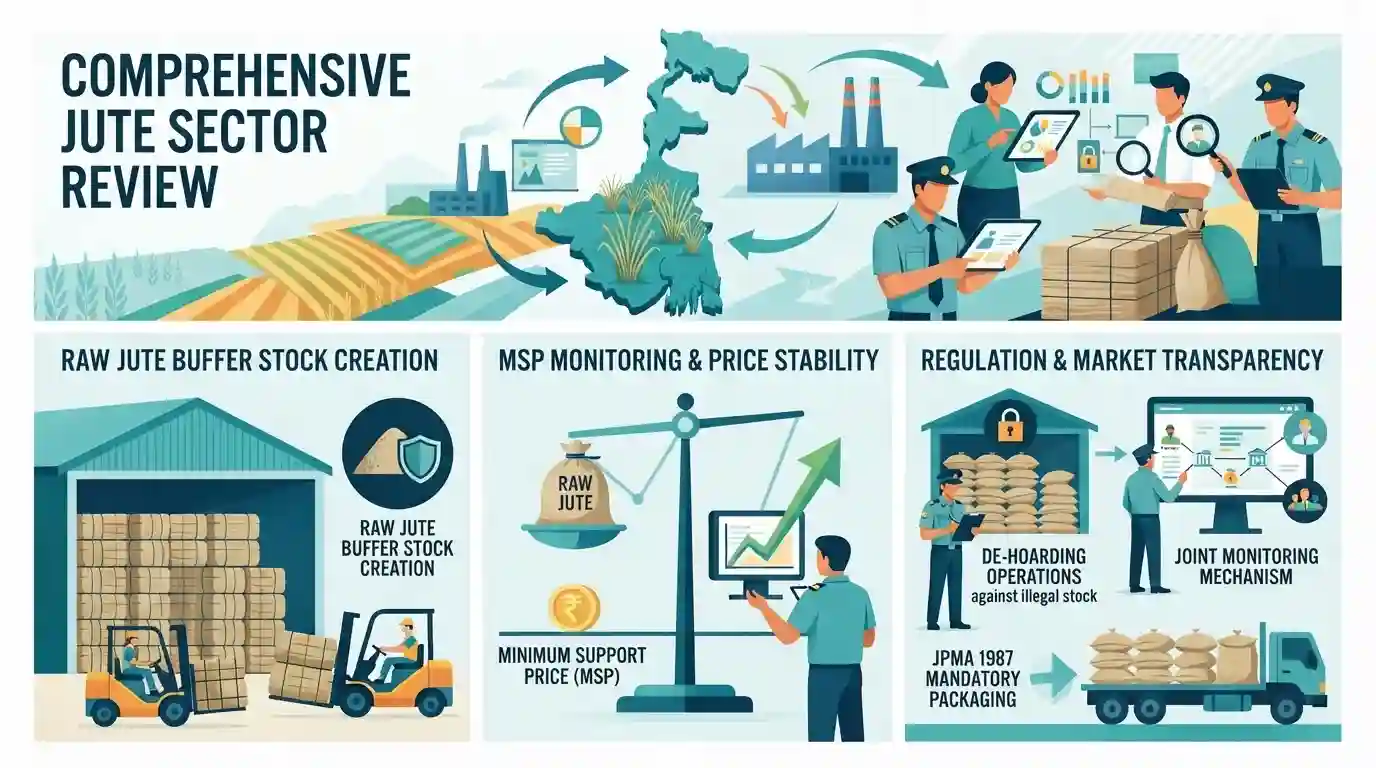
The West Bengal government is undertaking a comprehensive review of the state's jute sector to ensure an uninterrupted supply of raw fibre for mills. Measures being considered include the creation of a raw jute buffer stock, continuous monitoring of raw jute prices against the Minimum Support Price (MSP), and strict implementation of the Jute Packaging Materials Act, 1987. Furthermore, the state intends to initiate targeted de-hoarding operations against illegal stockholding and establish a joint monitoring mechanism to maintain market transparency.
মূল বিষয়
- The West Bengal government reviewed the jute sector to ensure a steady supply of raw fibre to jute mills.
- The Jute Commissioner is to share a list of registered raw jute traders with the labour department to improve market monitoring.
- Authorities are considering creating a buffer stock of raw jute to address potential market distress and shortages.
- A joint review mechanism involving DMs, SPs, and state departments aims to maintain transparency in raw jute pricing.
- Raw jute prices are being constantly monitored against the Minimum Support Price (MSP) trends observed since 2016.
- Strict de-hoarding operations will be launched against those holding stocks beyond legal limits to prevent artificial price hikes.
গুরুত্বপূর্ণ শব্দ
Jute Packaging Materials (Compulsory Use in Packing Commodities) Act, 1987

A central legislation mandating the compulsory use of jute packaging materials for supplying and distributing specific commodities like foodgrains and sugar, aiming to protect the livelihoods of jute farmers and workers.
UPSC context
GS Paper 3 (Agriculture). Crucial for understanding government interventions, supply chain regulations, and protectionism in commercial crops.
Minimum Support Price (MSP)
A market intervention scheme by the Government of India that guarantees a minimum price to farmers for their agricultural produce, protecting them against sharp market fluctuations and price exploitation.
UPSC context
GS Paper 3 (Economic Development). Highly tested concept involving agricultural pricing policies, farmer income security, and CACP recommendations.
Jute Commissioner
An authority functioning under the Ministry of Textiles that regulates the jute industry in India, oversees policy implementation, and manages the pricing and procurement directives for jute products.
UPSC context
GS Paper 3 (Indian Economy). Tests knowledge of regulatory bodies, textile industry governance, and statutory offices managing commercial markets.
প্রিলিমস ফাঁদ
"The Jute Corporation of India determines and announces the Minimum Support Price (MSP) for raw jute."
The Commission for Agricultural Costs and Prices (CACP) recommends and CCEA approves the MSP. The JCI only acts as the nodal procurement agency.
সংযুক্ত স্থির ধারণা
What are the ideal geographical conditions for cultivating jute?
- Temperature: Thrives in hot and humid climates with temperatures ranging between 24°C and 35°C.
- Rainfall: Requires heavy and well-distributed rainfall, typically between 150 cm to 250 cm annually.
- Soil: Grows best in light sandy or clayey loams; well-drained alluvial soil renewed by annual floods is ideal.
What is the institutional framework regulating India's jute sector?
- MSP Procurement: The CACP recommends the MSP for raw jute, and the Jute Corporation of India (JCI) procures it to prevent distress sales.
- Jute Packaging Act: Statutorily mandates that 100% of food grains and 20% of sugar be packaged in jute bags to protect domestic demand.
- Jute Commissioner: An office under the Ministry of Textiles that exercises regulatory powers, conducts anti-hoarding monitoring, and oversees the trade.
আন্তঃবিষয় প্যাটার্ন
Jute as a plastic alternative
The global phase-out of single-use plastics has renewed the economic relevance of the 'Golden Fibre'. UPSC frequently links commercial crop promotion with ecological mandates and sustainable packaging solutions.
De-hoarding and Essential Commodities
State-led de-hoarding drives against illegal stockholding of agricultural commodities intersect directly with the Essential Commodities Act, highlighting dynamic center-state federal relations in agricultural market regulation.

Expect a multi-statement prelims question covering the Jute Packaging Materials Act, CACP's role in jute MSP, and JCI procurement in 2026.
সংযুক্ত PYQ · 1
সংযুক্ত PYQ · 1
- 2013WBCS_PRELIMSGS1
Jute is mainly grown in
