Birth Certificate Verification and Electoral Integrity in West Bengal
Source:social-news-xyz ↗
Why It Matters
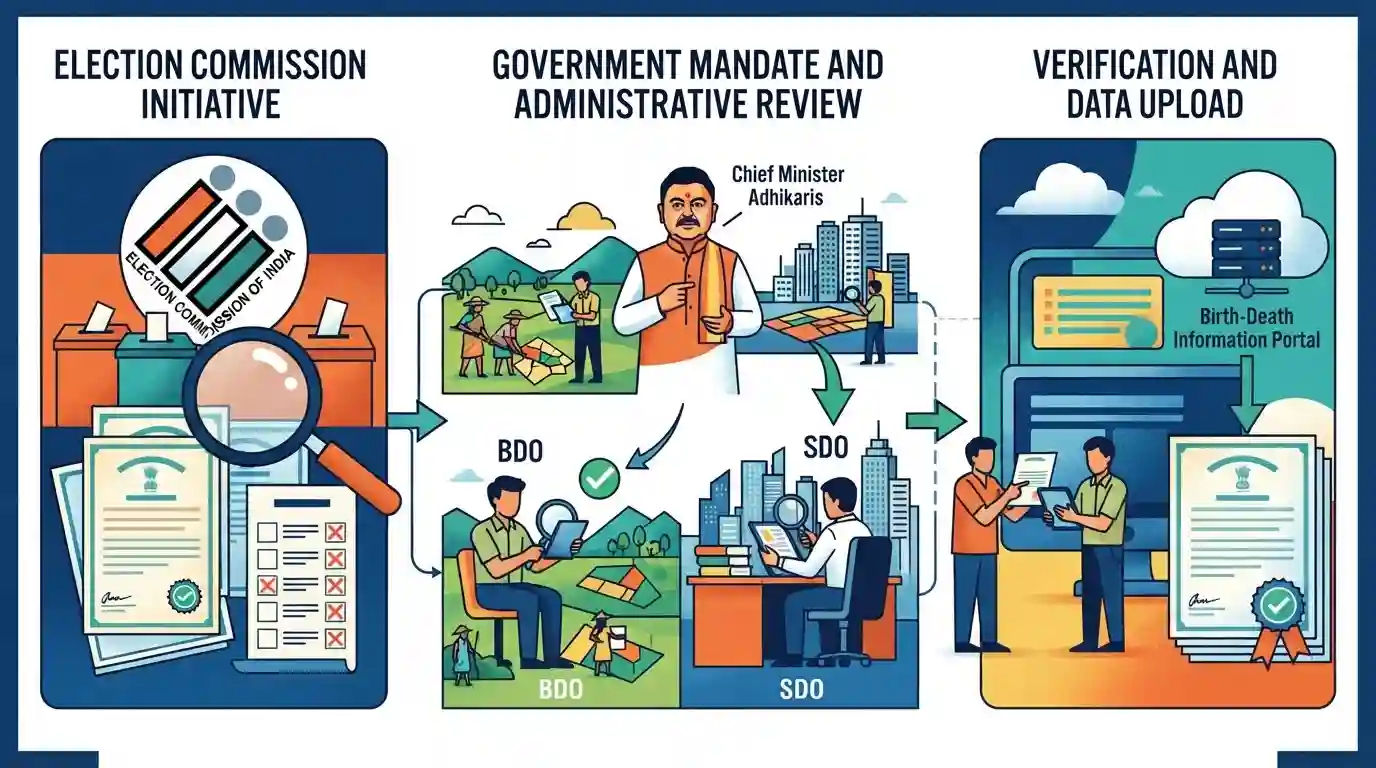
Demonstrates the intersection between civil registration and electoral integrity, highlighting the functional role of local administrative officers (SDOs/BDOs) in executing systemic governance audits.
Summary
The West Bengal government, led by Chief Minister Suvendu Adhikari, has mandated the reverification of all birth certificates issued between 2021 and 2026. This administrative overhaul was initiated after the Election Commission of India identified numerous fake certificates during its special intensive revision of electoral rolls. The verification exercise will be conducted by Block Development Officers (BDOs) in rural regions and Sub-divisional Officers (SDOs) in urban areas, with the final findings uploaded to the state's Birth-Death Information Portal.
Key Points
- The West Bengal government ordered a reverification of all birth certificates (digital and offline) issued between 2021 and 2026.
- The initiative follows the Election Commission of India (ECI) discovering a large number of fake birth certificates during the special intensive revision (SIR) before the recent assembly elections.
- Sub-divisional officers (SDOs) in urban areas and block development officers (BDOs) in rural areas are tasked with the verification process.
- Verified documents and comprehensive status reports must be uploaded to the 'Birth-Death Information Portal' by September.
Important Terms
Birth-Death Information Portal

West Bengal's official online platform for the state's Civil Registration System. It digitalizes the issuance and reverification of birth and death certificates to prevent forgery and ensure transparent record-keeping.
UPSC context
Important for WBCS Paper V and Paper IV, highlighting e-governance initiatives and civil registration administrative reforms.
Election Commission of India (ECI)
An autonomous constitutional body (Article 324) responsible for administering elections in India. It conducts periodic special intensive revisions of electoral rolls to eliminate fake voters and maintain accurate voter registries.
UPSC context
Core topic in WBCS Mains Paper V (Indian Polity), testing constitutional bodies, electoral processes, and voter verification mechanisms.
West Bengal Government
The sub-national executive and legislative authority administering West Bengal. In this context, it is responsible for state-wide governance, local administration through BDOs and SDOs, and managing the civil registration framework.
UPSC context
Essential for WBCS Paper V (State Administration), covering the powers, functions, and local administrative machinery of state governments.
Bharatiya Janata Party (BJP)
A major national political party in India. According to the 2026 context, it currently leads the West Bengal state government, initiating administrative reforms like the certificate reverification drive.
UPSC context
Relevant to WBCS Paper V (Indian Polity) for understanding the multi-party system and contemporary state political dynamics.
Trinamool Congress
A prominent Indian political party. In the article's 2026 context, it was the preceding ruling party in West Bengal, during whose tenure the disputed birth certificates were originally issued.
UPSC context
Relevant for WBCS Mains Paper V, covering regional political parties, electoral history, and transitions in state governments.
Prelims Trap
"The Election Commission of India mandated and is conducting the reverification of birth certificates in West Bengal."
While the ECI flagged the fakes during electoral roll revisions, civil registration is a State function. The state government, not the ECI, ordered and conducts the reverification exercise.
Static Concepts Connected
What is the statutory framework for birth and death registration in India?
- RBD Act 1969: Provides the central statutory framework for compulsory registration of births and deaths across India.
- 21-day timeline: Registration of births and deaths must mandatorily be completed within 21 days of the event.
- Executing Authority: Overseen nationally by the Registrar General of India (RGI), but executed by the State through local registrars like BDOs and SDOs.
What are the constitutional and statutory provisions governing electoral rolls?
- Article 324: Vests the superintendence, direction, and control of the preparation of electoral rolls in the Election Commission of India.
- RPA 1950: Section 21 mandates the preparation and regular revision of electoral rolls, including the Special Intensive Revision (SIR).
Cross-Topic Patterns
ECI powers vs. State administrative machinery
The ECI's mandate to purify electoral rolls often compels state administrative overhauls. This highlights the dual role of state bureaucrats (BDOs/SDOs) functioning under ECI deputation during elections.
E-Governance in vital statistics
West Bengal's 'Janma-Mrityu Tathya' portal reflects the broader national push for digital vital registration via the Civil Registration System, crucial for welfare targeting and potential NPR linkages.

Expect a statement-based question testing the difference between ECI's electoral roll powers (RPA 1950) and state civil registry rules.
Linked PYQs · 3
Linked PYQs · 3
- 2021WBCS_PRELIMSGS1
The Election Commission is constructed by the
- 2015WBCS_PRELIMSGS1
The local self-government of Kolkata is
- 2021WBCS_PRELIMSGS1
Who is the present Chief Election Commissioner of India (as of June, 2021)?
