West Bengal Launches Drive to Register Migrant Workers for Jobs
Source:theprint ↗
Why It Matters
The socio-economic dynamics of migrant labor are vital for West Bengal's administration. For WBCS Prelims, understanding the demographic concentration of migrant workers highlights key geographic realities (e.g., population and economic challenges in districts like Murshidabad and Malda). Additionally, rural employment guarantee frameworks are a fundamental component of the Indian Economy syllabus.
Summary
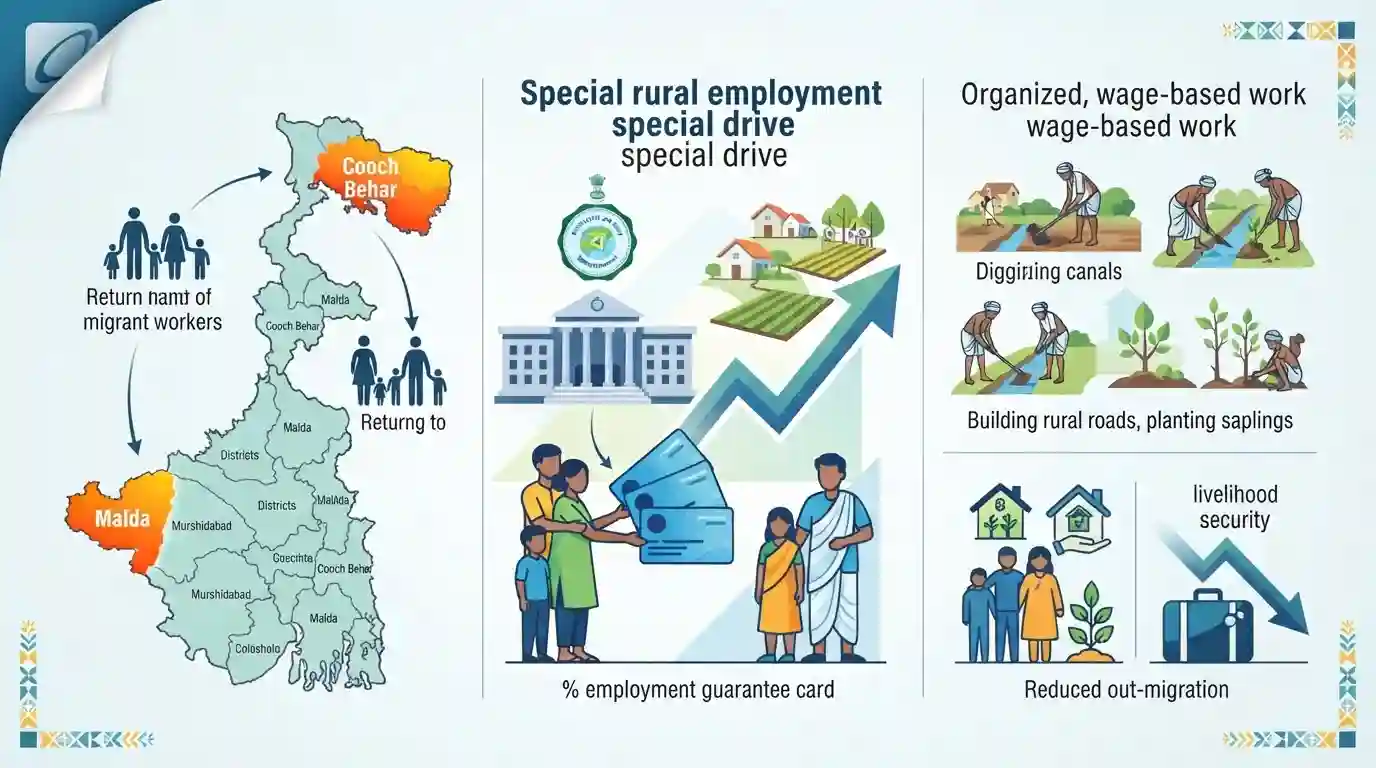
West Bengal has launched a special drive to provide rural employment guarantee cards to the families of over 22 lakh migrant workers. Murshidabad, Malda, and Cooch Behar reported the highest number of migrant workers among the state's 22 districts. The initiative, directed by the Panchayats and Rural Development Department, seeks to ensure eligible adult family members receive wage-based work on demand, aiming to bolster rural livelihood security and curb out-migration.
Key Points
- The West Bengal government launched a special drive to issue rural employment guarantee cards to families of over 22.24 lakh identified migrant workers across 22 districts.
- Murshidabad accounts for the highest number of identified migrant workers (over 3.86 lakh), followed by Malda and Cooch Behar.
- The Panchayats and Rural Development Department has instructed district administrations to ensure 100% coverage so eligible adults can demand and receive wage-based work.
- The initiative aims to strengthen local livelihood security for rural families and reduce the necessity of migrating for employment.
Important Terms
Rural employment guarantee programme

A government initiative offering a legal guarantee for wage-based rural employment to eligible adults. It aims to ensure livelihood security, stimulate the local economy, and curb distress out-migration.
UPSC context
Tested in WBCS Paper V (Indian Economy). Focuses on poverty alleviation, rural development strategies, and employment generation schemes.
MGNREGA
The Mahatma Gandhi National Rural Employment Guarantee Act (2005) mandates at least 100 days of guaranteed wage employment annually for rural households whose adults volunteer for unskilled manual labor.
UPSC context
Highly tested in Indian Economy (Paper V) regarding its core provisions, rural livelihood impact, and center-state funding dynamics.
Panchayats and Rural Development Department
The nodal state government department in West Bengal responsible for decentralized rural governance, local infrastructure, and implementing job schemes like the special drive for migrant workers.
UPSC context
Relevant for Paper VI (Polity & Administration); covers state-level administrative architecture, Panchayati Raj, and local governance.
Labour Department
The state authority tasked with labor welfare and employment tracking. It maintains the crucial database of West Bengal's 22 lakh identified migrant workers used for targeted welfare interventions.
UPSC context
Important for WBCS Paper V and VI, focusing on labor policies, demographic data, and social welfare administration in Bengal.
Prelims Trap
"The Labour Department is the nodal agency for issuing employment guarantee cards to migrants."
Aspirants intuitively link 'migrant workers' to the Labour Department, but rural employment guarantee programs are executed by the Panchayats and Rural Development Department.
Static Concepts Connected
What are the core constitutional and legal mandates behind the rural employment guarantee (MGNREGA)?
- Legal Guarantee: Legally guarantees 100 days of wage employment in a financial year to rural households whose adult members volunteer for unskilled manual work.
- DPSP Linkage: The scheme translates the Directive Principles of State Policy, specifically Article 41 (Right to Work), into a statutory right.
- Unemployment Allowance: If work is not provided within 15 days of a valid application, the state must pay an unemployment allowance.
What drives high out-migration in districts like Murshidabad and Malda?
- High Demographic Pressure: These districts exhibit some of the highest population densities in West Bengal, leading to fragmented, unviable agricultural landholdings per capita.
- Industrial Deficit: A severe lack of large-scale manufacturing and industrial hubs forces unskilled and semi-skilled laborers to seek construction and agricultural work outside the state.
- Riverbank Erosion: Vulnerability to riverbank erosion (especially by the Ganga/Padma) frequently causes landlessness and displaces rural families, acting as a major push factor.
Cross-Topic Patterns
Border demographics and out-migration patterns
High out-migration districts like Murshidabad and Malda overlap with border geography and high population density, directly linking demographic pressures with rural unemployment challenges in WB.
Centre-State fiscal federalism in rural schemes
West Bengal's localized drives for job card distribution are closely tied to recent Centre-State disputes over MGNREGA fund allocations, prompting state-specific schemes like 'Karmashree'.

Highest out-migration districts (Murshidabad, Malda) and the P&RD nodal agency are prime targets for WBCS Geography and Economy MCQs.
Linked PYQs · 4
Linked PYQs · 4
- 2013WBCS_PRELIMSGS1
National Rural Employment Guarantee Scheme gives right to employment for
- 2018WBCS_PRELIMSGS1
Murshidabad district is bisected into two halves by
- 2016WBCS_PRELIMSGS1
Largest tobacco producer district of West Bengal is :
- 2016WBCS_PRELIMSGS1
The tropic of Cancer passes through which district of West Bengal ?
