West Bengal Enforces Specific Provisions of Public Safety Act
Source:newindianexpress ↗
Why It Matters
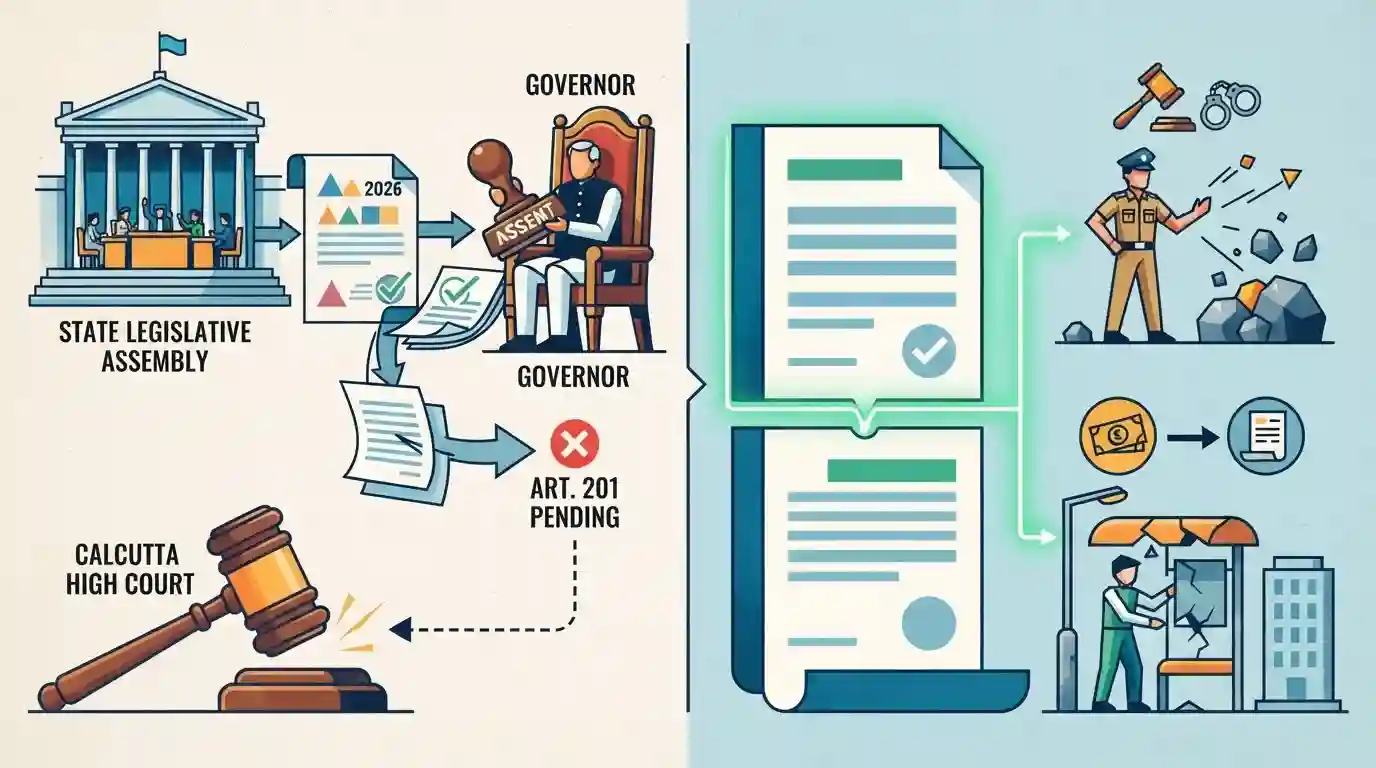
Brings attention to the constitutional mechanism under Articles 200 and 201 concerning the reservation of State Bills for the President's assent, and whether state governments can notify severable provisions that have obtained the Governor's approval.
Summary
The West Bengal government has invoked a specific portion of the West Bengal Public Safety and Control of Anti-Social Activities Act, 2026, aimed at prosecuting those attacking police personnel and recovering costs for damaging public property. While the Calcutta High Court had noted that the overall legislation could not be termed an Act as parts of it are still awaiting Presidential assent, the Chief Minister announced that the state could legally enforce the specific provisions that have already received the Governor's nod.
Key Points
- The West Bengal government has implemented a specific section of the new 'anti-goonda' Act dealing with attacks on police and recovery of damages to public property.
- The Calcutta High Court had recently declined to hear petitions challenging the Bill's constitutional validity because it had not yet fully become an Act.
- While some provisions await the President's assent, the state government proceeded with enacting the portion that received the Governor's approval.
Important Terms
West Bengal Public Safety and Control of Anti-Social Activities Act, 2026

A 2026 state law targeting organized crime by permitting up to 12 months of preventive detention without trial, property confiscation, and externment orders for anti-social elements.
UPSC context
Relevant for WBCS Paper V (Polity); tests state law-making powers, preventive detention limits, and public order frameworks.
Article 200 of the Constitution
A constitutional provision outlining the Governor’s powers over state bills: to grant assent, withhold assent, or reserve the bill for the President's consideration.
UPSC context
Crucial for WBCS Paper V; tests the Governor's legislative powers and constitutional checks within center-state relations.
Article 201 of the Constitution
Details the process for state bills reserved by the Governor. The President can grant assent, withhold it, or return non-Money Bills for state legislature reconsideration.
UPSC context
Vital for WBCS Paper V (Polity); examines the President's absolute veto power and Union oversight over State legislation.
Preventive Detention
The confinement of an individual without a conventional trial to prevent them from committing future offenses or endangering public safety and order.
UPSC context
Relevant for WBCS Paper V (Fundamental Rights); tests the exceptions under Article 22 and constitutional limits on personal liberty.
State List (List II)
The second list in the Seventh Schedule of the Constitution, enumerating subjects like 'Public Order' and 'Police' where state legislatures hold exclusive law-making authority.
UPSC context
Essential for WBCS Paper V (Federalism); tests the constitutional distribution of legislative powers between the Union and States.
Calcutta High Court
The oldest High Court in India, serving as the constitutional court for West Bengal. It scrutinizes the legal validity of state legislation and executive actions.
UPSC context
Core to WBCS Paper V; tests knowledge of High Court jurisdictions, judicial review, and institutional checks and balances.
Prelims Trap
The High Court can strike down a legislative Bill if it violates constitutional provisions before executive assent.
The judiciary cannot conduct constitutional reviews of incomplete legislative processes. A Bill must receive formal executive assent to become an Act before judicial review applies.
Static Concepts Connected
What are the Governor's options under Article 200 when presented with a State Bill?
- Assent or withhold: The Governor may formally give assent or withhold assent to the passed Bill.
- Return for reconsideration: The Governor can return a non-Money Bill to the state legislature with a message requesting reconsideration of specific provisions.
- Reserve for President: The Governor may reserve the Bill for the President's consideration (mandatory if the Bill endangers the position of the State High Court).
How does Article 254 resolve conflicts (repugnancy) between State and Central laws?
- General Repugnancy Rule: If a State law on a Concurrent List subject conflicts with a Central law, the Central law generally prevails and the State law is void.
- Presidential Exception: Under Article 254(2), the State law prevails within that state if it was reserved for and received the assent of the President.
- Parliamentary Override: Even if a State law gets Presidential assent, Parliament can still enact a new law to add, amend, vary, or repeal that State law.
Cross-Topic Patterns
Gubernatorial delays and federal friction
Parallels the recent Supreme Court litigations involving Kerala, Punjab, and Tamil Nadu regarding Governors indefinitely withholding assent or selectively reserving bills for the President under Article 200.
Public property damage recovery laws
Connects to the Prevention of Damage to Public Property Act, 1984, and Supreme Court guidelines on holding protestors financially liable, an approach previously popularized by Uttar Pradesh.

Articles 200, 201 and 254(2) will likely form a multi-statement question testing the exact conditions for Presidential assent.
Linked PYQs · 2
Linked PYQs · 2
- 2015WBCS_PRELIMSGS1
A bill of a state legislature becomes an Act when
- 2017WBCS_PRELIMSGS1
'Law and Order' is included in the
