Banga Bibhusan civilian award withdrawal over Netaji remarks
Source:The Hindu ↗
Why It Matters
Questions relating to Subhas Chandra Bose, the Azad Hind Fauj, and state-specific civilian awards (like Banga Bibhusan) are directly relevant for the WBCS Prelims exam under Modern Indian History and Current Events of State Importance.
Summary
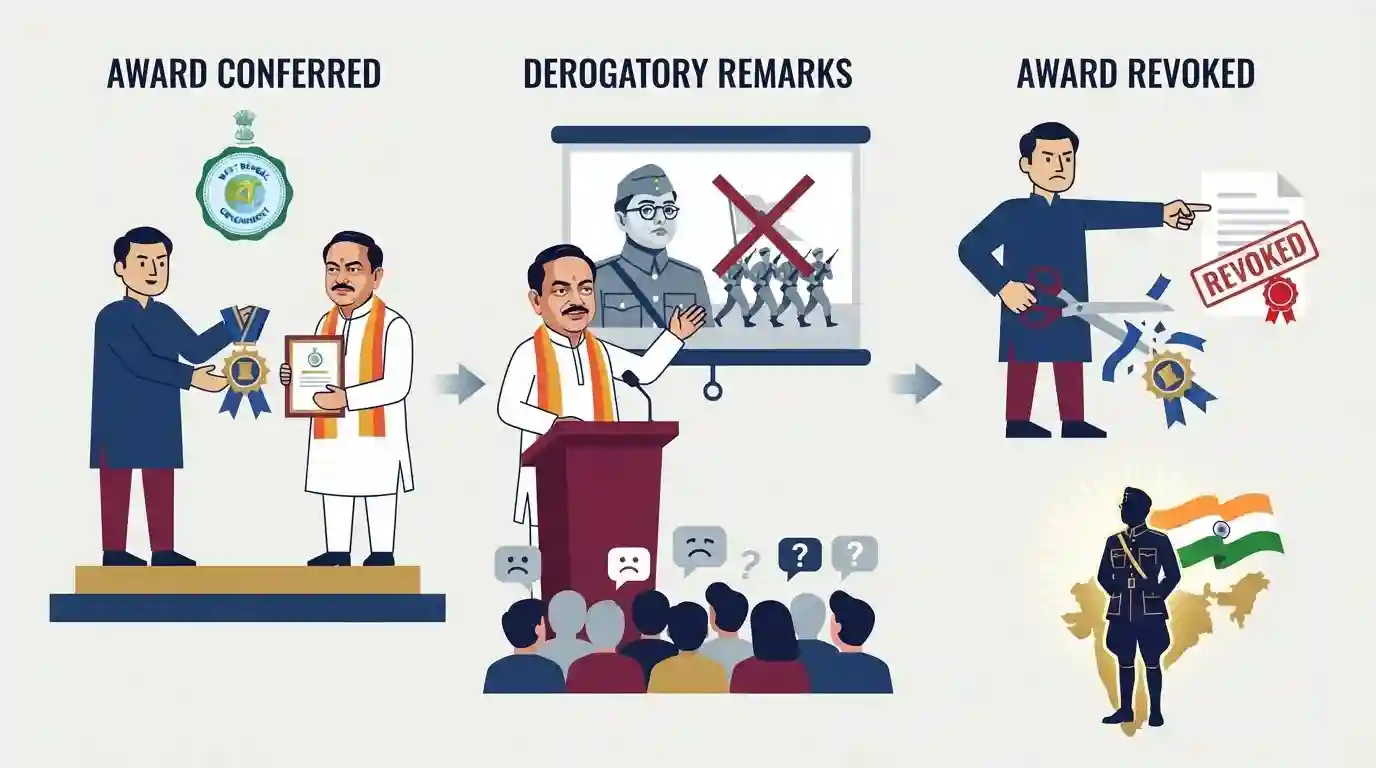
The West Bengal Government has revoked the Banga Bibhusan award given to BJP MP Nagendra Roy (Ananta Maharaj) due to his derogatory remarks against Netaji Subhas Chandra Bose and the Azad Hind Fauj. Roy, a leader of the Greater Coochbehar People’s Association, had questioned the INA's role in India's freedom struggle, sparking widespread condemnation. The Banga Bibhusan is the state's highest civilian honor. The controversy underscores the enduring legacy of Subhas Chandra Bose and the Indian National Army in India's independence movement.
Key Points
- The West Bengal Government has withdrawn the Banga Bibhusan award from BJP Rajya Sabha MP Nagendra Roy.
- The action was prompted by Roy's derogatory remarks against Netaji Subhas Chandra Bose, calling him a war criminal and questioning the contribution of the Azad Hind Fauj.
- The Banga Bibhusan, West Bengal's highest civilian state award, was conferred upon Roy in 2022.
- Roy is a prominent leader of the Greater Coochbehar People’s Association (GCPA).
- The incident brings attention to the legacy of Netaji and the Indian National Army (INA), a highly significant topic for modern Indian history.
Important Terms
Banga Bibhusan

The highest civilian honor instituted by the West Bengal government in 2011 to recognize outstanding contributions by personalities in various fields such as art, culture, and public service.
UPSC context
Relevant for State Civilian Awards in General Awareness; tests knowledge of regional honors and their socio-political significance.
Azad Hind Fauj (Indian National Army)
An armed force formed by Indian nationalists during WWII. Revived by Subhas Chandra Bose in 1943, it allied with Axis powers to secure India's independence from British rule.
UPSC context
Crucial for GS Paper I (Modern Indian History); tests knowledge of Bose's ideology, the INA trials, and military resistance.
Greater Coochbehar People’s Association (GCPA)
A regional political organization in North Bengal campaigning for a separate "Greater Cooch Behar" state, citing the 1949 accession treaty of the Cooch Behar princely state.
UPSC context
Relevant for GS Paper I & II (Regionalism, Post-Independence Consolidation); highlights ethnic statehood demands and internal security dynamics.
Prelims Trap
"Subhas Chandra Bose originally founded the Indian National Army (Azad Hind Fauj) in 1942."
The INA was originally formed in 1942 by Captain Mohan Singh with Japanese assistance. Subhas Chandra Bose only took over its leadership and revamped it later in 1943.
Static Concepts Connected
What were the distinct phases in the formation of the Indian National Army (INA)?
- Mohan Singh Phase: The first INA was formed in 1942 by Captain Mohan Singh using Indian POWs, but collapsed due to friction with the Japanese military.
- Subhas Chandra Bose: Bose took over leadership in 1943 in Singapore, forming the Provisional Government of Free India (Arzi Hukumat-e-Azad Hind) and vastly expanding the army.
- Indian Independence League: Led by Rash Behari Bose, it mobilized the Indian diaspora in Southeast Asia and laid the groundwork before being handed over to SC Bose.
How was the princely state of Cooch Behar integrated into post-independence India?
- Instrument of Accession: Signed in 1947 by the Maharaja of Cooch Behar, ceding defense, external affairs, and communications to the Indian Dominion.
- Merger Agreement: Signed in 1949, transferring full administrative control. It was placed under a Chief Commissioner before officially merging as a district of West Bengal in 1950.
Cross-Topic Patterns
State Awards & Article 18
State honors like Banga Bibhusan parallel Padma Awards. UPSC tests if such awards violate Article 18 (abolition of titles) and the constitutional/legal grounds for revoking civilian honors.
Cooch Behar & Statehood Demands
The GCPA's involvement highlights post-independence state reorganization issues, echoing parallel regional autonomy or statehood demands like Gorkhaland and Bodoland in eastern India.

Expect chronological matching questions combining INA's foundational phases with post-1947 princely state integrations in 2026.
Linked PYQs · 3
Linked PYQs · 3
- 2017WBCS_PRELIMSGS1
Who was the founder of the 'Azad Hind Fauz'?
- 2018WBCS_PRELIMSGS1
Party founded by Subhash Bose was
- 2019WBCS_PRELIMSGS1
Who set up the Indian Independence League?
