West Bengal Introduces Hybrid Electric Ferries for Hooghly Tourism
Source:millenniumpost ↗
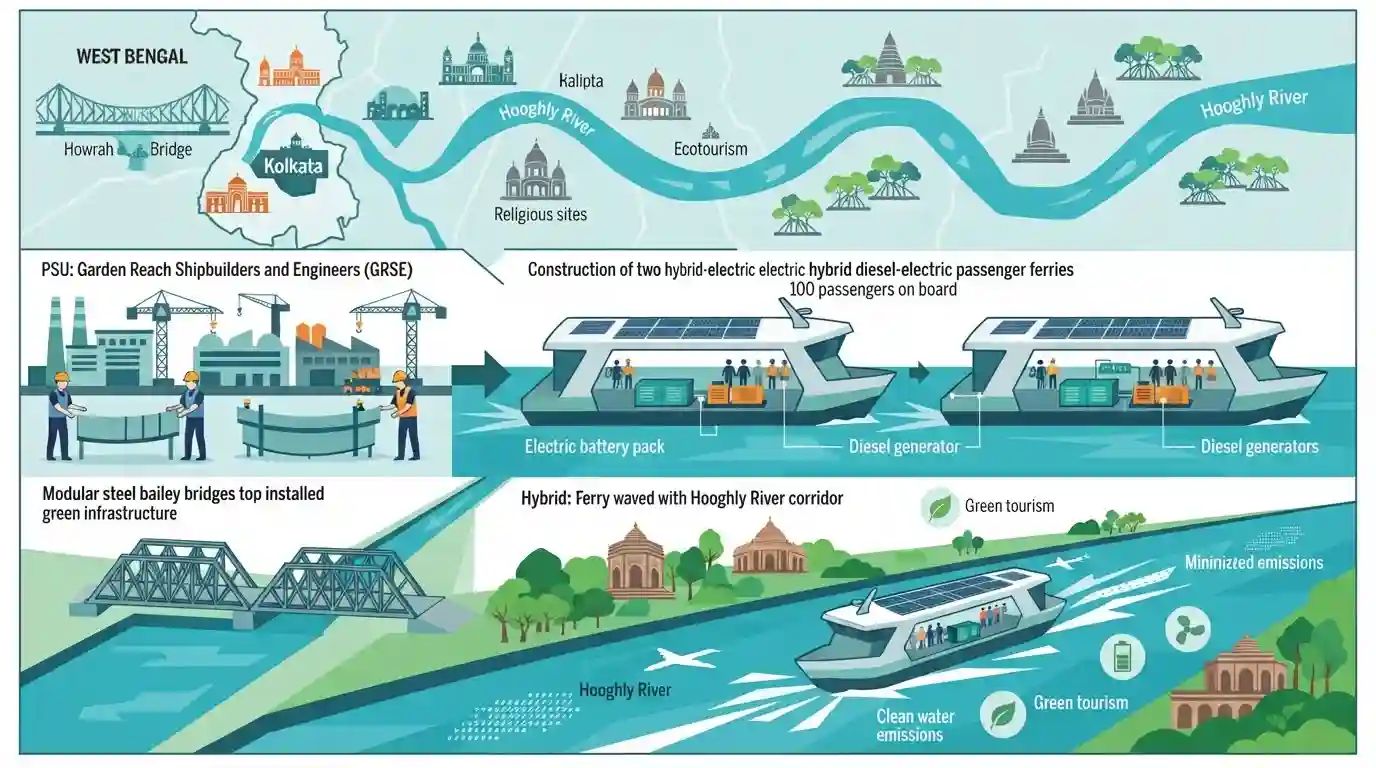
Why It Matters
The initiative marks a significant step in green mobility and inland water transport (IWT) in India. For WBCS Prelims, it links major syllabus topics including West Bengal's river geography (Hooghly River and NW-1), historical transport systems, and the role of Kolkata-based Defense PSUs like GRSE.
Summary
The West Bengal government is introducing India's first hybrid-electric passenger ferries for Hooghly River tourism. Handed over to Kolkata-based PSU Garden Reach Shipbuilders and Engineers (GRSE) Ltd, the project includes constructing two 100-passenger hybrid diesel-electric vessels and two bailey bridges. The project aims to develop a green tourism corridor linking Kolkata with key historical and religious sites, minimizing carbon footprint and promoting inland water transport (IWT).
Key Points
- The West Bengal State Tourism Department has formally commissioned Garden Reach Shipbuilders and Engineers (GRSE) Ltd to build two 100-passenger hybrid-electric ferries and two bailey bridges.
- This initiative is a first-of-its-kind in India, combining green mobility with eco-friendly inland river tourism along the Hooghly River to connect Kolkata with historic, colonial, and religious heritage sites.
- The hybrid diesel-electric ferries are designed with a length of 24 meters, a width of 8 meters, a passenger capacity of 100, and a shallow draft requirement of 1 meter to navigate inland waterways efficiently.
- The vessels are powered by advanced hybrid propulsion systems (batteries and diesel generators) that reduce carbon emissions and operational costs, achieving speeds of up to 9 knots in hybrid mode and 7 knots in fully electric mode.
- Classed by the Indian Register of Shipping (IRS), the vessels are expected to lower noise and vibration levels, offering enhanced passenger comfort.
Important Terms
Garden Reach Shipbuilders and Engineers (GRSE) Ltd

A premier Indian Navratna Defence Public Sector Undertaking based in Kolkata that designs and builds warships, commercial vessels, and modular steel bridges for national and international clients.
UPSC context
WBCS Paper III (Geography of West Bengal - Industries); tests knowledge of major public sector undertakings headquartered in the state.
Indian Register of Shipping (IRS)
An internationally recognized, independent ship classification society founded in India in 1975 that provides technical inspection, certification, and safety standards for marine vessels and offshore structures.
UPSC context
WBCS Paper IV (Science, Technology, and Environment); tests knowledge of regulatory bodies and safety certification standards in India's maritime sector.
West Bengal Tourism Development Corporation (WBTDCL)
A state-owned agency established in 1974 to develop, promote, and manage tourism infrastructure, hospitality services, and cultural heritage corridors across West Bengal.
UPSC context
WBCS Paper III (Geography of West Bengal); tests state-level tourism projects, economic development, and regional connectivity corridors.
National Waterway-1 (NW-1)
India's longest inland waterway, spanning from Haldia to Prayagraj along the Ganga-Bhagirathi-Hooghly river system, facilitating eco-friendly cargo and passenger transport.
UPSC context
WBCS Paper III (Geography of India - Transport); tests knowledge of inland water transport networks and river-based infrastructure in West Bengal.
Prelims Trap
West Bengal's hybrid-electric ferries represent India's first-ever electric passenger water transport system.
Kochi Water Metro (Kerala) was India's first commercial electric hybrid ferry network; the Hooghly project is West Bengal's first green tourism corridor.
Static Concepts Connected
What are the geographical limits and status of National Waterway 1 (NW-1)?
- Route extent: Spans 1,620 km from Prayagraj to Haldia along the Ganga-Bhagirathi-Hooghly river system, making it India's longest national waterway.
- West Bengal stretch: The river is officially designated as the Hooghly from Nabadwip (Nadia district) downstream to the Bay of Bengal.
What is the historical and administrative profile of GRSE?
- Origin and status: Established in 1884 in Kolkata, it is a leading Defence Public Sector Undertaking under the Ministry of Defence.
- Key operations: Specializes in building state-of-the-art warships, auxiliary vessels, and green inland passenger ferries like 'Dheu'.
Cross-Topic Patterns
Riverine transport + Colonial heritage tourism
Connecting historical towns like Chandannagar and Chinsurah via green ferries integrates West Bengal's colonial history with sustainable transport infrastructure.
Defense PSUs + Civil green transition
GRSE leveraging defense shipbuilding capabilities for civilian inland waterways highlights dual-use industrial applications supporting India's Net-Zero emission targets.

NW-1 geography, GRSE's location, or West Bengal's green vessel 'Dheu' likely to feature in WBCS geography/state-scheme questions.
Linked PYQs · 4
Linked PYQs · 4
- 2006WBCS_PRELIMSGS1
From Nabadwip to Bay of Bengal the Ganga river is named as
- 2016WBCS_PRELIMSGS1
The biggest ship-building yard of India is :
- 2014WBCS_PRELIMSGS1
The biggest ship building yard of India is
- 2019WBCS_PRELIMSGS1
First railway line was started in West Bengal between
