West Bengal Industrial Policy Plans Land-Use Conversion Relaxations
Source:ianslive ↗
Why It Matters
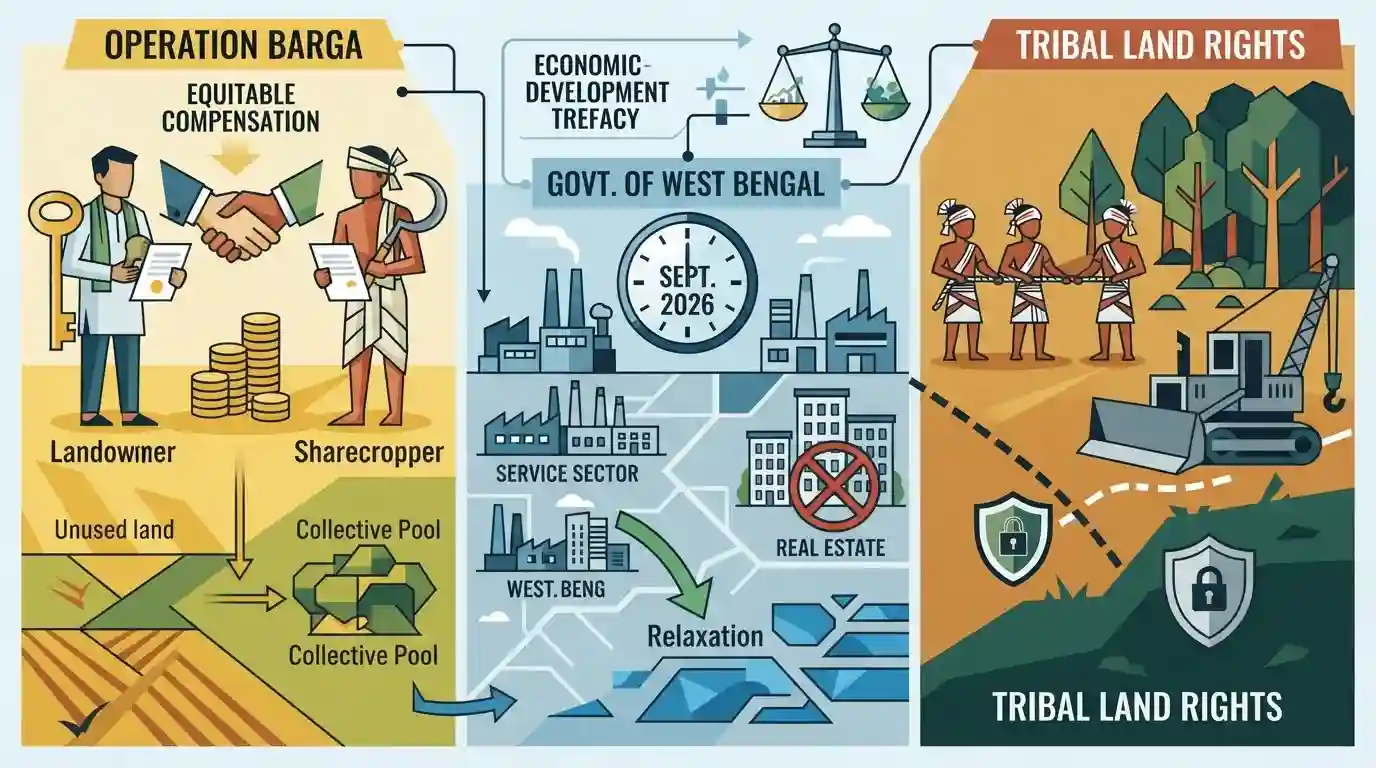
It highlights state-level strategies to stimulate industrialization through land reform, demonstrating the complex intersection of land acquisition, sharecropper (Bargadar) rights, ecological conservation, and the legal protection of tribal land.
Summary
The West Bengal government is preparing a new industrial policy to be announced by mid-September 2026, aiming to simplify land acquisition and usage. A key feature is the selective relaxation of land-use conversion rules, particularly for lands containing water bodies, to benefit manufacturing and services sectors—though real estate is explicitly excluded. Furthermore, the state intends to procure unused 'Barga' (sharecropping) land by ensuring equitable compensation for both landowners and sharecroppers. However, the legal restrictions preventing the transfer of tribal land to non-tribals continue to pose a significant hurdle for industrial expansion.
Key Points
- The West Bengal government plans to announce a new industrial policy by mid-September 2026, featuring selective relaxations in land-use conversion rules.
- Fast-track conversion of land containing water bodies will be permitted exclusively for manufacturing and services sectors, excluding real estate.
- The government will acquire long-unused 'Barga' land, compensating both the actual landowners and the sharecroppers (bargadars) equally at market or slightly higher rates.
- A major unresolved challenge remains the acquisition of tribal land for industrial use, as existing laws strictly prohibit the transfer of tribal land to non-tribals.
Important Terms
Operation Barga

A landmark 1978 land reform movement in West Bengal that systematically registered sharecroppers (bargadars), granting them legal tenancy rights, protecting them from arbitrary eviction, and ensuring a fair share of agricultural produce.
UPSC context
Highly relevant for WBCS Paper III (History) and Paper IV (Economy). Tests knowledge of structural land reforms and agrarian changes in Bengal.
Barga System
An agrarian arrangement where sharecroppers cultivate land and give a portion of the harvest to the actual owner. In West Bengal, bargadars hold protective title deeds granting them tenancy security.
UPSC context
Important for Paper IV (Indian Economy) and Geography of West Bengal, testing agrarian structures and the state's rural economy dynamics.
West Bengal Industrial Policy 2026
The state's upcoming framework aiming to revive industrialization by easing land acquisition. It proposes relaxing land-use conversion for water bodies and procuring unused Barga land for the manufacturing and service sectors.
UPSC context
Crucial for Current Affairs and Paper IV (State Policies). Tests awareness of recent economic initiatives, governance, and investment hurdles in West Bengal.
Tribal Land Transfer Restrictions
Legal safeguards (like Section 14C of the West Bengal Land Reforms Act) prohibiting the sale of tribal land to non-tribals or corporations without strict administrative approval, aimed at preventing exploitation.
UPSC context
Key for Paper III (Polity) and Paper IV (Economy). Tests awareness of indigenous rights, constitutional safeguards, and industrial land acquisition challenges.
Land-Use Conversion
The legal process of changing a land plot's designated purpose—such as converting water bodies to industrial zones. Often heavily regulated, its proposed relaxation aims to fast-track industrial clearances.
UPSC context
Relevant for Paper IV (Economy) and Paper VI (Environment). Tests understanding of the regulatory balance between environmental conservation and industrial expansion.
Prelims Trap
"The new industrial policy allows fast-track land-use conversion of water bodies for both real estate and manufacturing."
The policy explicitly excludes real estate from the fast-track conversion of water bodies, reserving this relaxation strictly for the manufacturing and services sectors.
Static Concepts Connected
What was the primary objective of Operation Barga (1978)?
- Recording Rights: Aimed to legally record the names of sharecroppers to secure their tenancy rights and protect them from arbitrary eviction.
- Crop Share: Ensured a fair statutory share of the crop for the bargadar, typically up to 75% if they provided the agricultural inputs.
- Hereditary Rights: The movement ensured that the cultivation rights of registered bargadars became hereditary.
How does the West Bengal Land Reforms Act protect tribal land?
- Section 14C: Prohibits the transfer of land owned by Scheduled Tribes to non-tribals or private companies without strict prior approval.
- Revenue Officer Approval: Any valid transfer of tribal land requires explicit permission from a designated Revenue Officer.
- Restoration Provisions: Contains provisions allowing for the restoration of alienated tribal lands to their original owners if transferred illegally.
Cross-Topic Patterns
Operation Barga's Modern Legacy
The legacy of 1978's Operation Barga directly intersects with modern industrialisation, as recorded tenancy rights now necessitate dual-compensation models (owner + sharecropper) for land acquisition.
Industrial Expansion vs. Wetland Conservation
Relaxing conversion rules for water bodies echoes the ongoing tensions seen in protecting the East Kolkata Wetlands, linking industrial policy directly with state environmental conservation challenges.

Expect multi-statement questions testing Section 14C of the WB Land Reforms Act and the dual-compensation Barga model in Mains Paper V.
Linked PYQs · 5
Linked PYQs · 5
- 2019WBCS_PRELIMSGS1
West Bengal Land Reform Act came into force in
- 2005WBCS_PRELIMSGS1
'Operation Barga' refers to
- 2010WBCS_PRELIMSGS1
The Sixth Schedule of the Constitution of India contains provisions for
- 2009WBCS_PRELIMSGS1
At present, as per government rulings, the maximum area allowed for a Special Economic Zone (SEZ) is
- 2012WBCS_PRELIMSGS1
Point out the main objective of creating "SEZ" (Special Economic Zone) in India :
