RG Kar Medical College Incident: Hospitals Observe Silence
Source:thehindu ↗
Why It Matters
This case underlines the importance of workplace safety for essential service providers like healthcare workers. It highlights the intervention of the judiciary (suo motu cognizance by SC, transfer of probe to CBI by HC) when state machinery faces public mistrust, making it relevant for GS-II topics on constitutional bodies and public administration.
Summary
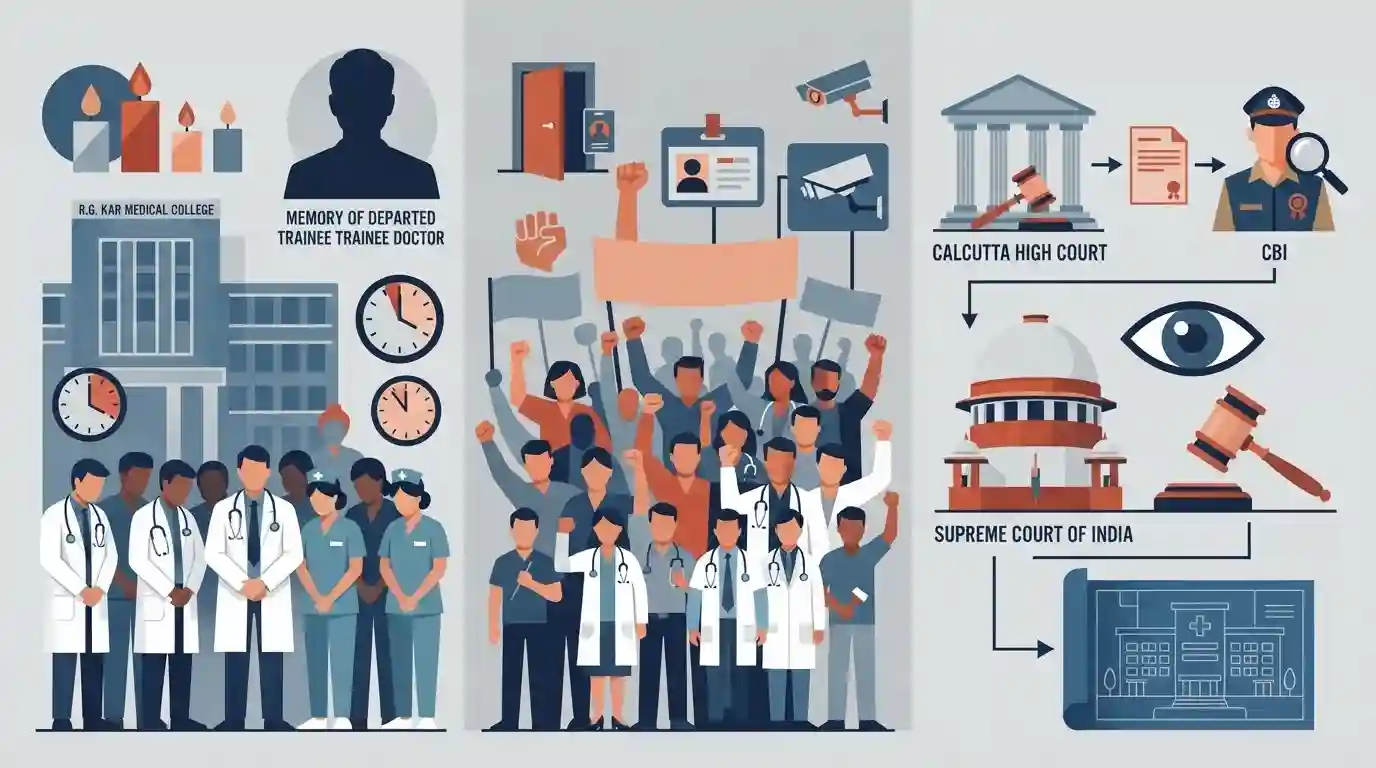
West Bengal government hospitals observed a two-minute silence in memory of the post-graduate trainee doctor who was raped and murdered at Kolkata's R.G. Kar Medical College and Hospital. The brutal incident sparked massive outrage, prompting the medical fraternity to demand strict safety protocols for healthcare workers. The case saw significant judicial intervention, with the Calcutta High Court handing the investigation to the CBI and the Supreme Court taking suo motu cognizance to enforce institutional security measures in hospitals.
Key Points
- Government hospitals in West Bengal observed a two-minute silence to honor the memory of the doctor who was raped and murdered while on duty at R.G. Kar Medical College.
- The tragic incident, which occurred in August 2024, sparked nationwide protests from medical professionals demanding enhanced workplace security.
- The Calcutta High Court transferred the probe into the crime and alleged financial irregularities to the Central Bureau of Investigation (CBI).
- The Supreme Court took suo motu cognizance of the case, issuing directives to improve security infrastructure and deploying paramilitary forces at the hospital.
Important Terms
Supreme Court of India

The apex judicial body under the Indian Constitution, possessing original, appellate, and advisory jurisdictions. It serves as the final interpreter of the Constitution and the ultimate guarantor of fundamental rights.
UPSC context
GS Paper 2 (Judiciary); tests understanding of judicial review, suo motu powers, and enforcement of fundamental rights like Article 21.
Central Bureau of Investigation (CBI)
India's premier investigative agency operating under the Ministry of Personnel, Public Grievances, and Pensions. It investigates corruption, economic offenses, and serious crimes, deriving powers from the DSPE Act, 1946.
UPSC context
GS Paper 2 (Statutory Bodies); crucial for questions on investigative mandates, federalism, state consent, and judicial oversight of investigations.
Calcutta High Court
The oldest High Court in India, established in 1862. It holds jurisdiction over West Bengal and the Andaman and Nicobar Islands, empowered to issue writs for fundamental rights enforcement.
UPSC context
GS Paper 2 (Judiciary); relevant for understanding constitutional remedies under Article 226 and the power to transfer investigations to central agencies.
R.G. Kar Medical College and Hospital
A state-run medical institution in Kolkata. It gained national prominence in 2024 following a tragic incident that triggered sweeping judicial interventions and a national task force on healthcare workplace safety.
UPSC context
GS Paper 2 (Health & Governance); highlights systemic challenges in institutional safety, gender violence, and workplace security for healthcare professionals.
Prelims Trap
The CBI cannot investigate a crime within a State's jurisdiction without the explicit consent of the State Government under any circumstances.
While Section 6 of the DSPE Act requires state consent, Constitutional Courts (SC and HCs) can bypass this and order a CBI probe under their writ jurisdiction.
Static Concepts Connected
How can the CBI assume jurisdiction over a case in a state?
- State Consent: Under Section 6 of the DSPE Act, 1946, the CBI needs either 'general' or 'case-specific' consent from the respective state government.
- Court Mandate: The Supreme Court (Article 32) and High Courts (Article 226) can unilaterally order a CBI investigation without the state government's consent.
How is workplace safety for women protected under Fundamental Rights?
- Article 19(1)(g): An unsafe or hostile working environment directly violates the fundamental right to practice any profession, trade, or business.
- Article 21: The right to life inherently includes the right to live with dignity, which encompasses physical safety and protection from harassment at workplaces.
- Vishaka Guidelines: The SC established that workplace harassment violates fundamental rights, laying the groundwork for the POSH Act.
Cross-Topic Patterns
Health & Police as State subjects
Demands for a permanent Central law protecting healthcare workers clash with the Seventh Schedule, as both 'Public Health' and 'Public Order/Police' are exclusively State List subjects.
CBI jurisdiction vs. State consent mechanics
Transferring state-level crimes to the CBI frequently triggers federalism debates. Constitutional courts bypassing the DSPE Act's state consent requirement is a recurring theme in Centre-State friction.

Expect a prelims statement mixing SC's suo motu powers (Arts 32, 129, 142) with CBI’s state-consent exceptions under the DSPE Act.
Linked PYQs · 3
Linked PYQs · 3
- 2020WBCS_PRELIMSGS1
The Supreme Court of India upheld that RTI was applicable to the
- 2020WBCS_PRELIMSGS1
'Chancellor' of the State-run Universities in West Bengal is
- 2020WBCS_PRELIMSGS1
According to Indian Constitution, the State Legislatures elect the
