Paschim Banga Awas Yojana verification survey deadline extension
Source:millenniumpost ↗
Why It Matters
Highlights administrative challenges in grassroots welfare implementation (weather, overlapping schemes) and the state's use of simple e-governance mechanisms (email helpdesks) to improve beneficiary access to the Paschim Banga Awas Yojana.
Summary
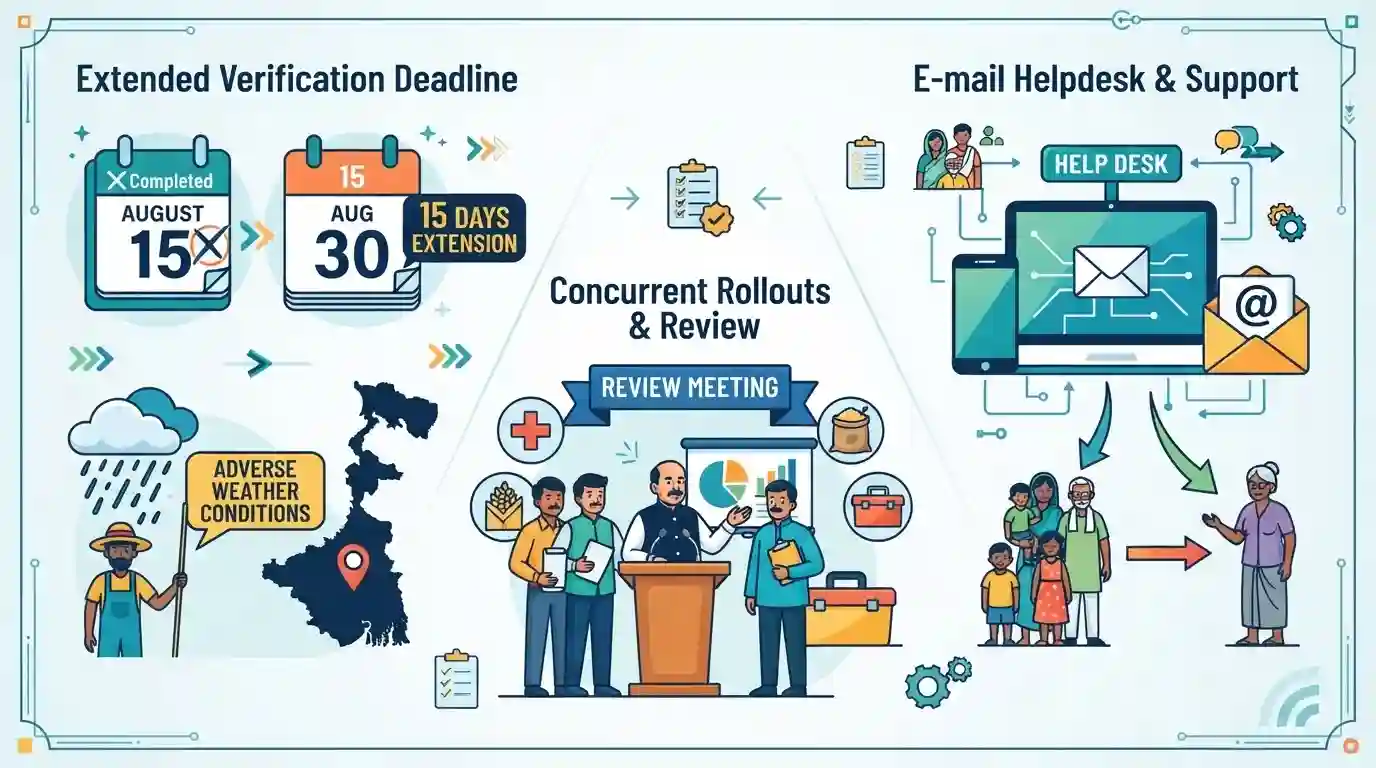
The West Bengal government has extended the deadline for the ongoing verification survey under the Paschim Banga Awas Yojana by 15 days, pushing past the original August 15 target. The state's Panchayats and Rural Development Minister Dilip Ghosh announced this extension after a review meeting in Durgapur, citing adverse weather conditions and concurrent rollouts of other schemes. Additionally, Ghosh launched an e-mail helpdesk for citizens seeking housing assistance under the scheme, emphasizing the government's commitment to ensuring no eligible family is left out.
Key Points
- The West Bengal government extended the deadline for the Paschim Banga Awas Yojana door-to-door verification survey by 15 days from its original August 15 deadline.
- The extension was granted by the Centre to account for delays caused by adverse weather conditions and the concurrent rollout of multiple government schemes.
- Panchayats and Rural Development Minister Dilip Ghosh announced the launch of an e-mail facility to help citizens easily request assistance or apply for housing under the scheme.
- The decision followed a high-level review meeting in Durgapur concerning housing scheme implementation in the East and West Burdwan districts.
Important Terms
Paschim Banga Awas Yojana

A 100% state-funded rural housing welfare scheme in West Bengal (formerly 'Banglar Bari') providing financial assistance of ₹1.20 lakh in two instalments to help eligible poor families construct permanent, secure houses.
UPSC context
GS Paper II (Welfare Schemes), testing government interventions, federal funding disputes, and rural housing.
Pradhan Mantri Awas Yojana (PMAY)
A flagship Centrally Sponsored Scheme launched by India's Ministry of Rural Development and Ministry of Housing and Urban Affairs to provide affordable, pucca housing with basic amenities to rural and urban poor.
UPSC context
GS Paper II (Welfare Schemes), testing social justice, housing security, and Centre-State cooperative federalism.
Panchayati Raj Institutions (PRIs)
The three-tier rural local self-government system in India (Gram Panchayat, Panchayat Samiti, and Zila Parishad) constitutionalized by the 73rd Constitutional Amendment Act, 1992, to empower grassroots democracy.
UPSC context
GS Paper II (Polity), testing decentralization, local governance, constitutional amendments, and rural development execution.
Direct Benefit Transfer (DBT)
A key e-governance initiative of the Indian government aimed at directly transferring subsidies and financial benefits to beneficiaries' bank accounts, enhancing transparency and reducing corruption or leakages.
UPSC context
GS Paper II (E-Governance/Welfare), testing transparency, financial inclusion, technology in governance, and administrative efficiency.
Panchayats and Rural Development Department
The nodal administrative department of the state government responsible for planning, executing, and monitoring rural welfare schemes, local governance, poverty alleviation, and infrastructural development.
UPSC context
GS Paper II (Governance), testing state administration machinery, local governance coordination, and rural development delivery mechanisms.
Prelims Trap
Pradhan Mantri Awas Yojana-Gramin (PMAY-G) is a Central Sector Scheme fully funded by the Central Government to ensure uniform implementation.
PMAY-G is a Centrally Sponsored Scheme (CSS), not a Central Sector Scheme. Funding is shared 60:40 with plain states and 90:10 with Himalayan/NE states.
Static Concepts Connected
What is the constitutional status of the 'Right to Shelter' in India?
- Article 21 integration: The Supreme Court in Chameli Singh (1996) held that the right to shelter is a fundamental right inseparable from the right to life.
- Broad interpretation: Shelter encompasses physical space, clean water, sanitation, electricity, and a safe environment, rather than just a physical roof.
- Directive principles link: Aligns with Article 38 (welfare promotion) and Article 47 (raising standard of living and nutrition levels).
How do CSS and Central Sector schemes differ in funding and execution?
- Central Sector Schemes: Fully 100% funded by the Union Government and mostly implemented directly by Union ministries.
- Centrally Sponsored Schemes: Funded on a cost-sharing basis (typically 60:40 or 90:10) and implemented entirely by State governments.
Cross-Topic Patterns
CSS Branding and Fiscal Federalism
Cooperative federalism is strained when the Centre suspends financial disbursements under Article 282 due to states altering scheme names, highlighting jurisdictional limits.
Social Welfare and Convergence Planning
Integrating housing with MGNREGA and Swachh Bharat exemplifies structural convergence, optimizing rural administrative efficiency and poverty reduction.

PMAY-G's cooperative federal friction, its CSS funding split, and its convergence with MGNREGA/SBM are highly likely for GS-II 2026.
Linked PYQs · 2
Linked PYQs · 2
- 2013WBCS_PRELIMSGS1
Panchayats in West Bengal are authorised to collect
- 2012WBCS_PRELIMSGS1
Name the programme of the poverty alleviation launched by the Government of India which was immensely benefited the rural power :
