Blood bank regulation and component trafficking crackdown
Source:the-csr-journal ↗
Why It Matters
Highlights the regulatory framework managing blood banks in India and the role of bodies like the State Blood Transfusion Council. Also connects directly to General Science syllabus concerning human blood components (RBCs, Plasma) which are frequent topics in State PCS preliminary exams.
Summary
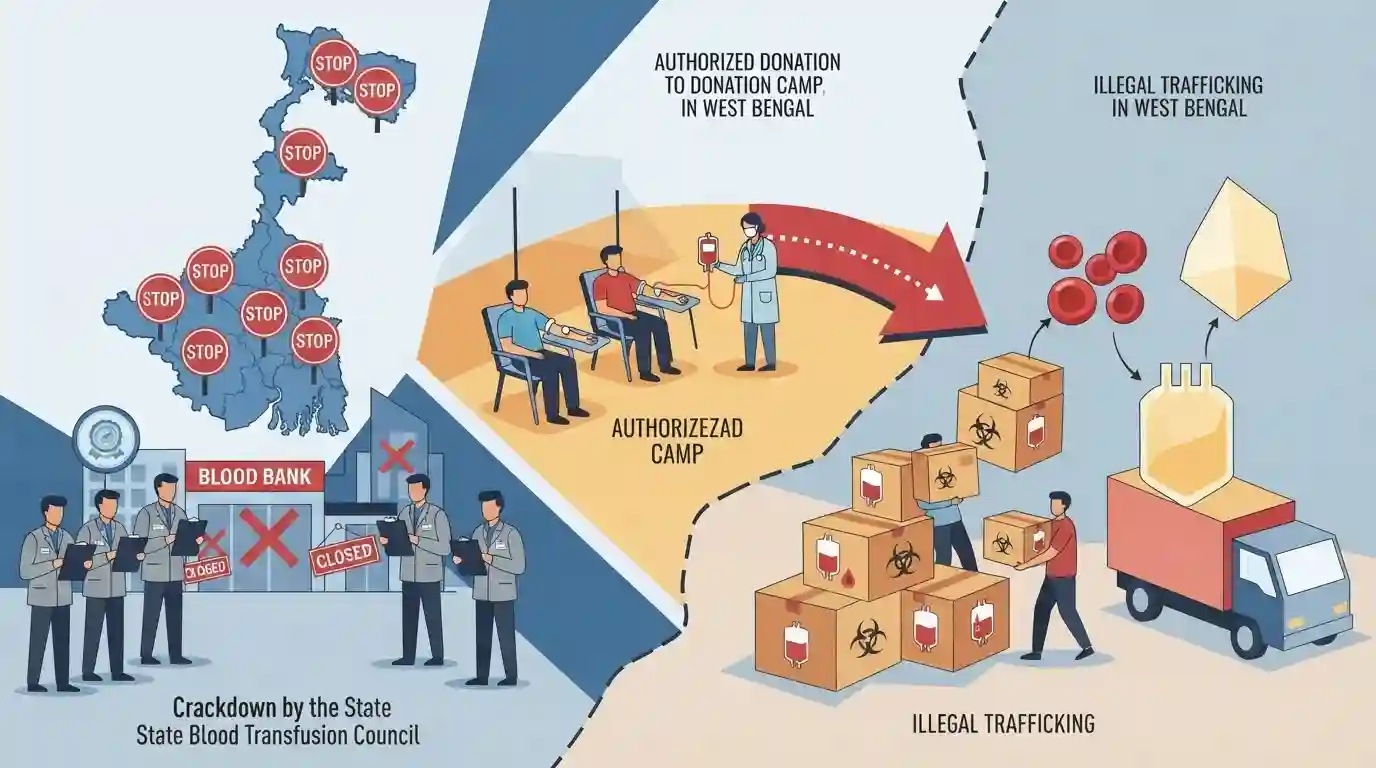
The West Bengal health department has cracked down on 11 blood banks across the state, restricting them from organizing external blood donation camps. The action, driven by the State Blood Transfusion Council's surprise inspections, comes amid allegations of unauthorized camps and the illegal trafficking of critical blood components, including red blood cells and plasma, to neighboring states.
Key Points
- West Bengal's health department has restricted 11 blood banks in the state after finding irregularities during inspections.
- The actions follow allegations of unauthorized blood donation camps and illegal trafficking of vital blood components such as red blood cells and plasma to other states.
- These blood banks are barred from organizing blood donation camps outside their premises until further notice.
- The State Blood Transfusion Council (SBTC) conducted surprise inspections to probe the trafficking claims.
Important Terms
State Blood Transfusion Council (SBTC)

Apex state-level bodies coordinating with the National Blood Transfusion Council to regulate blood transfusion services, promote voluntary donation, and oversee the licensing and inspection of blood banks.
UPSC context
GS Paper 2 (Health Governance). Highlights regulatory mechanisms for safe blood transfusion and public health administration.
West Bengal Health Department
The state government body responsible for administering public health services, enforcing medical regulations, and overseeing healthcare facilities—including blood banks—to ensure health security and compliance.
UPSC context
GS Paper 2 (State Interventions). Demonstrates the role of state agencies in executing health policies and cracking down on medical malpractices.
Blood Trafficking
The illegal commercialization, sale, or smuggling of human blood components. This violates India's National Blood Policy, which strictly prohibits the sale of blood, mandating it as a voluntarily donated commodity.
UPSC context
GS Paper 2 (Health) & GS Paper 3 (Organized Crime). Tests knowledge of health regulations, black market ethics, and law enforcement.
Red Blood Cells (RBCs)
Biconcave, enucleated blood cells containing hemoglobin. They make up a major cellular component of blood, functioning primarily to transport oxygen from the lungs to tissues throughout the body.
UPSC context
Prelims (General Science). Crucial for basic human biology, understanding respiratory transport, and diseases like anemia or thalassemia.
Blood Plasma
The yellowish liquid component of blood that holds blood cells in suspension. Constituting about 55% of blood volume, it primarily contains water, alongside crucial proteins, electrolytes, hormones, and waste products.
UPSC context
Prelims (General Science). Important for questions on human physiology, nutrient transport, and medical treatments like plasma therapy.
Prelims Trap
"Human blood and plasma are legally regulated under the Transplantation of Human Organs and Tissues Act in India."
Blood and its components are legally classified as a "drug" under the Drugs and Cosmetics Act, 1940, requiring CDSCO licensing, not organ transplant regulations.
Static Concepts Connected
What are the primary functions of human blood components?
- Red Blood Cells: Bind oxygen to hemoglobin for cellular transport; they lack a nucleus and have an average lifespan of about 120 days.
- Blood Plasma: The pale yellow liquid matrix (55% of blood volume) that transports dissolved nutrients, hormones, antibodies, and vital clotting factors like fibrinogen.
- Platelets & WBCs: Platelets are essential for blood coagulation (clotting), while White Blood Cells (leukocytes) manage immune defense against infections.
How is blood safety and transfusion regulated in India?
- Legal Classification: Human blood is legally defined as a "drug" under the Drugs and Cosmetics Act, 1940, mandating strict licensing by the Drug Controller General of India.
- Apex Body: The National Blood Transfusion Council (NBTC) is the apex policy-making body, enforcing the National Blood Policy which strictly prohibits paid or professional blood donations.
- e-RaktKosh Portal: A centralized IT portal under the National Health Mission (NHM) to provide real-time updates on blood availability and integrate donor tracking to prevent trafficking.
Cross-Topic Patterns
e-RaktKosh & Digital Health Governance
The e-RaktKosh portal relies on Aadhaar integration for donor tracking, connecting state-level blood trafficking issues directly to India's broader push for Digital Public Infrastructure (DPI) in healthcare like the Ayushman Bharat Digital Mission.
SC Directives & Regulatory Bodies
The NBTC's creation via a 1996 Supreme Court mandate reflects a recurring UPSC theme of judicial activism shaping critical health and environmental statutory bodies in India.

Expect a 2026 Prelims question mixing the biological functions of plasma/RBCs with blood's legal classification as a 'drug' under the law.
Linked PYQs · 3
Linked PYQs · 3
- 2020WBCS_PRELIMSGS1
Which can bind O2 molecules?
- 2018WBCS_PRELIMSGS1
Life span of red blood cells is ______ days.
- 2024WBCS_PRELIMSGS1
Which of the following carries oxygenated blood?
