Raniganj Coal Gasification Project Initiates Global Tech Hunt
Source:thestatesman ↗
Why It Matters
This project is critical for WBCS Prelims as it combines West Bengal geography (Raniganj Coalfields, ECL) with energy transition technology (surface coal gasification, syngas) and central policy initiatives (National Coal Gasification Mission, Viability Gap Funding). Understanding the geography of Paschim Bardhaman and coal mining history in Bengal is a frequent theme in the state services exam.
Summary
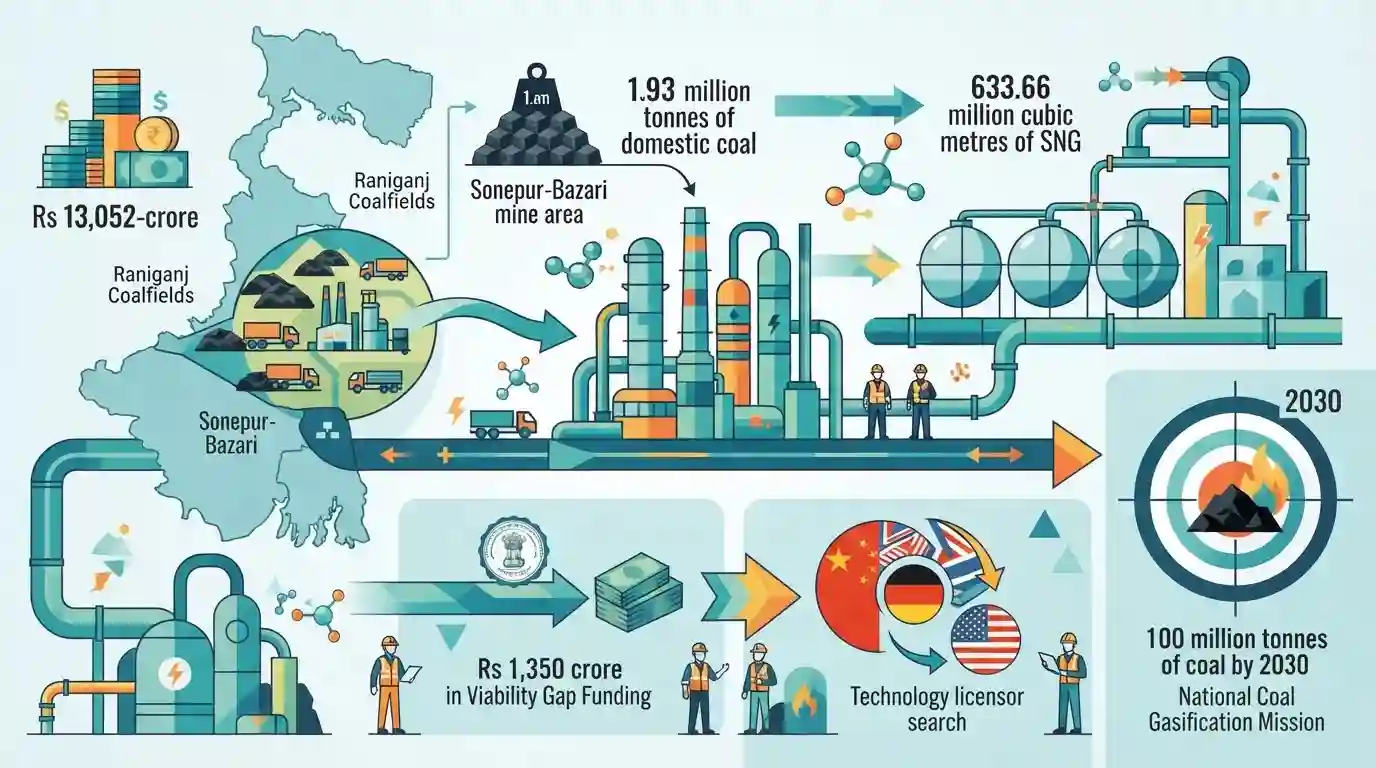
Coal Gas India Ltd (CGIL), a joint venture between Coal India Ltd and GAIL, is advancing its Rs 13,052-crore surface coal gasification project in the Raniganj Coalfields of West Bengal. Located at the Sonepur-Bazari mine area (between Pandaveswar and Jamuria), the facility aims to produce 633.66 million cubic metres of synthetic natural gas (SNG) annually using 1.93 million tonnes of domestic coal. Supported by Rs 1,350 crore in Viability Gap Funding (VGF) from the central government, the project has launched a global hunt for technology licensors from countries like China, Germany, and the USA. This landmark venture is a crucial step toward achieving the National Coal Gasification Mission's target of gasifying 100 million tonnes of coal by 2030.
Key Points
- Coal Gas India Ltd (CGIL), a Rs 13,052-crore joint venture between Coal India Ltd and GAIL, is setting up a landmark surface coal gasification (SCG) project in West Bengal.
- The project is located in the Sonepur-Bazari mine area of Eastern Coalfields Limited (ECL), between Pandaveswar and Jamuria in the Raniganj Coalfields.
- ECL has allocated 190 acres of land for the facility, which will consume 1.93 million tonnes of coal annually to produce 633.66 million cubic metres of synthetic natural gas (SNG) over a 25-year lifespan.
- The project has been approved for a Rs 1,350 crore Viability Gap Funding (VGF) by the Union Cabinet to de-risk the high capital expenditure.
- As India lacks indigenous technology for commercial-scale surface gasification of high-ash coal, CGIL is scouting for global technology licensors from countries such as China, Germany, and the United States.
- The initiative is a key part of India's National Coal Gasification Mission, which was launched in September 2021 with an aim to gasify 100 million tonnes of coal by 2030.
Important Terms
National Coal Gasification Mission

A strategic national initiative aimed at clean coal technology, targeting the gasification of 100 million tonnes of coal/lignite by 2030 to bolster energy security.
UPSC context
WBCS GS Paper IV and Paper III — tests national energy and environmental policies.
Viability Gap Funding (VGF) Scheme
A central government scheme providing financial grants to infrastructure projects that are economically justified but lack commercial viability, encouraging private or joint-venture investment.
UPSC context
WBCS GS Paper V (Economy) — tests public-private partnership (PPP) frameworks.
Eastern Coalfields Ltd (ECL)
A subsidiary of Coal India Limited operating coal mines in West Bengal and Jharkhand, including the flagship Sonepur-Bazari mine in the Raniganj Coalfield.
UPSC context
WBCS GS Paper III (Geography of West Bengal) — tests mineral resources and state-level PSUs.
Coal Gas India Ltd (CGIL)
A joint venture between Coal India Limited and GAIL (India) Limited established to develop India's milestone coal-to-synthetic natural gas project in West Bengal.
UPSC context
WBCS GS Paper III (WB Geography) — tests critical state energy projects and JVs.
Coal India Ltd (CIL)
An Indian state-owned coal mining corporate and Maharatna PSU headquartered in Kolkata, West Bengal, producing the vast majority of India's coal.
UPSC context
WBCS GS Paper III and GS Paper V — tests core industries headquartered in WB.
Prelims Trap
The Sonepur-Bazari project is a Coal Bed Methane (CBM) extraction facility tapping directly into unmined coal seams.
It is a surface coal gasification (SCG) plant converting mined high-ash coal chemically into synthetic natural gas (SNG), not a CBM extraction site.
Static Concepts Connected
What is the historical and geological significance of the Raniganj Coalfield?
- Historic Beginning: Commercial coal mining in India commenced here in 1774 during the British East India Company rule.
- Geological Formation: It belongs to the Gondwana coalfields, situated primarily in the Damodar River basin of Paschim Bardhaman district.
- Coal Type: Characterized by high-ash, non-coking coal, making it ideal for gasification rather than traditional steel metallurgy.
How does the chemical process of Coal Gasification work?
- Basic Mechanism: Converts solid coal into gas (syngas) using steam and oxygen at high temperatures and pressures.
- Syngas Composition: The output is a gas mixture primarily composed of carbon monoxide, hydrogen, carbon dioxide, and methane.
- Cleaner Alternative: Allows the capture and removal of sulfur and carbon dioxide before combustion, reducing post-combustion emissions.
Cross-Topic Patterns
Coal Gasification + Hydrogen Economy
Coal gasification produces hydrogen (grey/blue), serving as a crucial transitional bridge for India's clean energy goals before green hydrogen achieves commercial scale.
VGF + State Infrastructure Finance
The Rs 1,350 crore VGF highlights the fiscal federalism model where central funds de-risk high-capex infrastructure assets located within states.

Raniganj's historic role paired with the 2030 National Coal Gasification target is highly likely to feature in WBCS Geography/Economy paper.
Linked PYQs · 2
Linked PYQs · 2
- 2015WBCS_PRELIMSGS1
Coal mine disasters in West Bengal are due to
- 2023WBCS_PRELIMSGS1
Which of the following is not regarded as public expenditure in India?
