Annapurna Scheme: Eligibility criteria and payment dates announced
Source:theprint ↗
Why It Matters
State-level direct benefit transfer (DBT) schemes and their intersection with central schemes (like PM-Kisan) highlight the functional aspects of the welfare state. For WBCS Prelims, knowledge of major state government schemes, their targeted beneficiaries, and eligibility criteria is essential for answering questions on current affairs and state economy.
Summary
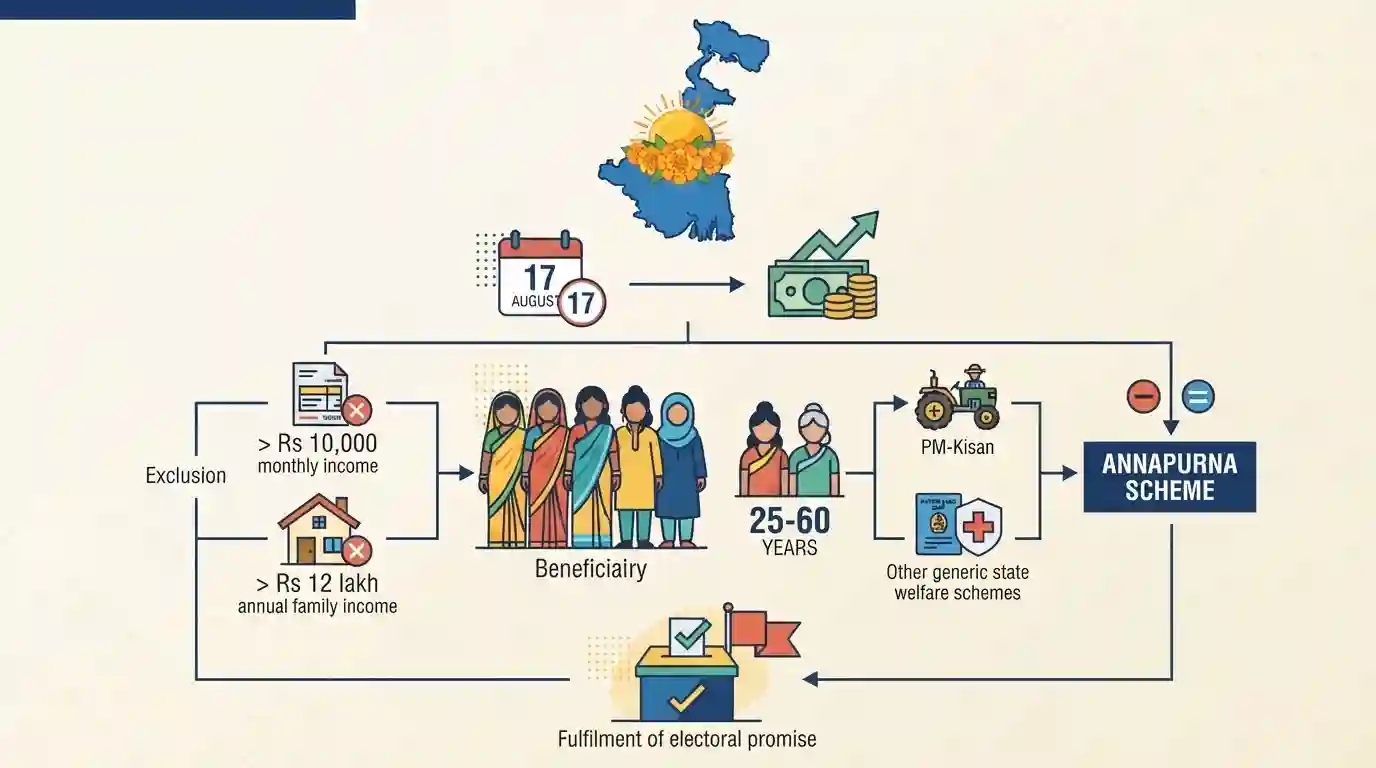
The West Bengal government has announced the eligibility criteria for its flagship Annapurna scheme, set to roll out payments of Rs 3,000 per month to women aged 25-60 starting August 17. The scheme excludes women with a monthly income exceeding Rs 10,000 or a family annual income over Rs 12 lakh. However, it accommodates beneficiaries of other state and central schemes, such as PM-Kisan, by offering differential payments where necessary. The scheme fulfills a major electoral promise of the ruling party.
Key Points
- The West Bengal government announced the eligibility criteria for the Annapurna scheme, promising Rs 3,000 monthly to eligible women aged 25 to 60.
- Payments for the Annapurna scheme are slated to begin on August 17.
- Women earning more than Rs 10,000 per month or whose family's annual income exceeds Rs 12 lakh are excluded from the scheme.
- Receiving other benefits like PM-Kisan or disability allowances does not automatically disqualify applicants, and those receiving lesser state allowances will receive the difference.
Important Terms
Annapurna Yojana (West Bengal)

A flagship social welfare scheme of West Bengal providing ₹3,000 monthly to resident women aged 25–60 via Direct Benefit Transfer to enhance financial stability and promote women's empowerment.
UPSC context
GS Paper II: Social Justice and Welfare Schemes, testing understanding of state-level social security interventions and gender-budgeting models.
PM-KISAN (Pradhan Mantri Kisan Samman Nidhi)
A Central Sector Scheme launched in 2019 providing ₹6,000 annually in three equal installments to all eligible landholding farmer families in India to supplement their agricultural and domestic financial needs.
UPSC context
GS Paper III: Indian Economy and Agriculture, evaluating central income support mechanisms, farm subsidies, and direct benefit systems.
Direct Benefit Transfer (DBT)
A major administrative reform launched in India in 2013 to transfer government subsidies, pensions, and benefits directly into beneficiaries’ Aadhaar-linked bank accounts, curbing leakage and eliminating intermediaries.
UPSC context
GS Paper II: Governance and E-governance, assessing technology-led public service delivery, subsidy reforms, and fiscal transparency.
Lakshmir Bhandar Scheme
The predecessor flagship women's welfare initiative of West Bengal (launched in 2021) that provided monthly cash transfers to women aged 25–60, which was replaced and upgraded to the Annapurna Yojana in June 2026.
UPSC context
GS Paper II: Social Justice, analyzing the transition and design of target-based basic income schemes for marginalized female heads of households.
Welfare State
A governance concept where the state actively plays a key role in protecting and promoting the social and economic well-being of its citizens through public assistance, social security, and developmental programs.
UPSC context
GS Paper II: Indian Constitution, exploring the realization of Directive Principles of State Policy through legislative and executive social security frameworks.
Prelims Trap
The Annapurna Scheme is a centrally sponsored scheme targeting senior citizens with free food grains.
UPSC may confuse West Bengal's cash-transfer scheme with the Ministry of Rural Development's older central 'Annapurna Scheme' (2000), which provides free food grains to senior citizens.
Static Concepts Connected
What is the distinction between Universal Basic Income (UBI) and Targeted Cash Transfers?
- Targeting mechanism: UBI is unconditionally paid to all citizens regardless of income, whereas targeted schemes use means-testing (like WB's income cap) to filter beneficiaries.
- Fiscal trade-off: UBI requires massive fiscal outlays, whereas targeted schemes aim to reduce fiscal leakage but face inclusion and exclusion errors.
- Administrative overhead: Targeted schemes can cause administrative hurdles in verification, whereas UBI bypasses targeting administrative overheads completely.
Which Directive Principles of State Policy (DPSPs) guide state-level cash transfer schemes?
- Article 38: Article 38 directs the State to secure a social order for the promotion of welfare and minimize inequalities in income and status.
- Article 39: Article 39 mandates the State to secure that citizens, men and women equally, have the right to an adequate means of livelihood.
- Article 41: Article 41 directs the State to secure the right to work, education, and public assistance in cases of unemployment, old age, or disablement.
Cross-Topic Patterns
Fiscal Federalism vs. Subnational Welfare
State-level DBT expansion highlights the growing tension between state fiscal discipline (FRBM limits) and competitive electoral populism, shaping Finance Commission debates on debt sustainability.
Scheme Convergence and Benefit Harmonization
The use of differential payments to offset other schemes (e.g. PM-Kisan) reflects a growing trend in welfare architecture to harmonize federal and state safety nets.

Mains 2026 may analyze the trade-offs of subnational targeted cash transfers on state fiscal health vs. women's economic autonomy.
Linked PYQs · 1
Linked PYQs · 1
- 2019WBCS_PRELIMSGS1
The ideal of 'Welfare State' in the Indian Constitution in enshrined in its
