Political protests over electoral roll revisions in West Bengal
Source:The Hindu ↗
Why It Matters
The integrity of electoral rolls is foundational to a functioning democracy. This issue is highly relevant for GS Paper 2 as it bridges constitutional mandates (Article 324, right to vote) with political realities, illustrating how the actions of autonomous bodies like the ECI can become flashpoints in Centre-State relations and federalism.
Summary
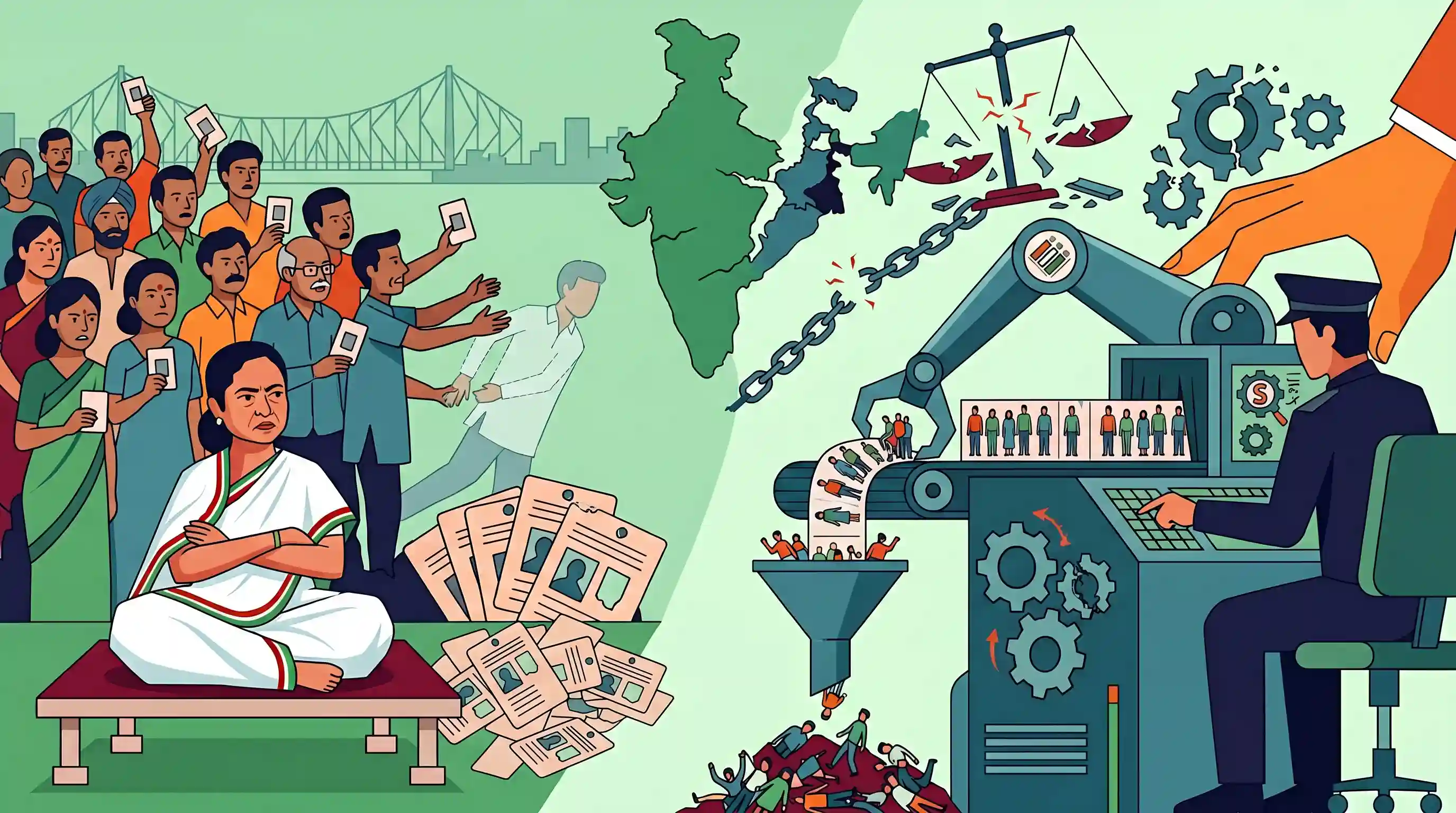
West Bengal Chief Minister Mamata Banerjee staged a sit-in protest in Kolkata against the alleged arbitrary deletion of over 63.66 lakh names from the state's voter rolls. The deletions were part of the Election Commission of India's Special Intensive Revision (SIR) exercise. Banerjee accused the poll body of stripping genuine voters of their rights to favor the BJP, linking the move to a broader strategy targeting Bengali-speaking communities. This controversy underscores ongoing frictions in India's federal structure and raises critical questions about the transparency of electoral administration and the operational independence of the ECI.
Key Points
- West Bengal Chief Minister Mamata Banerjee launched a sit-in protest in Kolkata against the deletion of 63.66 lakh names from the state's electoral rolls.
- The deletions were carried out by the Election Commission of India under the Special Intensive Revision (SIR) exercise, which accounted for approximately 8.3% of the state's electorate.
- Banerjee alleged that genuine voters were arbitrarily removed or marked as dead in a politically motivated attempt to disenfranchise Bengali-speaking people and favor the BJP.
- The protest reflects heightened Centre-State tensions and raises concerns regarding the transparency and impartiality of constitutional bodies in conducting pre-election processes.
Important Terms
Special Intensive Revision (SIR) exercise

A comprehensive, house-to-house verification and enumeration drive by the Election Commission to update electoral rolls, removing ineligible names (deceased/duplicates) and enrolling new voters before major elections.
UPSC context
GS Paper 2: Governance/Elections. Tests understanding of electoral roll purity, ECI powers under Section 21(3) of RPA 1950, and procedural transparency.
Election Commission of India (ECI)
An autonomous constitutional authority established under Article 324 to superintend, direct, and control elections to Parliament, State Legislatures, and the offices of President and Vice-President.
UPSC context
GS Paper 2: Constitutional Bodies. Essential for questions on institutional independence, electoral reforms, and the conduct of free and fair elections.
National Register of Citizens (NRC)
An official record of legal Indian citizens, mandated by the Citizenship Act 1955 (amended 2003), aimed at identifying legal residents and detecting illegal immigrants.
UPSC context
GS Paper 2: Polity/Statutory Bodies. Crucial for issues regarding citizenship, migration, federal friction, and minority rights.
Representation of the People Act (RPA), 1950
The primary legislation governing the allocation of seats, delimitation of constituencies, and the qualifications and registration of electors for Parliament and State Legislatures.
UPSC context
GS Paper 2: Salient features of the RPA. Tests knowledge of the legal framework for voter registration and electoral roll management.
Article 324
The constitutional provision vesting the superintendence, direction, and control of the preparation of electoral rolls and the conduct of elections in the Election Commission.
UPSC context
GS Paper 2: Constitution. Tests the extent of the ECI's plenary powers and its mandate to ensure electoral integrity.
Federalism
A constitutional structure dividing power between the Union and States. In India, it involves tensions over the ECI's administrative actions versus state-level political representation.
UPSC context
GS Paper 2: Functions and responsibilities of the Union and the States. Relevant for discussing Centre-State friction in administrative exercises.
Prelims Trap
Preparation of electoral rolls and voter deletion procedures are governed by the Representation of the People Act, 1951.
RPA 1950 handles electoral rolls, voter qualifications, and deletions. RPA 1951 governs the actual conduct of elections and corrupt practices. UPSC frequently swaps these two.
Static Concepts Connected
How does RPA 1950 differ from RPA 1951 regarding electoral administration?
- RPA 1950: Deals with the preparation of electoral rolls, delimitation of constituencies, and basic qualifications of voters.
- RPA 1951: Regulates the actual conduct of elections, qualifications/disqualifications for lawmakers, and defines corrupt electoral practices.
- Voter Deletions: Under Section 22 of RPA 1950, Electoral Registration Officers can delete names but must provide the voter a reasonable opportunity of being heard.
What is the constitutional mandate for electoral rolls and the Right to Vote?
- Article 324: Vests the Election Commission of India with plenary powers to superintend, direct, and control the preparation of electoral rolls.
- Article 326: Guarantees Universal Adult Suffrage, establishing that elections to the Lok Sabha and State Assemblies must be based on adult suffrage.
- Right to Vote: Recognized as a constitutional right (via Article 326), though strictly operationalized and regulated by statutory frameworks like the RPA.
Cross-Topic Patterns
ECI autonomy vs Federal friction
Recent clashes over CEC appointments and state-level roll purges test the operational independence and perceived neutrality of the ECI within India's federal structure.
Border states & citizenship anxieties
Mass voter deletions in border states like West Bengal and Assam increasingly intersect with NRC/CAA citizenship debates, linking electoral rights to internal security politics.

Expect a 2026 Prelims statement swapping RPA 1950 (rolls/deletions) with RPA 1951 (election conduct), or testing the scope of Article 326.
Linked PYQs · 4
Linked PYQs · 4
- 2024MainsGS2
What changes has the Union Government recently introduced in the domain of Centre-State relations ? Suggest measures to be adopted to build the trust between the Centre and the States and for strengthening federalism.
- 2017MainsGS2
To enhance the quality of democracy in India the Election Commission of India has proposed electoral reforms in 2016. What are the suggested reforms and how far are they significant to make democracy successful?
- 2017PrelimsGS1
For election to the Lok Sabha, a nomination paper can be filed by
- 2017PrelimsGS1
Consider the following statements: 1. The Election Commission of India is a five-member body. 2. Union Ministry of Home Affairs decides the election schedule for the conduct of both general elections and bye-elections. 3. Election Commission resolves the disputes relating to splits/mergers of recognised political parties. Which of the statements given above is/are correct?
