West Bengal launches ISKCON meal kitchen with mandated egg inclusion
Source:rediff ↗
Why It Matters
This highlights the dynamic collaboration between non-governmental organizations and state governments in executing national welfare programs like PM POSHAN, while emphasizing the importance of adapting dietary provisions to local nutritional needs and preferences.
Summary
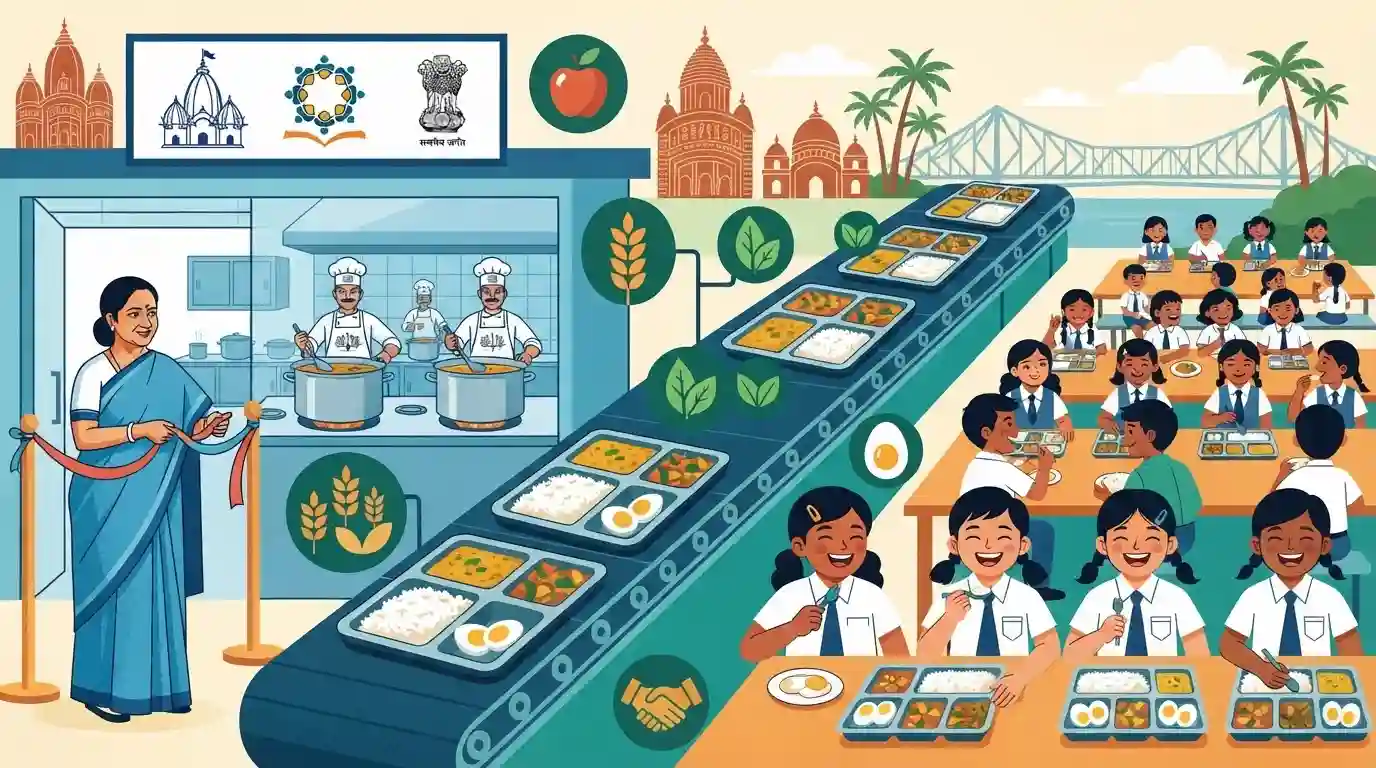
The West Bengal Chief Minister inaugurated an ISKCON-run mid-day meal kitchen to serve school children. While ISKCON supplies purely vegetarian food, the state government has mandated the inclusion of eggs in the meals to meet the nutritional demands and dietary preferences of the students. This reflects an adaptive public-private partnership under the PM POSHAN framework.
Key Points
- West Bengal Chief Minister launched an ISKCON-operated centralized kitchen to supply mid-day meals to schools.
- Despite ISKCON providing purely vegetarian meals, the state government ensured eggs will be added to the menu following demands from students.
- The initiative showcases public-private partnerships in welfare delivery by integrating NGO resources with state education and nutrition goals.
- Highlights the state\'s approach to maintaining regional dietary preferences and nutritional standards within centrally sponsored schemes like PM POSHAN.
Important Terms
PM POSHAN Scheme

A centrally sponsored program providing hot cooked meals to children from pre-primary to Class VIII in government and aided schools, aimed at addressing child malnutrition and improving attendance.
UPSC context
GS Paper 2 (Welfare Schemes). Essential for assessing nutritional interventions and government policies on child development.
Mid-Day Meal Scheme
A historic initiative, now subsumed under PM POSHAN, ensuring a nutritionally adequate daily lunch for school children to boost school enrollment, retention, and nutritional status.
UPSC context
GS Paper 2 (Education & Health). Foundational for understanding India's evolution of food security and educational retention policies.
ISKCON (Annamrita Foundation)
A non-profit wing of ISKCON that implements government mid-day meal programs, operating mega-kitchens to prepare and distribute hygienic, vegetarian school meals at a massive scale.
UPSC context
GS Paper 2 (Role of NGOs). Highlights the participation of non-governmental organizations and trusts in public service delivery.
National Food Security Act (NFSA), 2013
A landmark law that provides a legal framework for food security programs, establishing the statutory right of children to receive a mid-day meal in schools.
UPSC context
GS Paper 2 & 3. Critical for analyzing the transition to rights-based welfare and legal guarantees for nutrition.
Public-Private Partnership (PPP) in Welfare
A governance model where the state collaborates with private entities or NGOs to efficiently deliver essential public services, combining public funding with non-state resources and expertise.
UPSC context
GS Paper 2 (Governance). Frequently tested on the merits, challenges, and accountability mechanisms of involving private actors in welfare.
Prelims Trap
Under PM POSHAN, the Centre prescribes a uniform national menu and mandates supplementary items like eggs for all states.
The Centre prescribes strict nutritional norms (calories/protein), not a uniform national menu. States have the flexibility to design local menus and add supplementary items.
Static Concepts Connected
What are the key nutritional norms and coverage details of PM POSHAN?
- Expanded Coverage: Covers children in pre-primary classes (Bal Vatika) along with Classes 1 to 8 in government and government-aided schools.
- Nutritional Norms: Primary students (Classes 1-5) require 450 calories and 12g protein; Upper primary (Classes 6-8) require 700 calories and 20g protein daily.
- Nodal Ministry: It is a Centrally Sponsored Scheme administered by the Ministry of Education, not the Ministry of Women and Child Development.
How does the PPP model function in the delivery of PM POSHAN?
- Centralized Kitchens: NGOs like ISKCON (Akshaya Patra) operate centralized, highly mechanized kitchens in urban and semi-urban areas to ensure food safety, hygiene, and economies of scale.
- State Localization: While NGOs manage the core cooking, state governments retain the authority to supplement the meals (e.g., adding eggs/milk) to meet specific local dietary needs.
Cross-Topic Patterns
Centrally Sponsored Schemes & Fiscal Federalism
State additions to central schemes often rely on flexi-funds or pure state budgets, highlighting ongoing debates around fiscal burden-sharing and political branding in Centrally Sponsored Schemes.
Dietary preferences vs. Nutrition goals
The compromise between vegetarian NGO mandates (ISKCON) and biological protein requirements (eggs) reflects the broader sociological debate on standardizing welfare versus respecting diverse local diets.

Expect a Prelims question on PM POSHAN testing its nodal ministry (Education, not WCD), Bal Vatika inclusion, and state menu flexibility.
Linked PYQs · 1
Linked PYQs · 1
- 2006WBCS_PRELIMSGS1
Mid-day meal Scheme was launched in
