West Bengal Administration Responds to Bankura Law and Order Incident
Source:The Hindu ↗
Why It Matters
The article highlights the critical intersection of grassroots civic audits of public infrastructure (like primary schools), local political violence, and the constitutional duties of the state administration under Article 21 (Right to Life) and the Rule of Law. It connects to governance and public administration issues commonly tested in civil service examinations.
Summary
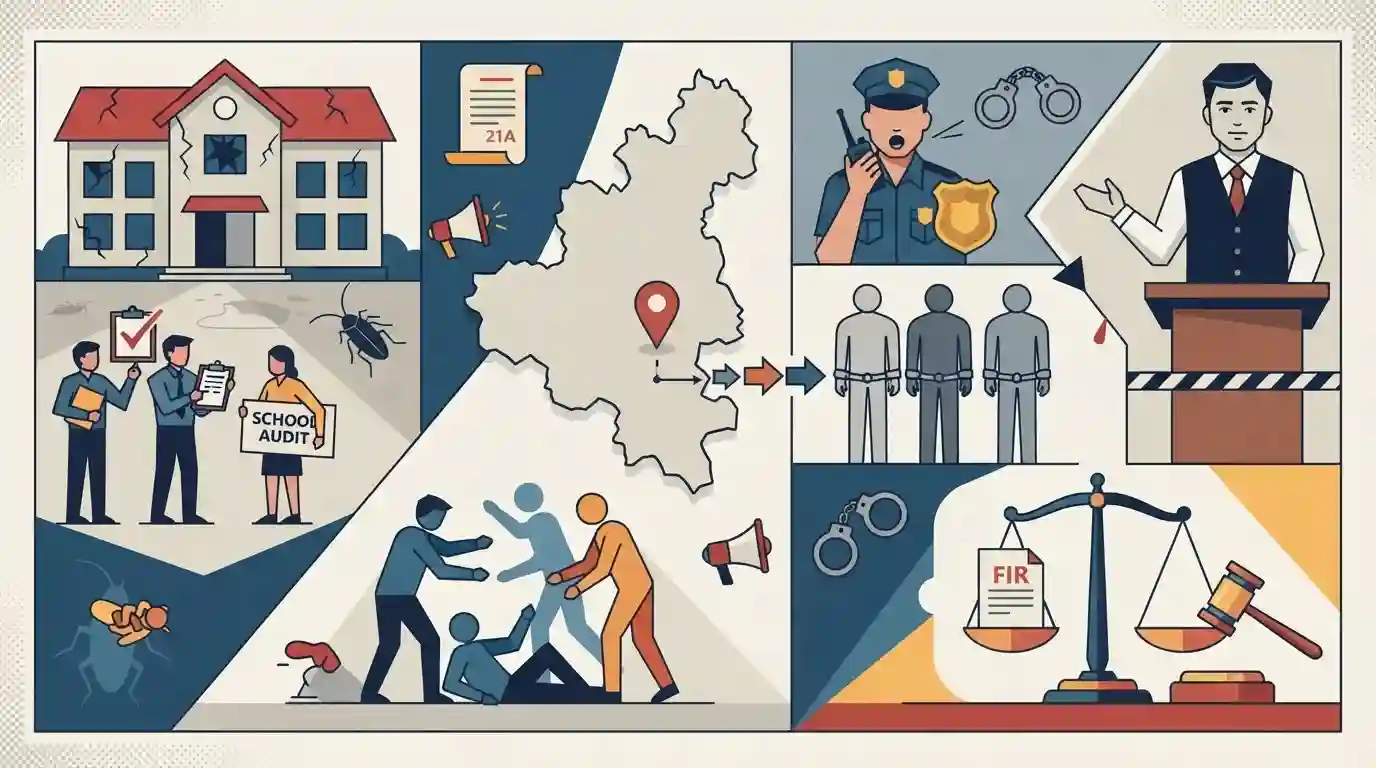
West Bengal Chief Minister Suvendu Adhikari denied claims that BJP workers were behind the assault on Cockroach Janta Party (CJP) volunteer Shaik Abdul Hafeez and the death of his father, Janab Mafik, in Bankura district. The assault occurred following the volunteer's audit of a local school's infrastructure under the 'School Thik Karo' campaign. Adhikari emphasized that police have filed an FIR and arrested three of the five named accused, asserting that law and order would take its course without political bias.
Key Points
- West Bengal Chief Minister Suvendu Adhikari dismissed claims of BJP involvement in the assault of Shaik Abdul Hafeez (a Cockroach Janta Party volunteer) and the subsequent death of his father, Janab Mafik.
- The assault took place in Karisunda village, Bankura district, after the volunteer assessed a government primary school under CJP's nationwide 'School Thik Karo' campaign.
- Janab Mafik suffered head injuries during the attack on August 13, 2026, and succumbed to his injuries on August 15, 2026.
- While CJP alleged political motives by local BJP workers, the WB government stated that an FIR has been registered and three of the five named accused have already been arrested, ensuring standard law-and-order action.
- Union Minister Sukanta Majumdar and State Minister Agnimitra Paul also clarified that the BJP does not tolerate violence and the administration will act strictly according to law.
Important Terms
School Thik Karo campaign

A civic campaign launched in 2026 by the Cockroach Janta Party to conduct social audits of government school infrastructure. It aims to document deficiencies, ensure accountability, and demand fee caps in private education.
UPSC context
Essential for GS Paper 2 (Education, Governance). Illustrates citizen-led social audits and grassroots mobilization to secure the Right to Education (Article 21A).
Cockroach Janta Party (CJP)
A youth-led political and civic movement established in 2026 by Abhijeet Dipke. Originally a satirical response to judicial remarks, it mobilizes citizens around education reform, youth employment, and systemic accountability through grassroots campaigns.
UPSC context
Relevant for GS Paper 2 (Pressure Groups, Civil Society). Demonstrates the role of youth-driven civic movements and non-traditional platforms in Indian democratic participation.
Bharatiya Janata Party (BJP)
A major national political party in India. In the context of West Bengal, it operates as a prominent political force frequently engaged in electoral and ideological competition concerning state governance and law administration.
UPSC context
Important for GS Paper 2 (Polity). Covers the role of national political parties in federal structures, electoral democracy, and state-level political dynamics.
Prelims Trap
Political justice is explicitly guaranteed as a Fundamental Right under Part III of the Constitution.
Political justice is explicitly mentioned only in the Preamble and DPSP (Article 38). While Part III implicitly enables it, the precise term is absent.
Static Concepts Connected
What are the key constitutional provisions regarding the Right to Education?
- Article 21A: Added by the 86th Amendment Act (2002), this makes free and compulsory education a fundamental right for children aged 6 to 14 years.
- Article 51A(k): Also added by the 86th Amendment, this mandates parents or guardians to provide educational opportunities for their children between 6 and 14 years.
- Article 45: The 86th Amendment altered this DPSP to direct the state to provide early childhood care and education for all children up to the age of six.
How does the Constitution distribute jurisdiction over law and order administration?
- State List dominance: 'Public order' (Entry 1) and 'Police' (Entry 2) are definitively placed under the State List (List II) of the 7th Schedule.
- Executive responsibility: State governments hold exclusive executive jurisdiction over local crime investigation, maintaining peace, and prosecuting offenders without direct Union interference.
Cross-Topic Patterns
RTE Act & Civil Society Audits
The 'School Thik Karo' campaign acts as an informal social audit. Under Section 21 of the RTE Act, School Management Committees legally mandate community oversight of local school infrastructure and grants.
Bengal's district-wise literacy divide
School infrastructure drives highlight regional disparities. WBCS consistently tests Census 2011 stats: West Bengal's average literacy is 76.26%, peaking in Purba Medinipur (87.66%) and trailing in Uttar Dinajpur (60.13%).

Expect Polity MCQs linking Article 21A (RTE), community oversight (SMCs), and DPSP Article 45 in a single multi-statement question.
Linked PYQs · 5
Linked PYQs · 5
- 2019WBCS_PRELIMSGS1
Right to vote and to be elected in India is a
- 2023WBCS_PRELIMSGS1
The term 'Political Justice' is mentioned in the Indian Constitution under which of these
- 2021WBCS_PRELIMSGS1
Article 21 of the Indian Constitution ensues
- 2019WBCS_PRELIMSGS1
Literacy rate of West Bengal is
- 2020WBCS_PRELIMSGS1
Literacy rate in West Bengal census 2011 —
