West Bengal building plan violations crackdown and approvals
Source:thestatesman ↗
Why It Matters
Showcases the role of urban local bodies in regulating infrastructure development, enforcing building codes, and managing structural safety hazards to prevent civic disasters.
Summary
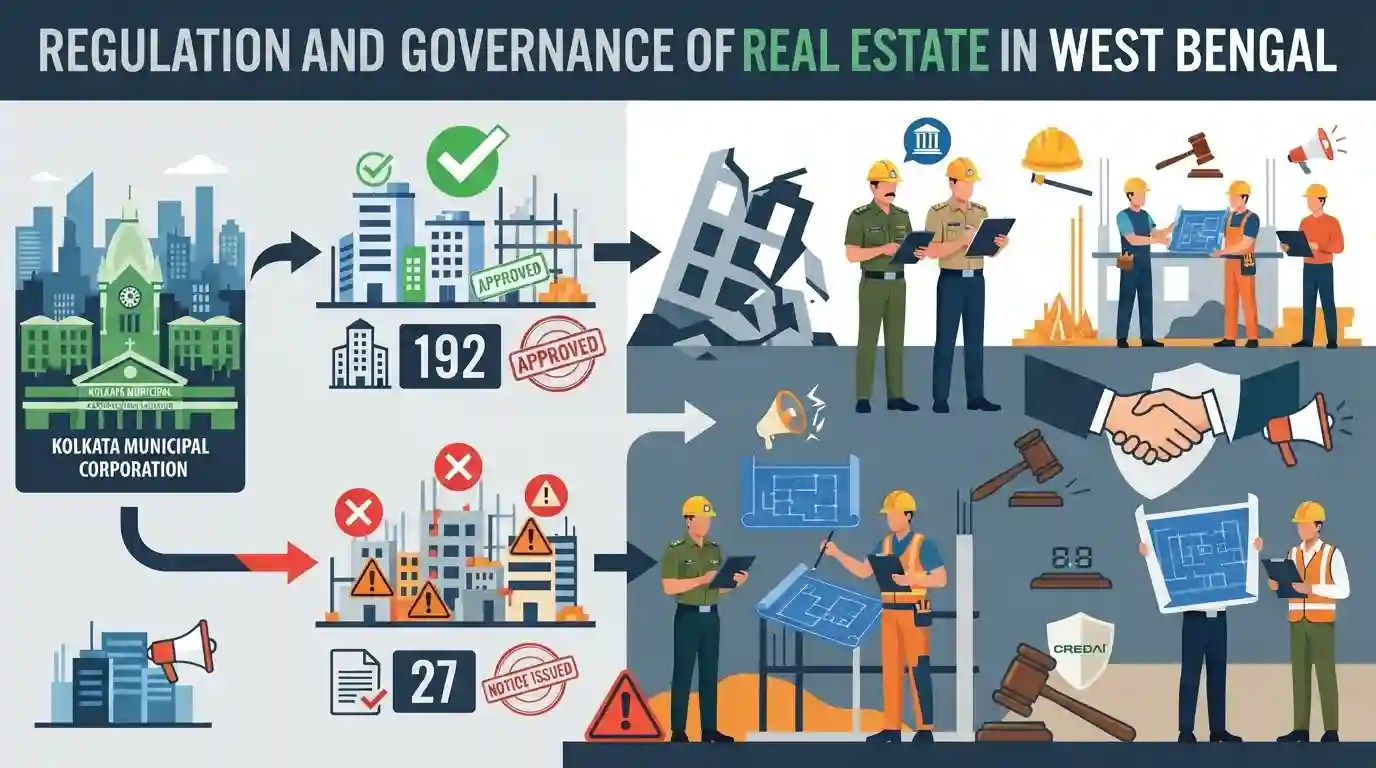
The West Bengal government has approved 192 construction projects while issuing notices to 27 others over illegalities and deviations from sanctioned building plans. The crackdown on unauthorized real estate developments gained momentum after a tragic structural collapse in Kolkata's Taratala. Urban local bodies like the Kolkata Municipal Corporation (KMC) are actively inspecting construction sites and collaborating with real estate bodies like CREDAI to enforce strict compliance with building codes and prevent future disasters.
Key Points
- The West Bengal government has cleared 192 construction projects to support regulated real estate development in the state.
- Show-cause notices were issued to 27 projects for significant deviations from approved building plans and other illegalities.
- This strict administrative action was triggered by a recent warehouse collapse in Taratala, which resulted in fatalities and raised structural safety concerns.
- Municipal corporations and urban local bodies have been directed to intensify building code enforcement and curb unauthorized constructions.
Important Terms
Real Estate (Regulation and Development) Act (RERA)

A 2016 parliamentary act establishing state-level authorities to regulate the real estate sector. It protects homebuyers by mandating project registration, ensuring transparency, preventing fund diversion, and providing a fast-track dispute resolution mechanism.
UPSC context
Relevant to GS Paper II (Governance) and GS Paper III (Infrastructure). Tests knowledge of regulatory frameworks, consumer protection, and urban policies.
Disaster Management Act, 2005
A landmark legislation providing the legal and institutional framework for disaster management in India. It established the NDMA, SDMAs, and NDRF, shifting the national approach from reactive relief to proactive prevention, mitigation, and preparedness.
UPSC context
Essential for GS Paper III (Disaster Management). Tests understanding of India's disaster response architecture, institutional frameworks, and state-centre coordination.
Kolkata Municipal Corporation (KMC)
The local self-government body responsible for civic administration and urban infrastructure in Kolkata. Divided into 144 wards, it manages essential services like water supply, drainage, waste management, and building plan approvals.
UPSC context
Relevant to GS Paper II (Urban Local Bodies, 74th Amendment). Tests knowledge of municipal governance, urban planning, and local disaster resilience.
Confederation of Real Estate Developers' Associations of India (CREDAI)
The apex private body representing thousands of real estate developers across India. It engages in policy advocacy, promotes ethical industry practices, and collaborates with the government on housing, urban development, and regulatory compliance.
UPSC context
Fits in GS Paper II (Industry Bodies) and GS Paper III (Infrastructure). Tests understanding of private sector roles in urban growth and regulation.
National Disaster Response Force (NDRF)
India's specialized, multi-skilled force established under the Disaster Management Act, 2005. It provides rapid, centralized emergency response to natural and man-made disasters, conducting rescue operations while supporting state authorities.
UPSC context
Crucial for GS Paper III (Disaster Management). Tests knowledge of central response mechanisms, inter-agency coordination, and disaster mitigation strategies.
State Disaster Response Force (SDRF)
State-level specialized forces established to provide rapid, localized response to disasters. They work in coordination with the NDRF and local administration to conduct rescue operations, distribute relief, and enhance local disaster preparedness.
UPSC context
Important for GS Paper III (Disaster Management). Highlights state-level preparedness, decentralized emergency response capacity, and centre-state coordination during localized disasters.
Prelims Trap
The National Building Code of India is a central statutory law that automatically binds all municipal construction projects.
The NBC is recommendatory and published by the BIS. It only gains mandatory legal force when adopted into state-level municipal building bylaws.
Static Concepts Connected
What is the constitutional basis for municipal regulation of buildings in India?
- 74th Amendment Act: Introduced by the 74th Amendment Act of 1992, granting constitutional status to urban local bodies.
- 12th Schedule Item: Explicitly lists the 'Regulation of land-use and construction of buildings' as one of the 18 functional responsibilities of municipalities.
- State Municipal Acts: Actual enforcement powers and specific bylaws are derived from respective state-enacted municipal corporation acts.
What is the Doctrine of Repugnancy in Indian federalism?
- Constitutional Basis: Governed by Article 254, it addresses conflicts between central and state laws on Concurrent List subjects.
- Judicial Precedent: The Supreme Court in FPCE (2021) struck down West Bengal's parallel housing law, affirming the supremacy of central RERA.
- Legal Outcome: States cannot enact parallel regimes that mimic or conflict with exhaustive Central Acts on Concurrent subjects.
Cross-Topic Patterns
Urban Governance vs. Federal Supremacy
The conflict between local building plans and central laws like RERA illustrates the complex intersection of local urban planning, federal legislative competence, and Article 254.
Disaster Mitigation + Building Codes
Structural collapses expose gaps in translating recommendatory safety documents like the National Building Code into mandatory municipal executive action under disaster mitigation frameworks.

The legislative overlap between central RERA and state housing laws is likely to be tested under Article 254 (Repugnancy) in 2026.
Linked PYQs · 2
Linked PYQs · 2
- 2020WBCS_PRELIMSGS1
National Institute of Disaster Management or NIDM was previously named as:
- 2018WBCS_PRELIMSGS1
Which Amendment of the constitution provided constitutional status to the Panchayats?
