West Bengal Christian Groups Suspend Prayers Amid Conversion Probe
Source:Indian Express ↗
Why It Matters
This issue touches upon crucial constitutional themes concerning freedom of religion under Article 25, minority protections, public order, and regional governance challenges in West Bengal.
Summary
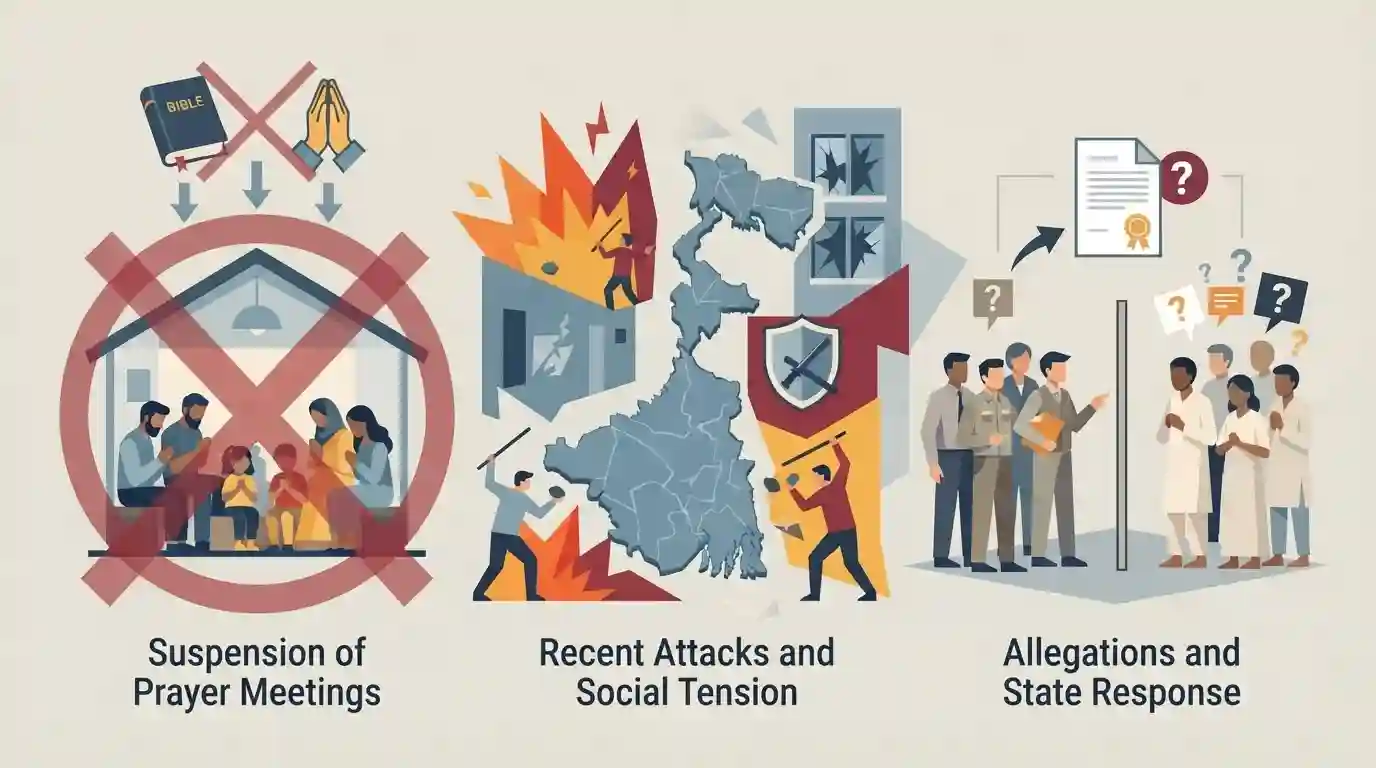
Christian groups in West Bengal suspended house prayer meetings following recent attacks, while state authorities linked the unrest to allegations of forced conversions, highlighting issues surrounding religious freedom, minority rights, and social tensions in the region.
Key Points
- Christian groups in West Bengal have reportedly suspended house prayer meetings following incidents of attacks.
- The state government and local authorities pointed to allegations of forced religious conversions as a contributing factor behind tensions and actions.
- The situation highlights ongoing concerns regarding freedom of religion, minority rights, and law and order issues in the state.
Important Terms
Freedom of Religion

The constitutional and statutory framework guaranteeing freedom of conscience and the right to freely profess, practice, and propagate religion under Articles 25-28 of the Indian Constitution, subject to public order, morality, and health.
UPSC context
WBCS Paper V (Polity and Constitution) — tests understanding of fundamental rights, secularism, and state regulation of religious practices.
Minority Rights
The constitutional protections, safeguards, and statutory bodies established to preserve the identity, culture, and religious practices of religious and linguistic minorities in India.
UPSC context
WBCS Paper V (Polity, Governance and Social Welfare) — tests policies, rights, and state administration regarding minority communities.
West Bengal government
The executive branch of the state government of West Bengal responsible for maintaining law and order, public administration, and the implementation of central and state policies within the state.
UPSC context
WBCS Paper V (State Administration) — tests knowledge of state governance, law enforcement, and regional administrative responses.
Prelims Trap
The right to propagate religion under Article 25 includes the absolute right to convert any individual through persuasion or inducement.
Aspirants often assume Article 25 protects the right to convert others; however, the Supreme Court has repeatedly clarified that 'propagate' means transmission of beliefs, not forced or fraudulent conversion.
Static Concepts Connected
What are the constitutional boundaries of the freedom of religion under Article 25?
- Scope: Guarantees freedom of conscience and the right to freely profess, practice, and propagate religion to all persons.
- Restrictions: Subject to public order, morality, health, and other provisions of Part III of the Constitution.
- Conversion Limit: Supreme Court held in Rev. Stainislaus (1977) that 'propagate' does not include the right to convert another person.
Cross-Topic Patterns
Article 25 vs. State Anti-Conversion Laws
The legal limits on 'propagation' under Article 25 intersect directly with state-level anti-conversion laws and law-and-order maintenance in federal polities.
Border Demographics and Regional Governance
Minority demographic shifts in border districts often trigger administrative interventions combining public order concerns with welfare distribution debates.

Expect a multi-statement prelims question testing the exact scope of 'propagate' under Art 25 and state-level minority determination rules.
Linked PYQs · 2
Linked PYQs · 2
- 2021WBCS_PRELIMSGS1
Article 21 of the Indian Constitution ensues
- 2021WBCS_PRELIMSGS1
Article 18 of the Indian Constitution guarantees the right to
