Tiger Reintroduction and Inter-State Conservation in India
Source:Indian Express ↗
Why It Matters
Understanding tiger reintroduction, wildlife corridor management, and inter-state conservation strategies is crucial for biodiversity preservation and aligns directly with India's commitments under Project Tiger and the NTCA guidelines.
Summary
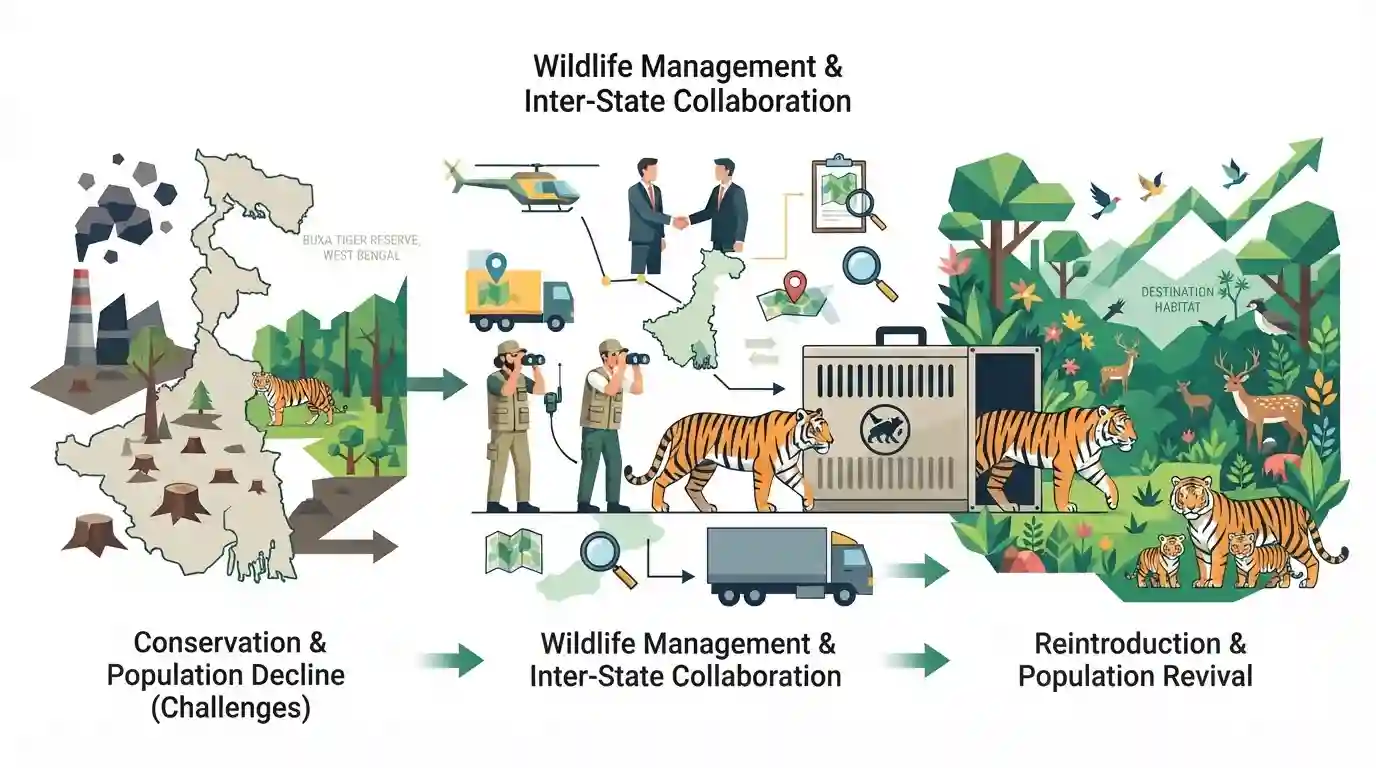
An overview of initiatives involving the transfer and reintroduction of tigers from West Bengal's Buxa Tiger Reserve to support conservation and population revival efforts, highlighting inter-state collaboration and wildlife management strategies under the NTCA.
Key Points
- A tigress from Buxa Tiger Reserve in West Bengal is being considered or involved in tiger reintroduction initiatives/movements linked to Bihar.
- Tiger reintroduction programs require careful ecological assessment, monitoring, and approval by bodies like the National Tiger Conservation Authority (NTCA).
- Buxa Tiger Reserve has historically faced challenges regarding its tiger population, making inter-state or intra-state transfers and reintroduction strategies vital for population revival.
Important Terms
Project Tiger

A centrally sponsored scheme launched in 1973 to ensure a viable tiger population in India, focusing on core-buffer strategies and habitat protection.
UPSC context
UPSC GS Paper III (Environment & Ecology): Tests knowledge of wildlife conservation schemes, biodiversity management, and species protection policies.
Buxa Tiger Reserve
A protected area in northern West Bengal spanning the Bhabar-Terai region, recognized for its strategic ecological connectivity with Bhutan and Assam.
UPSC context
UPSC GS Paper III (Geography/Environment): Important for protected area networks, tiger translocations, and inter-state conservation strategies.
National Tiger Conservation Authority (NTCA)
A statutory body under the Ministry of Environment, Forest and Climate Change established in 2005 for tiger conservation oversight under the Wildlife Protection Act.
UPSC context
UPSC GS Paper III (Environment & Governance): Evaluates institutional frameworks, statutory bodies, and wildlife management policies in India.
Prelims Trap
Inter-state tiger transfers can be executed solely through memorandums of understanding between participating state forest departments without central approval.
Translocations and reintroductions require mandatory statutory clearance from the NTCA, not merely bilateral state executive consent.
Static Concepts Connected
What are the powers and composition of the National Tiger Conservation Authority (NTCA)?
- Statutory Origin: Statutory body established under the Wildlife (Protection) Act, 1972, following the 2006 tiger task force amendments.
- Composition: Chaired by the Minister for Environment, Forest and Climate Change, with experts and officials as members.
- Key Functions: Approves tiger conservation plans, oversees translocation, and sets standards for core and buffer zones.
Cross-Topic Patterns
NTCA Mandates and Cooperative Federalism
Inter-state wildlife translocation requires balancing central statutory mandates under the WPA with concurrent state-level forest management, testing cooperative federalism in conservation.

NTCA statutory powers + tiger reintroduction protocols likely to feature in a statement-based prelims question.
Linked PYQs · 2
Linked PYQs · 2
- 2026PrelimsGS1
With reference to Madhav National Park, which of the following statements is/are correct ? 1. It was declared a Tiger Reserve in India in 2025. 2. Sakhya Sagar, which is designated as a Ramsar Site, is situated within this National Park. 3. Its area is shared between Madhya Pradesh and Rajasthan. Select the answer using the code given below :
- 2019PrelimsGS1
Which of the following are in Agasthyamala Biosphere Reserve?
