West Bengal tables bill allowing year-long preventive detention
Source:The Hindu ↗
Why It Matters
This article serves as a prime case study on State-level preventive detention laws and their friction with Fundamental Rights under Article 22 of the Constitution. It is crucial for GS2 questions exploring the extent to which civil liberties (like access to legal counsel) can be restricted in the name of public order, and the legislative mechanisms (like Advisory Boards) designed to oversee such powers.
Summary
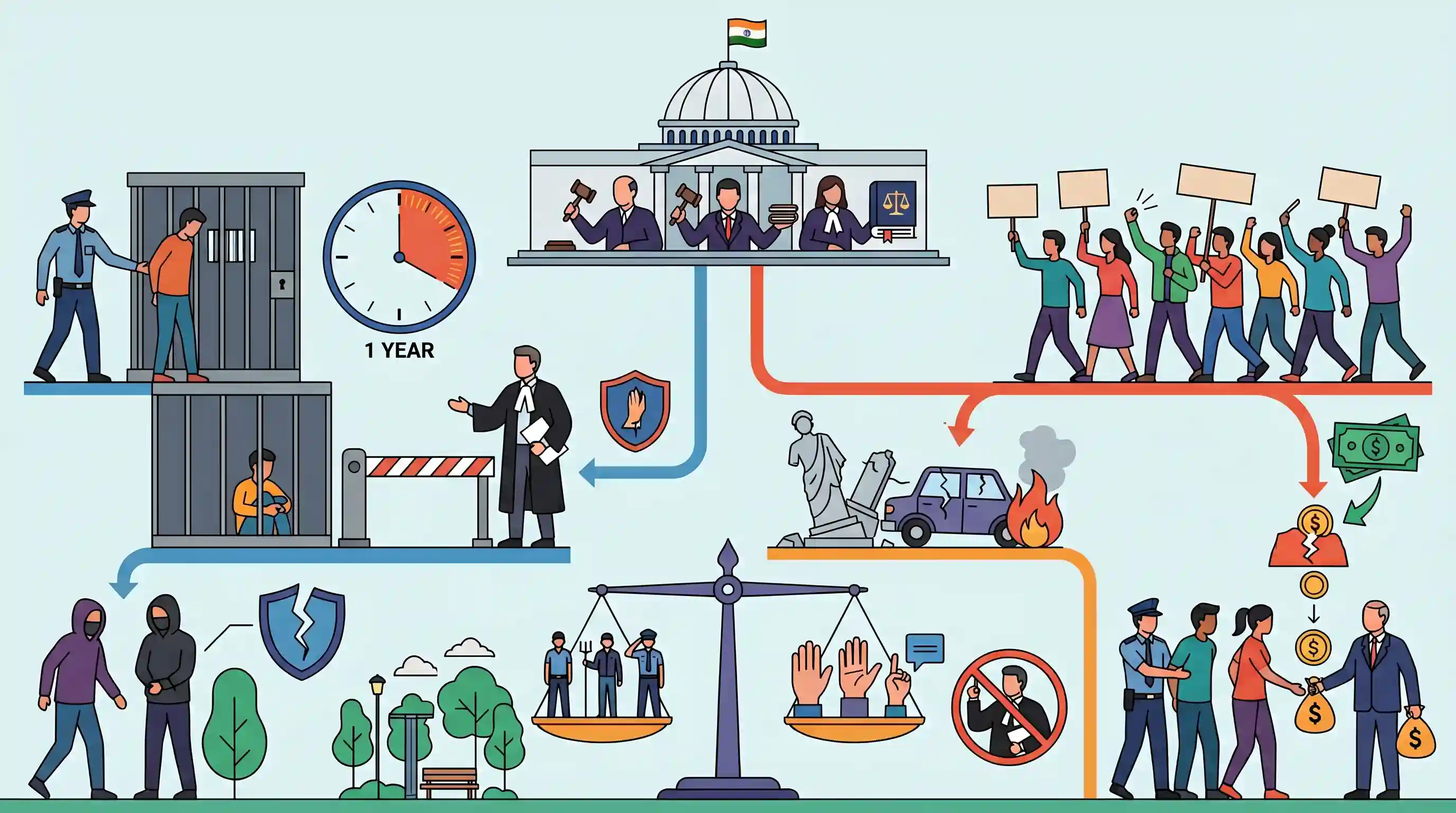
The West Bengal government has introduced two significant bills focused on maintaining public order and deterring anti-social activities. The West Bengal Public Safety and Control of Anti-Social Activities Bill, 2026, permits preventive detention for up to a year and restricts a detainee's access to legal counsel during Advisory Board proceedings. The West Bengal Maintenance of Public Order (Amendment) Bill, 2026, addresses the destruction of properties during protests by imposing strict penalties, including the requirement for offenders to pay compensation for damages to public and private property. These moves highlight critical constitutional issues surrounding preventive detention, Article 22 rights, and the balance between public order and civil liberties.
Key Points
- The West Bengal government introduced the Public Safety and Control of Anti-Social Activities Bill, 2026, which allows for preventive detention for up to one year to maintain public order.
- The legislation explicitly bars detainees from being represented by a legal practitioner in any matters connected with proceedings before the newly established Advisory Board.
- The Advisory Board, responsible for reviewing detention orders, will be chaired by a sitting or former High Court judge.
- A second bill, the West Bengal Maintenance of Public Order (Amendment) Bill, 2026, aims to curb the destruction of public and private property during protests and bandhs.
- The amendment requires offenders involved in property damage to pay financial compensation, adding a strict deterrent against violent protests.
Important Terms
Preventive Detention

Detention of an individual without trial or conviction, based on the apprehension that they may commit future offences prejudicial to national security, public order, or essential services.
UPSC context
GS Paper II (Polity). Tests understanding of civil liberties, executive discretion, and constitutional limits on state power.
Article 22
Constitutional provision granting protection against arrest and detention. It mandates informing the accused of grounds, legal consultation rights, and production before a magistrate, while also detailing preventive detention procedures.
UPSC context
GS Paper II (Polity). Critical for Fundamental Rights and the balance between individual liberty and state security.
Advisory Board
A quasi-judicial body, comprising High Court judges or qualified individuals, mandated by Article 22(4) to review preventive detention cases and determine if sufficient cause exists for extended detention.
UPSC context
GS Paper II (Polity). Essential for studying judicial safeguards against executive overreach and procedural fairness under the Constitution.
The West Bengal Public Safety and Control of Anti-Social Activities Bill, 2026
2026 state legislation permitting one-year preventive detention of suspected "anti-social" elements. It notably restricts a detainee's right to legal counsel during Advisory Board review proceedings.
UPSC context
GS Paper II (Polity/State Laws). Analyzes the interplay between state police powers, Article 22, and civil liberties.
The West Bengal Maintenance of Public Order (Amendment) Bill, 2026
State legislation enabling authorities to recover compensation for public and private property damage from individuals involved in riots, violent protests, or unlawful assemblies.
UPSC context
GS Paper II (Polity/Governance). Relevant for debates on the right to protest and administrative accountability for property damage.
Prelims Trap
"Persons under preventive detention have a fundamental right to legal representation before the Advisory Board."
Article 22(3) explicitly denies the fundamental rights under Article 22(1) and (2) — including the right to a legal practitioner — to anyone detained under preventive detention laws.
Static Concepts Connected
How is legislative power over Preventive Detention divided between Union and States?
- Union List: Parliament has exclusive power for reasons connected with Defense, Foreign Affairs, and the Security of India (Entry 9).
- Concurrent List: Both Parliament and States can legislate for the security of a state, maintenance of public order, and essential supplies (Entry 3).
What Constitutional safeguards exist for a person under Preventive Detention?
- Advisory Board: Detention beyond three months requires approval by an Advisory Board consisting of individuals qualified to be High Court judges.
- Grounds Communication: The authority must communicate the grounds of detention as soon as possible, unless disclosure is against the public interest.
- Right to Represent: The detenu must be afforded the earliest opportunity to make a representation against the detention order to the authorities.
Cross-Topic Patterns
Article 19(1)(b) vs Public Property
Links the freedom of assembly with the Prevention of Damage to Public Property Act, 1984, and the SC's 2009 guidelines holding rioters strictly financially liable for damages.
State Public Order vs Union Security
Contrasts state-level preventive detention laws aimed at 'public order' with central anti-terror frameworks like UAPA and NSA, highlighting the nuanced division in the Seventh Schedule.

Expect a tricky Prelims statement confusing Union vs Concurrent list powers for preventive detention and the exact limits of Article 22(3).
Linked PYQs · 3
Linked PYQs · 3
- 2023PrelimsGS1
Consider the following statements: 1. According to the Constitution of India, the Central Government has a duty to protect States from internal disturbances. 2. The Constitution of India exempts the States from providing legal counsel to a person being held for preventive detention. 3. According to the Prevention of Terrorism Act, 2002, confession of the accused before the police cannot be used as evidence. How many of the above statements are correct?
- 2021PrelimsGS1
With reference to India, consider the following statements : 1. When a prisoner makes out a sufficient case, parole cannot be denied to such prisoner because it becomes a matter of his/her right. 2. State Governments have their own Prisoners Release on Parole Rules. Which of the statements given above is/are correct?
- 2019MainsGS2
From the resolution of contentious issues regarding distribution of legislative powers by the courts, 'Principle of Federal Supremacy' and 'Harmonious Construction' have emerged. Explain.
