West Bengal Approves Three New Thermal Power Generation Plants
Source:times-of-india ↗
কেন এটি গুরুত্বপূর্ণ
Relevant for WBCS Prelims and Mains (Geography & Economy of West Bengal). Candidates should be familiar with the major thermal power plants in the state (Santaldih, Bakreshwar), their district locations, energy sector challenges, and coal allocation schemes like the SHAKTI policy used in thermal power generation.
সারসংক্ষেপ
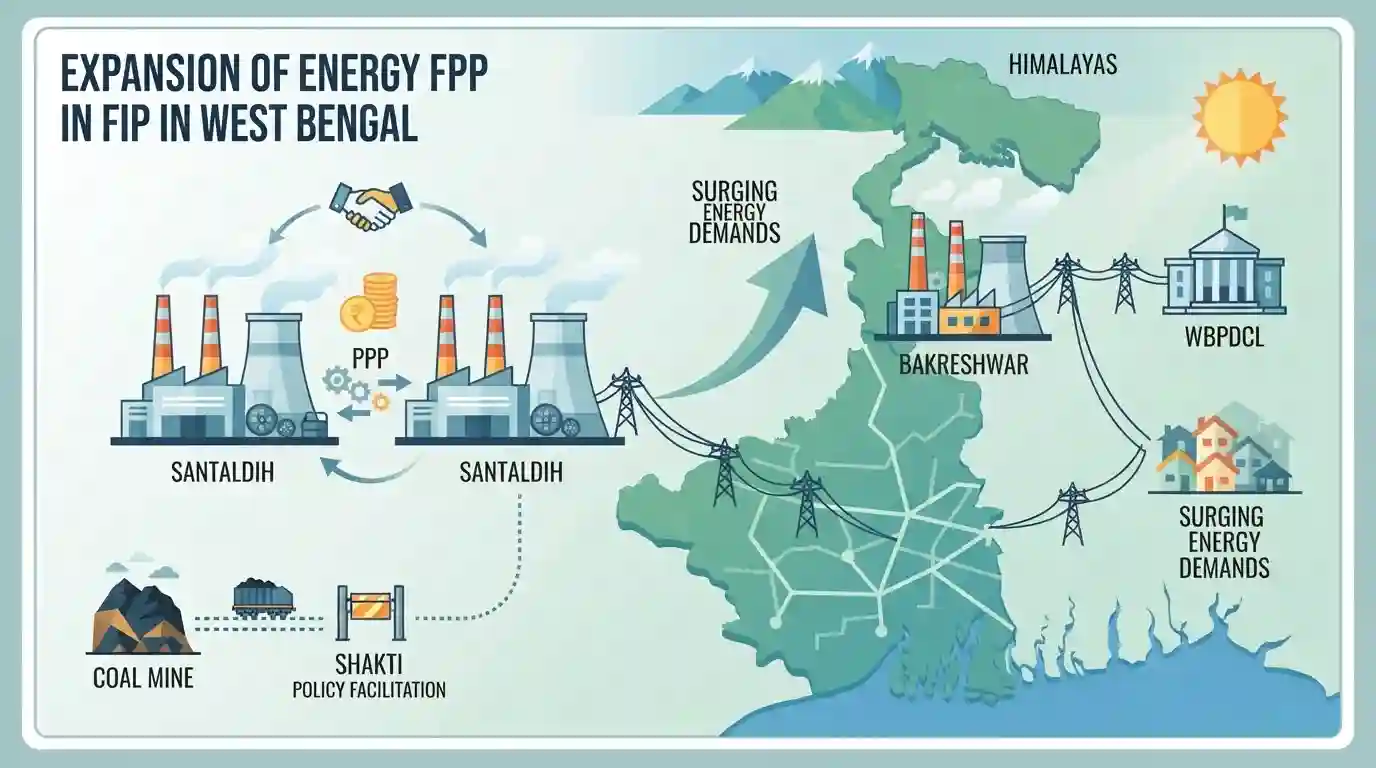
The West Bengal government has sanctioned the establishment of three new thermal power plants to meet the state's surging energy demands. Anticipating an investment of around Rs 30,000 crore, the project includes two 800 MW units at Santaldih under a Public-Private Partnership (PPP) model and one 800 MW unit at Bakreshwar managed by WBPDCL. The initiative seeks to bridge the gap between internal generation and peak summer consumption. Coal for the Santaldih units will be facilitated through the central SHAKTI policy.
মূল বিষয়
- The West Bengal cabinet has approved the construction of three new 800 MW supercritical/ultra-supercritical thermal power units to address increasing electricity demand.
- Total investment is projected at Rs 30,000 crore, aiming to manage peak summer loads which recently exceeded 10,000 MW.
- Two units will be built at Santaldih in Purulia under a PPP (DBFOO) model, with an estimated investment of Rs 18,000-20,000 crore.
- One unit will be constructed at Bakreshwar in Birbhum by the state-owned WBPDCL at a cost of approximately Rs 8,000 crore.
- Coal linkage for the PPP plants will be secured from Coal India Limited under the central government's SHAKTI policy.
গুরুত্বপূর্ণ শব্দ
SHAKTI Policy (Scheme for Harnessing and Allocating Koyala Transparently in India)

A transparent coal allocation scheme launched in 2017 (revised in 2025) that replaced nomination-based allocation with market-driven, auction, and tariff-based bidding to ensure fair, efficient fuel supply to thermal power plants.
UPSC context
GS Paper 3: Infrastructure (Energy) and Coal reforms. Tests policy initiatives for domestic resource management and energy security.
Public-Private Partnership (PPP) model
A long-term contractual arrangement between a public authority and a private entity, aimed at financing, designing, implementing, and operating public infrastructure and services while sharing risks and rewards.
UPSC context
GS Paper 3: Investment Models and Infrastructure. Tests understanding of alternative financing methods and risk-sharing structures.
DBFOO (Design, Build, Finance, Own and Operate) basis
A Public-Private Partnership (PPP) model where the private developer is responsible for the design, construction, financing, ownership, and long-term operation of the infrastructure asset, retaining the ownership rather than transferring it.
UPSC context
GS Paper 3: Investment models. Tests technical knowledge of specific concession structures and asset ownership frameworks in infrastructure.
Damodar Valley Corporation (DVC)
Established in 1948 and modeled on the US Tennessee Valley Authority, it is India’s first multipurpose river valley project, operating thermal and hydel power stations across West Bengal and Jharkhand.
UPSC context
GS Paper 1: Geography and GS Paper 3: Energy. Tests historical infrastructure development and integrated river basin management.
Coal India Ltd (CIL)
A state-owned Maharatna coal mining behemoth, headquartered in Kolkata, responsible for the vast majority of India's domestic coal production and primary fuel supply to thermal power generators.
UPSC context
GS Paper 3: Energy security and Resource distribution. Tests understanding of public sector undertakings in key mineral management.
West Bengal Power Development Corporation Ltd (WBPDCL)
A state-owned company established in 1985, tasked with thermal power generation in West Bengal, managing critical stations including Kolaghat, Bakreswar, Sagardighi, Santaldih, and Bandel.
UPSC context
State PCS & GS Paper 3: Infrastructure. Tests regional energy generation structures and public sector utility management.
প্রিলিমস ফাঁদ
Supercritical thermal plants operate using a conventional boiler drum to separate water and steam phases under high pressure.
Supercritical boilers are 'once-through' systems. Because they operate above water's critical point, water converts directly to steam without boiling, eliminating the need for a steam-drum separator.
সংযুক্ত স্থির ধারণা
What is the SHAKTI Policy for coal allocation in India?
- Origin & Purpose: Scheme for Harnessing and Allocating Koyala Transparently in India, launched in 2017 to replace discretionary allocation with market-driven, transparent linkages.
- Allocation Mechanism: Allocates coal to public sector thermal plants via administrative route and to private IPPs through competitive, transparent bidding.
- Strategic Objective: Aims to reduce fuel-supply risks, resolve stressed thermal power assets, and lower the burden of bad loans (NPAs) on public sector banks.
How do Supercritical and Ultra-supercritical thermal plants differ from Subcritical ones?
- Thermodynamic State: Operate above the critical point of water (22.11 MPa and 374°C), where liquid and gas phases merge into a single, indistinguishable fluid.
- Efficiency & Emissions: Achieve over 40-45% efficiency compared to ~32-35% in traditional subcritical plants, requiring less coal and reducing CO2 emissions per megawatt.
- Material Requirements: Require advanced metallurgy (like high-chromium steels) to withstand intense pressures and temperatures without structural failure.
আন্তঃবিষয় প্যাটার্ন
Thermal expansion vs. COP targets
Examines the friction between India's immediate energy security needs (expanding supercritical coal units) and its global climate commitments to transition toward renewable energy.
Concurrent List & Energy Security
Highlights center-state interdependence where state-level power generation plants rely on central regulatory frameworks like the SHAKTI scheme for fuel linkages.

UPSC may test the thermodynamic principles of supercritical boilers alongside the regulatory mechanisms of the SHAKTI coal policy.
সংযুক্ত PYQ · 2
সংযুক্ত PYQ · 2
- 2015WBCS_PRELIMSGS1
The most superior industrial coal of West Bengal is of
- 2024WBCS_PRELIMSGS1
Wind Energy Project was set up in West Bengal at:
